Installation guide
 Owner’s manual
 Error Codes


How many cubic feet is my Kenmore Elite washer?
The exact tub capacity (cubic feet) for Kenmore Elite washer model 11027087604 is listed in the product specifications section of the 11027087604 owner's manual. If you do not see it there, use the measurement method below to estimate capacity accurately.
How to estimate washer capacity (cubic feet)
We estimate capacity by measuring the inside of the wash basket (not the outer tub), then converting cubic inches to cubic feet.
- Unplug the washer for safety.
- Measure the inside diameter of the basket (in inches).
- Measure the usable depth from the bottom of the basket up to the highest fill line you normally use (in inches).
- Use the formula below.
- Compare your result to typical Kenmore top-load capacity ranges.
Capacity formula
Use this calculation:
- Cubic inches = 3.1416 × (diameter ÷ 2)² × depth
- Cubic feet = cubic inches ÷ 1,728
Typical capacity ranges (for context)
Most Kenmore top-load washers fall into these general ranges:
| Washer type | Typical capacity range |
|---|---|
| Standard top-load | ~3.0 to 3.6 cu. ft. |
| Large-capacity top-load | ~3.7 to 4.5 cu. ft. |
| Extra-large top-load | ~4.6+ cu. ft. |
Why it matters
Capacity affects how much laundry you can load without overfilling. For this Kenmore Elite washer, we follow the manual guidance to avoid loading clothes above the top of the stainless steel basket; that helps cleaning performance and reduces out-of-balance spinning.
Related setup tip that impacts real-world capacity
If the washer is not level, it can go out of balance more easily, which effectively reduces how much you can wash per load. Leveling steps and foot adjustment guidance are covered in the 11027087604 installation guide.
Last updated: January 2026
How to force a Kenmore Elite washer to drain?
To force-drain a Kenmore Elite washer model 11027087604, we first stop the cycle and remove power, then manually release water through the drain path (hose or pump area) and clear any blockage so the drain pump can move water out normally. Use the steps in the 11027087604 installation guide for safe drain hose setup.
Fast steps to get the water out
- Unplug the washer (or switch off the breaker).
- Turn off both water faucets.
- If the tub is full, bail out water into a bucket to reduce spill risk.
- Check the drain hose behind the washer for kinks, crushing, or a clogged standpipe/laundry tub.
- Lower the drain hose into a shallow pan or floor drain (keep control of the hose end).
- If water still will not move, the drain pump or a blockage in the pump inlet is the likely cause.
Drain hose setup that prevents “no drain” and siphoning
Your 11027087604 needs the drain hose installed correctly to drain reliably.
Key requirements from the install instructions:
- Use the drain hose form and secure the hose with the beaded tie strap.
- Do not insert more than 4 1/2 in. (11.4 cm) of drain hose into the standpipe or drainpipe.
- The standpipe height is typically at least 39 in. (99 cm).
Quick check table
| What we check | What “good” looks like | What it causes if wrong |
|---|---|---|
| Drain hose depth in standpipe | 4 1/2 in. (11.4 cm) max | Siphoning, slow drain, repeated draining issues |
| Hose condition | No kinks, no crushing | No drain, long drain times |
| Standpipe/drain | Clear and flowing | Water backs up into washer |
When a part is likely needed
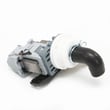
If the hose and household drain are clear but the washer still will not drain, the drain pump is a common fix. For this model, the drain pump part is pump-water W10536347.
Symptoms that point to the drain pump
- You hear humming but little or no water exits
- Draining is very slow even with a clear hose
- The washer stops mid-cycle with water left in the tub
Why it matters
A forced drain is a short-term way to get water out safely, but correcting the drain hose setup and clearing restrictions prevents repeat no-drain problems and helps protect the motor, wiring, and flooring from water damage.
Last updated: January 2026
How to hard reset a Kenmore Elite washer?
To hard reset a Kenmore Elite washer model 11027087604, we power-cycle it to clear a stuck control state: turn the washer off, unplug it briefly, then restore power and restart a cycle. Use the button functions described in the 11027087604 owner's manual to restart safely.
Hard reset steps (power-cycle reset)
- Press POWER to turn the washer off.
- Unplug the washer from the wall outlet.
- Wait 1 minute (this lets the control fully discharge).
- Plug the washer back in.
- Press POWER, select a cycle, then press START.
If the washer still will not start
These checks fix the most common “looks dead” or “won’t run” situations after a reset.
- Confirm the washer is plugged into a grounded 3-prong outlet (no extension cord).
- Close the lid firmly; the washer will not start with the lid open.
- Press STOP once to pause and unlock; press STOP twice to stop and power off, then try again.
- If the lid will not lock or unlock correctly, inspect the lid lock.
- If the tub will not drain and the cycle will not complete, check the drain path and pump.
| Symptom after reset | Most likely area to check | What to do next |
|---|---|---|
| No response to buttons | Power supply, outlet | Try a different outlet, then repeat reset |
| Won’t start, lid won’t lock | Lid lock | Inspect/replace washer lid lock WPW10619844 |
| Stops mid-cycle, won’t drain | Drain system | Check hose for kinks; consider pump-water W10536347 |
Why it matters
A hard reset clears temporary control glitches, but it will not fix a failed lid lock, drain pump, or wiring issue. Matching the symptom to the right system prevents repeat shutdowns and incomplete cycles.
Last updated: January 2026
What is the UL code on the Kenmore Elite Oasis HE washer?
On the Kenmore Elite washer model 11027087604, a UL code indicates the washer detected an unbalanced load condition during spin. In many cases, correcting how the load is distributed fixes it; if UL returns with normal loading, a mechanical drag or control issue is likely.
What to do first (quick fixes)
- Press STOP once to pause; wait for the Lid Lock light to turn off, then open the lid.
- Redistribute items evenly around the basket; avoid one heavy item by itself.
- Remove some items if the basket is tightly packed.
- Run Drain/Spin again (or restart the cycle) after rebalancing.
- Confirm the washer is firmly on all four feet and level (an out-of-level cabinet triggers repeated imbalance).
If UL keeps coming back (common causes)
Repeated UL with properly loaded, mixed-size items usually points to a condition that prevents smooth spinning.
- Washer not level or rocking: Re-level and tighten the locknut after adjustment.
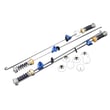
- Suspension wear: Weak suspension lets the tub swing too far; inspect and replace if worn (see suspension W10820048).
- Mechanical friction or bearing/shaft drag: A rough, noisy spin or resistance by hand can indicate bearing/shaft problems.
- Drive system issues: Problems in the rotor/stator area can cause poor acceleration into spin.
- Control not responding correctly: Less common, but possible if symptoms do not match a mechanical issue.
Leveling checklist (installation basics)
Use the setup steps in the 11027087604 installation guide as your baseline.
| Check | What “good” looks like | What to fix |
|---|---|---|
| Floor contact | All 4 feet firmly on the floor | Adjust feet until rocking stops |
| Level | Level front-to-back and side-to-side | Re-level, then tighten locknut |
| Load size | Mixed items, not overloaded | Reduce load, balance items |
Why it matters
When the washer cannot balance the load, it limits or stops high-speed spin to protect the basket, suspension, and cabinet. Fixing the root cause reduces noise, vibration, and repeat UL interruptions.
Last updated: January 2026