Owner’s manual
 View engine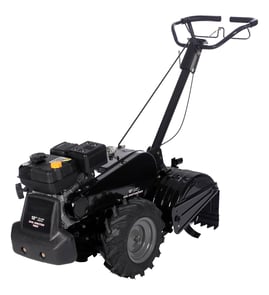



Where is the model number on a Craftsman rear tine tiller?
On a Craftsman rear-tine tiller, the model number is printed on the product ID label; for model 917297032, it’s commonly found on the tine shield/guard area or on the frame near the front of the machine. Confirm the exact label location using the 917297032 owner's manual.
Where to look first
- Check the tine shield (the guard over the tines) for a label or decal
- Look on the main frame rails near the front of the tiller
- Inspect around the handle support area and control panel mounting points
- Wipe off dirt and oil; labels are often hidden under grime
What the label looks like
Most Craftsman tiller ID labels include the model number and a serial number. The model number is typically formatted with a dot (example: 917.297032) even though it’s the same model as 917297032.
| What you see on the label | What it means | Use it for |
|---|---|---|
| 917.297032 | Model number | Ordering parts and matching diagrams |
| Serial number | Unique unit ID | Service history and identification |
Why it matters
Using the correct model number ensures we match the right parts and diagrams for your tiller’s exact configuration (handles, tine assembly, belt guard, and gear case components can vary by model series).
Last updated: January 2026
What tiller is made in the USA?
If you’re specifically looking for a tiller made in the USA, Mantis is a commonly cited example of a brand that manufactures in the United States. For your Craftsman rear-tine tiller model 917297032, our 917297032 owner's manual focuses on operation and maintenance rather than country of manufacture.
How to shop for a USA-made tiller (what to check)
When you compare tillers, we recommend confirming origin details on the unit itself and in the product listing.
- Look for a “Made in USA” or “Assembled in USA” label on the engine shroud or frame
- Check the carton label and the model tag (often near the handle mount or transmission)
- Verify whether the claim applies to the whole tiller or only certain components
- Confirm parts support (belts, tines, cables) so you can keep it running for years
- Match the tiller type to your work: rear-tine for tougher soil, front-tine for lighter gardens
What we can confirm for Craftsman 917297032
The Craftsman 917297032 documentation provides operating specs and maintenance items (fuel, oil, spark plug) and a detailed parts breakdown, including tine and hardware components.
| Item type | What you’ll typically find | Example for 917297032 |
|---|---|---|
| Maintenance spec | Fuel, oil type/capacity, spark plug and gap | Listed in the manual |
| Wear parts | Belts, tines, cables, shear pins | Drive belt and tine hardware are serviceable |
| Repair support | Diagrams and part identification | Tine assembly diagram is included |
Why it matters
Country of manufacture can be important, but long-term ownership usually comes down to serviceability. With a rear-tine tiller like the Craftsman 917297032, keeping the drive system and tine assembly in good shape (belt condition, correct tine hardware, proper adjustments) has the biggest impact on performance.
Last updated: January 2026
How to lubricate a tiller?
For the Craftsman rear-tine tiller model 917297032, we lubricate key moving points and service the transmission on a schedule. The manual calls for lubricating the right-hand gear case grease fitting once per season using 1 oz. of EP #1 grease; this keeps the transmission running smoothly and reduces wear.
What to lubricate on a rear-tine tiller
Focus on friction points that move under load or pivot during operation:
- Transmission gear case: grease the right-hand gear case fitting (seasonally)
- Control linkages and pivots: throttle linkage, shift linkage, and handle pivots (light oil)
- Wheel hubs/axles: light oil where the wheel rotates on the shaft
- Tine shaft support points: inspect for dryness or squeal; lubricate only where the design allows
- Cables: keep cable ends and pivot points lightly oiled (do not soak the cable housing)
For diagrams and the exact lubrication points for 917297032, use the 917297032 owner’s manual.
Transmission grease: what to use and how much
The 917297032 manual specifies a single seasonal grease service for the gear case.
| Item | Spec for 917297032 | Interval |
|---|---|---|
| Right-hand gear case grease fitting | 1 oz. EP #1 grease | Once per season |
Tip: Wipe the grease fitting clean before attaching the grease gun so dirt does not get pushed into the gear case.
Quick safety steps before lubricating
We follow these basics every time to prevent accidental starting and burns:
- Let the engine and muffler cool
- Disconnect the spark plug wire before working around tines, belts, or pulleys
- Work on a flat surface; block the tiller so it cannot roll
- Keep grease and oil off belts and pulleys
Why it matters
Proper lubrication reduces heat and metal-to-metal wear in the transmission and pivots. On a rear-tine tiller, that directly improves tine engagement, shifting feel, and overall service life.
Last updated: January 2026
What are the common problems with lawn tillers?
Common problems with the Craftsman 917297032 rear-tine tiller include hard starting, rough running, poor tilling performance, and tines or wheels that do not engage. Most issues trace back to fuel quality, ignition, drive components (belt, cable, chain), or soil conditions and operating technique; see the 917297032 owner's manual for model-specific checks.
Most common symptoms and likely causes
- Engine will not start or starts then dies: stale fuel, clogged fuel filter/line, choke not set correctly, fouled spark plug
- Engine runs rough or misfires: carburetor mixture out of adjustment (especially at high altitude or below 32°F), dirty fuel, ignition tune-up needed
- Tines do not turn or tilling is weak: worn or slipping drive belt, stretched/misadjusted clutch cable, broken tine shear pin, chain or pulley wear
- Excessive bouncing or hard handling: soil too dry/hard, trying to till too deep too fast, depth stake set too aggressively
- Poor cultivating results: wheels not set correctly for cultivating width, shields not positioned to protect plants
Quick checks we recommend (in order)
- Fuel and air basics: drain old gas, refill with fresh fuel, confirm fuel shut-off is open, verify choke operation.
- Ignition: inspect and service the spark plug (clean/replace if fouled).
- Drive engagement: with the engine off, inspect belt condition and tension; a glazed, cracked, or stretched belt commonly slips.
- Shear pins at the tines: if the tiller jams or overloads, shear pins are designed to break to protect the transmission; replace only the correct type listed for this model.
- Soil and technique: target a 4 to 6 inch tilling depth; avoid forcing the machine deeper at high speed.
Parts that commonly solve “no drive” or weak tilling
| Symptom | Common fix | Example part for 917297032 |
|---|---|---|
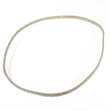
| Tines/wheels weak or intermittent | Replace worn belt | Husqvarna rear-tine tiller drive belt 591372401 |
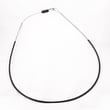
| Tines do not engage smoothly | Adjust/replace clutch cable | Tiller clutch cable 532110675 |
| Grinding, binding, or no tine drive | Inspect chain and sprockets | Tiller chain, #25-50 532102134 |
Why it matters
Running with a slipping belt, misadjusted cable, or broken shear pin can quickly turn a simple tune-up into transmission wear. Correct depth and soil moisture also reduce bouncing and improve traction, making the tiller safer and easier to control.
Last updated: January 2026