 Owner’s manual



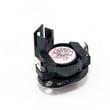
How do I tell if my dryer heating element is bad?
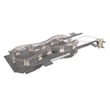
If your Kenmore Elite dryer model 11067042600 runs but produces no heat (after you have confirmed proper 240V power), the heating element is a top suspect. We confirm it by safely testing the element for continuity with a multimeter; an open circuit means it has failed.
Quick checks before you test the element
Start with the basics the manual calls out for “no heat” so you do not replace parts unnecessarily.
- Run a Timed Dry heated cycle for about 5 minutes, then open the door and feel for heat (do not use Air Only) per the 11067042600 owner's manual.
- Check both household fuses or breakers; many electric dryers can tumble with only one leg of power.
- Confirm the dryer is on a 240-volt supply (electric dryers require 240V).
- Make sure the vent is not crushed or kinked; restricted airflow can trip safety devices.
- If the dryer overheated recently, also suspect a blown thermal fuse.
How we test the heating element (multimeter)
- Unplug the dryer (and shut off the breaker).
- Access the heater terminals (location varies; follow the 11067042600 owner's manual).
- Remove at least one wire from the element terminal.
- Measure resistance across the element terminals.
What readings mean
| Meter result | What it indicates | Next step |
|---|---|---|
| Continuity (typically about 10 to 50 ohms) | Element is likely OK | Check thermostats, thermistor, airflow, wiring |
| No continuity (OL/open) | Element is bad | Replace the dryer heating element WP8544771 |
| Continuity to metal housing (short to ground) | Element is bad and unsafe | Replace the element and inspect wiring |
Related parts that commonly cause “no heat”
If the element tests good, these parts often fail in the same symptom set:
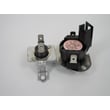
- Dryer thermal fuse WP3390719 (opens if overheating occurs)
- Dryer high-limit thermostat WP8557403 (can open and stop heat)
- Dryer thermistor WP8577274 (temperature sensing issues)
Why it matters
A failed heating element stops drying performance, but airflow or power-supply issues can create the same “no heat” symptom. Verifying power, venting, and continuity first prevents repeat failures and unnecessary part replacement.
Last updated: February 2026
Can you get parts for a Kenmore dryer?
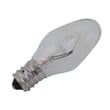
Yes. We can help you get replacement parts for your Kenmore Elite dryer model 11067042600, including common wear items (belts, rollers, thermal fuses, heating parts) and convenience parts like the lint screen and drum light. Use the 11067042600 owner's manual to confirm symptoms and part locations before ordering.
Parts you can commonly replace on Kenmore Elite 11067042600
These are the most frequently needed dryer parts for noise, no-heat, and long-dry-time problems:
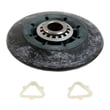
- Drum support parts such as the support WPW10314173 (drum support roller)
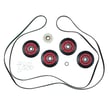
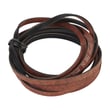
- Drive parts such as the dryer drum belt WP8547157
- Tensioning parts such as the dryer idler assembly WPW10547292
- Heating and safety parts such as the dryer heating element WP8544771 and dryer thermal fuse WP3390719
- Airflow and sensing parts such as the screen W10120998 (lint screen) and dryer moisture sensor WP3387223
Quick help: match the part to the symptom
| Symptom | Most likely part area | Example part for this model |
|---|---|---|
| Loud squeal, thump, or rumble | Drum support and belt drive | Support roller, belt, idler |
| Runs but does not heat | Heating circuit and safety devices | Heating element, thermal fuse |
| Takes too long to dry | Venting and lint handling | Lint screen, vent system checks |
| Clothes overdry or underdry on auto cycles | Moisture sensing | Moisture sensor |
Why it matters
Using the correct model-specific part for 11067042600 prevents fit issues and repeat failures. For example, a blown thermal fuse often points to restricted airflow, so replacing the fuse and correcting venting helps the repair last.
Before you order (fast checks)
- Confirm the full model number from the dryer’s ID tag: 11067042600
- Compare your symptom to the troubleshooting section in the 11067042600 owner's manual
- Check and clean the lint screen and verify the vent is not crushed or clogged
- If the dryer overheated, correct airflow issues before replacing a thermal fuse
Last updated: February 2026
How do I know if my Kenmore dryer thermal fuse is blown?
A blown thermal fuse in your Kenmore Elite dryer model 11067042600 most often shows up as a dryer that will not run even though the dryer has power and the door is closed. You confirm it by testing the fuse for continuity with a multimeter.
Signs that point to a blown thermal fuse
- Dryer will not start when you press Start
- Drum does not turn because the motor will not run
- Power is available (outlet is live; breakers are not tripped)
- Door is fully closed and Start is pressed firmly (some loads require holding Start 2 to 5 seconds)
- Problem started after long dry times or very hot operation (airflow restriction)
How we test the thermal fuse (continuity)
- Unplug the dryer or disconnect power.
- Access the fuse using the steps in the 11067042600 owner’s manual.
- Pull one wire off the fuse terminal.
- Set the meter to continuity (or lowest ohms).
- Probe the two terminals.
| Meter result | What it means | Next step |
|---|---|---|
| Continuity (near 0 ohms) | Fuse is good | Check other no-start causes (door switch, timer/control, motor circuit) |
| No continuity (OL/infinite) | Fuse is blown | Replace the fuse and correct the overheating cause |
Prevent the new fuse from blowing again
A thermal fuse opens when the dryer overheats, usually from restricted venting. Fix these before regular use:
- Clean the lint screen and lint chute; replace a damaged screen W10120998
- Check the vent hose for kinks, crushing, or excessive length
- Clean the outside vent hood and make sure the damper opens freely
- Clear lint from the blower housing and internal ducting
Why it matters
The thermal fuse is a safety device; restoring airflow prevents repeat failures, improves drying performance, and reduces overheating.
Last updated: February 2026
How to hard reset a Kenmore dryer?
To hard reset your Kenmore Elite dryer model 11067042600, disconnect power (unplug the cord or switch the breaker off) for about 1 to 5 minutes, then restore power and start a new cycle. This clears the control and restores normal operation.
Hard reset steps (safe and effective)
- Turn the dryer OFF.
- Unplug the dryer, or turn OFF the dedicated dryer circuit breaker.
- Wait 1 to 5 minutes to let the control fully power down.
- Restore power.
- Close the door and press START to run a cycle.
For model-specific control behavior and cycle restart details, use the 11067042600 owner's manual.
If the dryer is stuck mid-cycle
The control panel on this model uses STOP and START to pause, cancel, and restart:
- To pause/stop: open the door or press STOP once.
- To cancel/clear a cycle: press STOP twice.
- To restart: close the door and press START.
Quick control actions
| What you want to do | What to press/do | What to expect |
|---|---|---|
| Pause the cycle | STOP once (or open door) | Cycle pauses |
| Cancel the cycle | STOP twice | Program clears and dryer shuts down |
| Restart after pause | Close door, press START | Continues if restarted within about 5 minutes |
Why it matters
A hard reset is the fastest way to clear a “frozen” keypad, a non-responsive display, or a cycle that will not start after a power glitch. If the issue returns, it usually points to an airflow problem (lint buildup) or a failing temperature-sensing or safety part.
Parts that commonly relate to “no heat” or shutdown symptoms
- Dryer thermal fuse WP3390719 (opens if the dryer overheats)
- Dryer thermistor WP8577274 (helps the control regulate temperature)
- Dryer high-limit thermostat WP8557403 (safety temperature limit)
- Dryer heating element WP8544771 (electric heat source)
If you see an error code after resetting, use Kenmore elite dryer error codes to match the code to the next best check.
Last updated: February 2026
What are the codes for Kenmore Elite dryer?
For the Kenmore Elite dryer model 11067042600, common display codes include PF (power failure) and AF (low airflow). Many models in this Kenmore Elite family also use F codes that point to control, keypad, heater relay, or thermistor problems; use the 11067042600 owner's manual to match the code to the right checks.
Common Kenmore Elite dryer codes and what they mean
Here are the codes customers most often ask about on Kenmore Elite dryers:
- PF: Power failure interrupted the cycle; press and hold START to restart.
- AF: Low airflow condition; clear lint and venting restrictions.
- F:01: Main electronic control board problem.
- F:02: Keypad or user interface problem.
- F:20: Heater relay problem.
- F:22 / F:23: Outlet thermistor problem.
- F:24 / F:25: Inlet thermistor problem.
Quick fixes we recommend before replacing parts
Many codes are caused by airflow, power, or a loose connection. We recommend these steps first:
- Unplug the dryer for 1 minute, then restore power and recheck the display.
- Clean the lint screen and confirm the lint screen housing is clear.
- Inspect the vent from the dryer to the wall for kinks, crushing, or heavy lint.
- Check the outside exhaust hood for blockage.
- If AF returns, have the full vent run professionally cleaned.
When a code points to heat or temperature sensing
If the dryer runs but heat is erratic, shuts off early, or shows thermistor related codes, these parts are commonly involved:
| Symptom | Code examples | Parts often checked |
|---|---|---|
| No heat or heat cuts out | F:20, overheating symptoms | Dryer heating element WP8544771, dryer thermal fuse WP3390719, high-limit thermostat |
| Temperature reading issues | F:22 to F:25 | Dryer thermistor WP8577274 |
Why it matters
Codes help us narrow the problem fast. For example, AF is a venting warning that can cause long dry times and overheating, while PF explains why a cycle stopped unexpectedly.
Last updated: February 2026
How much does it cost to replace a heating element in a Kenmore dryer?
For Kenmore Elite dryer model 11067042600, replacing the heating element typically costs $90 to $350 total. The part itself is commonly $50 to $120, and professional labor often adds $100 to $250, depending on access, diagnostics, and local rates.
Typical cost breakdown
- Heating element part cost: $50 to $120 (OEM-style parts are usually higher)
- Service call and labor: $100 to $250
- Optional related parts (sometimes needed): $15 to $90
- DIY cost (parts only): $50 to $150
| Repair approach | What you pay for | Typical total |
|---|---|---|
| DIY replacement | Part(s) only | $50 to $150 |
| Pro replacement | Part(s) + labor | $90 to $350 |
| Pro with extra fixes | Element + airflow or sensor-related parts | $150 to $450 |
Parts that commonly affect the final price
If the dryer overheated or has airflow restrictions, we often see additional parts replaced at the same time as the element:
- Dryer heating element WP8544771 (the heater that produces heat)
- Dryer thermal fuse WP3390719 (safety fuse that can open if the dryer overheats)
- Dryer high-limit thermostat WP8557403 (limits heater temperature)
- Dryer thermistor WP8577274 (helps regulate temperature)
Why it matters (and what to check first)
A new heating element can fail early if the dryer is running hot due to restricted venting or heavy lint buildup. The manual’s troubleshooting guidance also points to checking power supply and breakers when there is no heat.
Before you pay for a heating element
Use these quick checks to avoid replacing the wrong part:
- Confirm the dryer is getting full power; many electric dryers use two breakers/fuses.
- Run the dryer for about 5 minutes, then check for heat (then cancel the cycle).
- Clean the lint screen and inspect the exhaust vent for clogs or crushed ducting.
- If there is still no heat after power checks, plan on heater circuit diagnosis.
For model-specific operating and care steps, use the 11067042600 owner’s manual.
Last updated: February 2026
What size is a Kenmore Model 11067042600 dryer?
The Kenmore Elite dryer model 11067042600 has a cabinet size of about 38 inches wide x 31 inches deep x 43 inches high (approximate). For exact measurements and required installation clearances (including vent space), we follow the dimensions shown in the 11067042600 owner's manual.
Dimensions and clearance you should plan for
Dryer “size” usually means two things: the cabinet dimensions and the space needed around it for safe venting and service access.
- Cabinet width/height/depth: use the manual dimensions for the most accurate fit
- Rear clearance for venting: most installs need about 5 inches behind the dryer for the exhaust vent elbow
- Door swing: allow enough room for the door to open fully
- Closet installs: plan for required ventilation openings and spacing
Quick fit guide (what to measure)
| What to measure | Where to measure | Why it matters |
|---|---|---|
| Width | widest point of cabinet | Confirms it fits between walls/cabinets |
| Depth | front of cabinet to back panel (not including vent) | Prevents the dryer from sticking out |
| Height | floor to top of cabinet | Confirms clearance under shelves |
| Rear space | back of dryer to wall | Prevents crushed venting and overheating |
Why the “depth” can look different in listings
Depth often varies depending on what’s included in the measurement (knob, door, handle, or the vent elbow). For the most reliable fit, we use the cabinet dimensions plus the recommended rear vent clearance from the 11067042600 owner's manual.
Related parts that affect space and performance
If the dryer is being pushed too close to the wall, airflow can suffer and drying times can increase. These parts are commonly involved when airflow or heat issues show up:
- Dryer thermal fuse WP3390719 (opens if overheating occurs)
- Dryer heating element WP8544771 (electric heat source)
- Dryer fan blower wheel WP8544737 (moves air through the drum and vent)
Last updated: February 2026
Where is the model number on Kenmore Elite dryer?
On a Kenmore Elite dryer like model 11067042600, the model number is printed on the rating label, most often on the cabinet frame just inside the door opening. Some units also place the label on the back of the dryer near the top.
Where to look first (fastest checks)
- Open the dryer door and look along the door opening frame (cabinet front)
- Check the inside edge of the door itself
- Look around the lint screen housing area (near the opening)
- If you do not see it inside the door area, check the back panel near the top
For pictures and the exact label location callouts for your series, use the 11067042600 owner's manual.
What the model number label looks like
The rating label is usually a small sticker or metal tag that includes:
- Model number (example: 11067042600)
- Serial number
- Electrical information (volts/amps)
- Brand and safety markings
Quick ID tips
| What you see | What it usually means | What to do |
|---|---|---|
| A long number starting with 110 | Kenmore 110-series style model number | Use the full number when ordering parts |
| Model number plus a separate serial number | Normal rating label format | Write both down for service |
| Worn or peeling label | Age, heat, and cleaning wear | Take a photo and copy it exactly |
Why it matters
We use the full model number to match the correct parts and diagrams for your exact Kenmore Elite dryer configuration (heating system, drum support style, and control features). Even one digit off can point to a different parts list.
Last updated: February 2026








