Owner’s manual
 Error Codes


What is the average lifespan of a Kenmore Elite refrigerator?
Most Kenmore Elite refrigerators, including model 79577542600, typically last 10 to 15 years with normal household use. Regular maintenance (cleaning condenser coils, keeping door gaskets sealing, and changing filters on schedule) helps you reach the high end of that range.
Typical lifespan and what affects it
A refrigerator’s life is mostly determined by how hard the sealed cooling system and fans have to work day to day.
- Maintenance habits: clean coils, clear vents, replace filters
- Room conditions: hot garages and tight built-ins shorten life
- Door use and sealing: frequent openings and weak gaskets increase run time
- Water and ice use: heavy dispenser use can wear valves and tubing faster
- Repair history: repeated cooling or defrost issues often signal end-of-life decisions
For model-specific care and maintenance intervals, follow the 79577542600 owner’s manual.
What “average lifespan” looks like in real ownership
| Age of refrigerator | What’s common | What we recommend |
|---|---|---|
| 0 to 5 years | Minor adjustments, occasional ice maker or dispenser issues | Keep coils clean; confirm temps stay stable |
| 6 to 10 years | Fan noise, defrost drain clogs, water leaks | Address small issues early to prevent bigger failures |
| 10 to 15 years | Higher chance of major cooling repairs | Compare repair cost vs. replacement value |
Why it matters
Once a refrigerator gets past about 10 years, a single major cooling-system repair can cost enough that replacement becomes the better value. Staying ahead of airflow, sealing, and water system maintenance reduces strain on the compressor and helps the refrigerator cool efficiently.
Maintenance checklist to help it last longer
- Vacuum condenser coils and the grille area regularly
- Keep the freezer drawer and refrigerator vents unblocked
- Make sure doors close fully and gaskets seal all the way around
- Flush and maintain the water system; replace filters as scheduled
- Fix puddles or leaks quickly to prevent corrosion and ice buildup
If you are troubleshooting dispenser or ice maker performance, the how to prevent water dispenser and ice maker problems guide is a good next step.
Last updated: January 2026
What size is Kenmore refrigerator model 79577542600?
Kenmore Elite refrigerator model 79577542600 is a bottom-freezer design; most 795-series units of this style are about 33 inches wide, 31 to 34 inches deep (deeper with handles), and 68 to 70 inches tall. For the exact cabinet and door-clearance measurements, use the 79577542600 owner's manual.
How to measure your refrigerator correctly
Use a tape measure and record three numbers; measure twice for accuracy.
- Width: left cabinet side to right cabinet side (do not include the door swing space)
- Height: floor to top of hinge cover (or top of cabinet if the cover is removed)
- Depth: front of cabinet to back; then measure again to the front of the handles
- Door clearance: allow extra space so doors and the freezer drawer open fully
- Ventilation space: leave room behind and above for airflow
Typical size ranges for this model family
These ranges help with planning delivery, cabinetry fit, and door-swing clearance.
| Measurement | Typical range (795 bottom-freezer) | What changes it most |
|---|---|---|
| Width | ~33 in | Cabinet design, trim pieces |
| Height | ~68 to 70 in | Leveling legs, hinge cover |
| Depth | ~31 to 34 in | Handles, door thickness |
Why it matters
Correct sizing prevents delivery-day surprises and helps avoid problems like doors hitting walls, the freezer drawer not clearing an island, or restricted airflow that can reduce cooling performance.
Related help
If you are also planning for filter access or water line routing, our guide on how to replace the water filter in a Kenmore refrigerator helps you plan the space needed around the fresh food compartment.
Last updated: January 2026
What are the common problems with Kenmore Elite refrigerators?
Common problems on the Kenmore Elite 79577542600 bottom-mount refrigerator include weak or no cooling, frost buildup, water leaks, ice maker issues (slow, small cubes, bad taste), and doors that do not seal or close correctly. Many fixes start with cleaning, leveling, and checking airflow and temperatures per the 79577542600 owner's manual.
Most common symptoms and what usually causes them
- Not cooling or warm temperatures: dirty condenser area, failed evaporator fan, sealed system or compressor issue
- Frost or ice crystals on food: door not closing fully, frequent door openings, gasket sealing problems
- Water puddles or leaks: clogged or misrouted drain tube, cracked water tubing, loose water tube fitting
- Ice maker problems (slow ice, small cubes, off taste): temperature not cold enough, door left open, water valve restriction, old ice or new installation purge needed
- Doors hard to open or “vacuum” feeling: normal pressure equalization after closing, dirty or sticky gaskets
Quick checks we recommend first (fast, no parts)
- Confirm the refrigerator and freezer controls are set correctly; allow 24 hours for temperatures to stabilize after changes.
- Make sure nothing is holding a door open; check bin and drawer alignment.
- Clean door gaskets and the surfaces they touch; if gaskets stick, apply a thin coat of wax after cleaning.
- Level the refrigerator to reduce wobble and help doors self-close.
- If ice tastes or smells off, discard old ice and rewrap foods to prevent odor transfer.
Parts that commonly solve these issues on model 79577542600
| Problem area | Part to consider | What it affects |
|---|---|---|
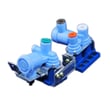
| Slow ice, no ice, weak water flow | Lg refrigerator water inlet valve 5221JB2006K | Water supply to ice maker and dispenser |
| Frost buildup from defrost failure | Lg refrigerator defrost heater 5300JK1005D | Melts frost off the evaporator |
| Water leaking inside or under unit | Refrigerator drain tube 5251JA3003D | Routes defrost water to the drain pan |
| Noisy or warm fridge section | Refrigerator motor assembly 4681JB1029H | Moves air across the evaporator for cooling |
Why it matters
Cooling, ice production, and leak issues often start small (a door not sealing, a restricted valve, a clogged drain) but can quickly lead to food spoilage, heavy frost, or water damage. Catching the symptom early usually keeps the repair simpler.
For model-specific troubleshooting steps (including door alignment, ice maker checks, and temperature guidance), follow the 79577542600 owner's manual.
Last updated: January 2026