Owner’s manual
 Error Codes


What size is RFG297HDRS?
The Samsung RFG297HDRS is a full-size French door, bottom-mount refrigerator. From the model’s documentation, it measures about 35 6/8 inches wide, 68 1/2 inches tall (cabinet), and about 33 1/8 inches deep (with an overall depth listed around 35 5/8 inches). See the RFG297HDRS owner's manual for the exact measurement definitions.
These are the key size specs called out for the RFG297** series in the manual.
| Measurement | Approx. size |
|---|---|
| Width | 35 6/8 in (about 35.75 in) |
| Cabinet height | 68 1/2 in |
| Overall height (with hinge) | 69 6/8 in |
| Depth (cabinet) | 33 1/8 in |
| Overall depth | 35 5/8 in |
We recommend measuring your path and the final opening so the refrigerator can be moved in and the doors can swing.
- Doorway width and height (including trim)
- Hallway turns and stair clearances
- Ceiling height along the route
- Space behind the unit for water line connections (if equipped)
- Clearance at the side when installed next to a fixed wall (the manual notes 3 3/4 inches minimum for door swing)
Correct width, depth, and clearance prevent door-swing issues, pinched water lines, and poor airflow. Proper clearance also helps the refrigerator run efficiently and maintain stable temperatures.
Last updated: February 2026
What are the 4 types of ice Samsung?
On the Samsung RFG297HDRS, the dispenser lets you choose cubed or crushed ice (plus water). Some newer Samsung refrigerators advertise four ice styles, but this model’s user controls are designed around cubed and crushed selection as shown in the RFG297HDRS owner's manual.
From the front dispenser controls, we typically see these options:
- Cubed ice
- Crushed ice (the unit grinds cubes into crushed)
- Water (dispenses water, not ice)
- Ice Off (turns the ice maker off)
Samsung marketing for certain models may mention four ice types (for example, specialty shapes). For the RFG297HDRS dispenser interface, the manual describes alternating Cubed and Crushed when you press the Ice Type button.
| Feature | RFG297HDRS dispenser behavior | What it means for you |
|---|---|---|
| Ice selection | Cubed or crushed | Two ice textures from the dispenser |
| How crushed is made | Cubes are ground | Crushed depends on the ice maker producing cubes |
| Stopping ice | Ice Off | Useful for vacations or low usage |
These quick checks solve most “wrong ice” or “no crushed” complaints:
- Confirm Cubed/Crushed is selected on the display (toggle with the Ice Type button).
- Make sure the door is fully closed; the dispenser won’t run with the door open.
- Empty and reseat the ice bin so it sits squarely.
- Break up clumped ice (clumps can block the crusher).
- If ice production is the issue, inspect the ice maker and bin components.
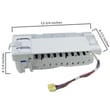
If you need replacement parts tied to ice production and dispensing, we commonly see customers replace the refrigerator ice maker assembly da97-07365g or the refrigerator ice bin DA97-11117A when they are damaged or not cycling correctly.
Knowing the exact ice options for your model helps you troubleshoot faster. On RFG297HDRS, “crushed” is created by crushing cubes, so anything that prevents normal cube making or bin movement can also prevent crushed ice.
Last updated: February 2026
What features does the RFG297HDRS have?
The Samsung RFG297HDRS French door, bottom-mount refrigerator includes key convenience features such as an in-door ice and water dispenser, selectable ice type (cubed or crushed), Energy Saver mode, and Power Freeze for faster freezing. For the full feature list and control panel functions, use the RFG297HDRS owner's manual.
- External ice and water dispenser for quick access at the door
- Cubed and crushed ice selection (the ice maker crushes cubes when “Crushed” is selected)
- Energy Saver mode (helps reduce condensation and energy use; turn it off if door condensation appears)
- Power Freeze (speeds up freezing when the freezer temperature has warmed)
- Cool Select Pantry Plus storage zone (listed in the parts and features section)
| Feature/option | What it does | When to use it |
|---|---|---|
| Energy Saver | Reduces condensation and supports efficient operation | Leave on normally; turn off if moisture forms on doors |
| Power Freeze | Temporarily boosts freezing performance | After loading groceries or if freezer warmed up |
| Ice type select | Switches between cubed and crushed ice | Based on drink/recipe preference |
These features help you manage temperature recovery after door openings, reduce moisture on doors, and get ice and water without opening the refrigerator. Using Energy Saver and Power Freeze correctly also helps protect food quality and day-to-day performance.
- Keep doors closed as much as possible after loading groceries so temperatures stabilize faster.
- If you see water droplets on the doors, switch Energy Saver off.
- Allow clearance during installation so doors swing fully and airflow stays efficient (clearance guidance is in the manual).
- If the door handle loosens over time, tighten the bolts located on the inside of the door.
Last updated: February 2026
What is the most common problem with Samsung refrigerators?
The most common Samsung refrigerator problem is a cooling issue caused by restricted airflow or frost buildup on the evaporator, which can make the fresh food section warm even when the freezer still seems cold. On the Samsung RFG297HDRS, ice maker and water system issues are also frequent.
- Frost or ice buildup behind the rear panel that blocks airflow
- Evaporator fan not moving cold air into the refrigerator compartment
- Dirty condenser coils causing poor heat removal
- Doors not sealing, letting humid air in and creating excess frost
- Ice maker not producing ice due to a freeze-up, low water flow, or a control issue
- Confirm airflow: Make sure vents inside the refrigerator are not blocked by food packages (the manual warns not to block air holes). See the RFG297HDRS owner's manual.
- Check door sealing: Close a sheet of paper in the gasket and tug; resistance should feel consistent around the door.
- Look for frost symptoms: Heavy frost, fan noise changes, or warm fridge temps point to a defrost or airflow problem.
- Clean condenser coils: Dust buildup commonly causes weak cooling.
- For ice maker complaints: Verify the ice maker is turned on, the ice bin is seated, and the freezer is cold enough.
| Symptom | Most likely area | What to do next |
|---|---|---|
| Freezer cold, fridge warm | Airflow or defrost system | Check vents, look for frost buildup, listen for fan |
| Temps swing up and down | Sensors/control or airflow restriction | Confirm vents clear; check for frost patterns |
| No ice or small cubes | Water supply/filter restriction or ice maker freeze-up | Replace filter on schedule; inspect ice maker area |
| Water dispenses slowly | Clogged water filter | Replace filter; reset filter indicator per manual |
If troubleshooting points to a failed component, these model-matched parts are commonly involved:
- Refrigerator evaporator assembly DA96-00462D (cooling and frost-related issues)
- Refrigerator electronic control board DA92-00147B (temperature regulation and system control)
- Refrigerator ice maker assembly da97-07365g (no ice, jammed ice, or inconsistent production)
Cooling and ice-making problems often start as airflow restrictions (blocked vents, frost buildup, dirty coils) and then snowball into warm temperatures, food spoilage risk, and repeated ice maker failures. Catching the early signs keeps repair costs down and performance stable.
Last updated: February 2026