Owner’s manual
 Error Codes


How to remove bottom grille on GE refrigerator?
On the GE PFE28RSHHSS bottom-mount refrigerator, the bottom grille (base grille/toe grille) typically comes off by releasing its retaining tabs or removing a few screws, then pulling the grille straight out and down. We recommend following the exact release points shown in the PFE28RSHHSS owner’s manual.
- Unplug the refrigerator or switch off power at the breaker (safer around wiring and fans).
- Open both fresh food doors for better access.
- Look along the top edge of the grille for retaining clips or tabs.
- If you see screws, remove them with a Phillips screwdriver and set them aside.
- Pull the grille straight toward you; if it resists, press the tabs inward while pulling.
- Lift the grille away from the bottom edge and remove it.
- Align the bottom edge first, then swing the top edge into place.
- Press along the length of the grille until all clips snap in.
- Reinstall any screws (do not overtighten).
- Confirm the grille is not rubbing the freezer drawer.
Removing the grille is a good time to do quick maintenance that helps cooling performance.
| What to check | What you’re looking for | Why it matters |
|---|---|---|
| Airflow path | No boxes, rugs, or dust blocking the intake | Better temperatures and efficiency |
| Floor level | Refrigerator sits level and stable | Helps doors seal and close properly |
| Drips/puddles | Water under the front edge | Can point to a drain or water line issue |
A properly installed base grille helps protect components, supports correct airflow across the condenser area, and reduces temperature swings that can affect food storage.
Related help: how to reset the door alarm on a GE refrigerator.
Last updated: January 2026
How to remove the bottom drawer of a GE refrigerator?
To remove the bottom freezer drawer on your GE PFE28RSHHSS bottom-mount refrigerator, we typically pull the drawer fully open, lift the front slightly to release it from the slide rails, then remove the basket or drawer sections as needed. Use the steps and diagrams in the PFE28RSHHSS owner's manual for your exact drawer style.
- Unplug the refrigerator or switch off power at the breaker (recommended if you will remove multiple parts).
- Remove heavy items first (frozen food, ice bin, pizza trays) to prevent tipping.
- Protect the floor with a towel or cardboard.
- Use a second person if the drawer is loaded or feels awkward.
- Open the freezer drawer fully until it stops.
- Remove the upper basket (if equipped): lift the basket straight up and out.
- Remove the lower basket or bin: lift the front edge up, then pull it out.
- Release the drawer front from the slide rails:
- Look for locking tabs or clips near the front of each rail.
- If there are no visible tabs, lift the drawer front up while pulling forward to disengage the rail hooks.
- Lift the drawer front off the rails and set it aside.
- Check for ice buildup along the rails; thaw with the door open for 10 to 15 minutes.
- Make sure the drawer is fully extended; partial extension can keep the hooks engaged.
- Inspect for a bent or binding rail; a damaged rail may need replacement (for example, the right slide rail is refrigerator freezer drawer slide rail, right WR17X13077).
| Drawer area | What usually comes out first | What to look for |
|---|---|---|
| Upper section | Upper basket | Lift straight up |
| Lower section | Lower basket/bin | Front lift then pull |
| Drawer front | Drawer face panel | Rail tabs, hooks, or clips |
Removing the bottom drawer correctly prevents cracked drawer fronts, bent slide rails, and alignment issues that can cause poor sealing and frost buildup.
Last updated: January 2026
What is the most common problem with GE profile refrigerators?
The most common issue we see on GE Profile refrigerators like model PFE28RSHHSS is cooling trouble (fresh food section warm, freezer not holding temperature, or temps swinging). The next most frequent complaints are ice maker and dispenser problems, unusual noises, and water leaks; all are usually tied to airflow, sensors, or water supply components.
- Refrigerator not cooling or warm fresh food: airflow restriction, evaporator fan issue, defrost problem, or a bad sensor
- Freezer cold but fridge warm: iced-up evaporator area, fan not moving air, or damper/air path blockage
- Ice maker not making ice: water supply issue, inlet valve problem, or ice maker failure
- Dispenser not dispensing water/ice: filter restriction, air in the line, frozen reservoir/line, or dispenser mechanism issue
- Water leaking: clogged defrost drain, loose water line, or valve seepage
- Confirm controls are set correctly and allow 24 hours for temperature changes.
- Make sure vents inside the fresh food section are not blocked by food packages.
- Listen for the evaporator fan; it should run when the compressor is running.
- Check for frost buildup on the rear interior panel (a strong sign of a defrost/airflow issue).
- If water flow is slow, replace the filter and purge air from the dispenser.
| Problem area | What fails most often | Example part for this model |
|---|---|---|
| Temperature sensing | Sensor reads wrong temp, causing poor cooling | Refrigerator temperature sensor WR55X10025 |
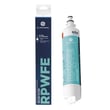
| Water/ice performance | Filter restriction reduces flow and ice production | GE refrigerator water filter RPWFE |
| Water supply to ice maker/dispenser | Valve not opening fully or leaking | Refrigerator dual water inlet valve assembly WR57X24979 |
Cooling and ice maker complaints often share the same root causes: restricted airflow, incorrect temperature feedback, or limited water flow. Catching those early helps prevent food spoilage, ice clumps, and repeat service calls.
For control settings, diagnostic steps, and component locations on GE PFE28RSHHSS, follow the troubleshooting and component access instructions in the PFE28RSHHSS owner's manual. If the display shows a fault, use the GE refrigerator error codes reference to narrow the failure to a specific system.
Last updated: January 2026
What is the most common problem with GE refrigerators ice maker?
The most common ice maker problem on a GE refrigerator like model PFE28RSHHSS is poor water flow, usually caused by a clogged water filter. Replacing the filter and purging air from the water line often restores normal ice production.
- Confirm the ice maker is turned ON and the bin is seated correctly.
- Make sure the freezer is cold enough; most ice makers need about 0°F to 10°F to cycle reliably.
- Replace the water filter if it is older than 6 months or water flow looks weak.
- Dispense water for 1 to 2 minutes to clear air and verify steady flow.
- Check the fill tube for ice blockage (a frozen fill tube stops water from entering the mold).
A restricted filter reduces water pressure to the ice maker, leading to small cubes, hollow cubes, slow production, or no ice.
- Use the correct filter for this model: GE refrigerator water filter RPWFE.
- Follow the steps in PFE28RSHHSS owner's manual for filter replacement and reset (if your control panel tracks filter life).
If a new filter does not help, these are the next most common causes:
| Symptom | Likely cause | What to check next |
|---|---|---|
| No water to ice maker, dispenser also weak | Low supply pressure or valve issue | Kinked line, shutoff valve fully open, inlet valve |
| Dispenser works, ice maker does not fill | Ice maker or fill path issue | Frozen fill tube, ice maker module |
| Intermittent ice, odd cube size | Temperature or sensor/control issue | Freezer temp, airflow, sensors |
Model PFE28RSHHSS uses a dual water valve to feed the dispenser and ice maker; if the ice side fails, the valve can be the culprit: refrigerator dual water inlet valve assembly WR57X24979.
An ice maker that is starved for water can cycle incorrectly and create clumps, jams, and inconsistent cube size. Fixing water flow early helps prevent repeat ice maker problems and keeps dispenser performance steady.
Last updated: January 2026