Owner’s manual



How do I tell what model my Kenmore dryer is?
Your Kenmore dryer’s model number is printed on the model and serial number plate; for Kenmore model 11062602100, that plate is the official identifier you should use when ordering parts, checking features, or looking up specifications in the 11062602100 owner's manual.
Where to find the model number plate
On most Kenmore electric dryers, the model and serial number plate is located in one of these common spots:
- Inside the dryer door opening (on the cabinet frame)
- On the back panel of the dryer cabinet
- Near the lint screen housing area (depending on design)
- On a metal plate or durable label (not a paper sticker)
How to read the number (and why it matters)
Kenmore model numbers often start with a 3-digit prefix (such as 110 or 796) that helps identify the manufacturing source and parts family. The full model number is what ensures the correct match for items like a heating element, thermostat, or drum belt.
Why it matters
Using the exact model number prevents common fit and wiring mismatches, especially for electrical and heating parts.
What to write down before you shop for parts
Record these details exactly as shown on the plate:
- Model number
- Serial number
- Purchase date (if known)
- Fuel type (electric for model 11062602100)
Quick reference table
| What you need | Where it’s used | Example for this dryer |
|---|---|---|
| Model number | Parts lookup, manuals, feature info | 11062602100 |
| Serial number | Service identification, production details | From the same plate |
If the plate is hard to read
If the label is worn, gently clean the area and use bright light to read stamped characters. Once you confirm the model, you can confidently match common wear items like the dryer drum belt 341241 to your Kenmore dryer.
Last updated: February 2026
What is the average lifespan of 11062602100?
A Kenmore electric dryer like model 11062602100 typically lasts 13 years with normal household use and proper venting. Keeping airflow strong (lint screen, lint chute, and vent duct) is the biggest factor in reaching that lifespan.
What affects lifespan the most
- Vent restriction (long runs, crushed flex duct, clogged wall cap) that overheats the heater and thermostats
- Overloading that strains the drum belt, idler pulley, and drum support
- Heat setting habits (high heat on heavy loads increases thermal stress)
- Maintenance (lint removal inside the cabinet and at the blower housing)
- Electrical supply quality (loose terminal connections can cause heat damage)
Maintenance checklist (best ROI)
- Clean the lint screen before every load; wash it with mild soap monthly to remove residue.
- Inspect and clean the lint path; the lint chute and blower area commonly pack with lint.
- Verify strong exhaust outside while running; weak airflow means the vent needs cleaning.
- Keep the dryer level; reduces vibration and wear on drum supports.
- Review safety and care steps in the 11062602100 owner's manual.
Common wear items vs. what they impact
| Wear item | What you notice | Why it matters |
|---|---|---|
| Drum belt | Drum stops turning, squeal, burning rubber smell | Prevents no-tumble failures and motor strain |
| Heating system safeties | No heat or short cycling | Protects the heater and reduces overheating |
| Door switch/latch | Won’t start or stops when door moves | Prevents intermittent operation |
Why it matters
Most “dryer died early” problems trace back to overheating from poor airflow. Good venting protects the heating element, high-limit thermostat, and thermal cut-off so the dryer runs cooler and lasts longer.
Last updated: March 2026
What replacement parts are most commonly needed for the 11062602100?
For Kenmore electric dryer model 11062602100, the most commonly replaced parts are the drum belt, idler pulley, heating element, and thermal safety parts (thermal cut-off and high-limit thermostat). These parts wear from normal use, heat, and airflow restrictions.
Most common replacement parts for this model
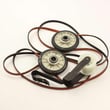
- Dryer drum belt 341241 (belt wear, squealing, drum not turning)
- Idler pulley WP691366 (chirping/squealing, belt slipping)
- Dryer element 279838 (no heat, long dry times when airflow is good)
- Dryer thermal cut-off fuse kit 279816 (no heat, dryer overheats then stops heating)
- Dryer high-limit thermostat WP3977767 (overheating protection trips, heat cycles oddly)
- Door switch WPW10237959 (won’t start, stops when door is bumped)
Quick symptom-to-part guide
| Symptom | Most likely parts to check | Notes |
|---|---|---|
| Runs but no heat | Heating element, thermal cut-off kit, high-limit thermostat | Also confirm strong vent airflow |
| Drum won’t turn, motor runs | Drum belt, idler pulley | Often accompanied by squeal first |
| Loud rumble or thump | Drum support parts (bearings/rollers) | Inspect drum supports while belt is off |
| Won’t start | Door switch, push-to-start switch | Also check power at the outlet |
Before you order: 5-minute checks that prevent repeat failures
- Clean the lint screen and confirm strong exhaust outside.
- Inspect the vent duct for kinks or heavy lint buildup.
- If a thermal cut-off or high-limit thermostat failed, correct airflow first.
- Unplug the dryer before opening panels or testing continuity.
- Use the wiring diagram and troubleshooting steps in the 11062602100 owner's manual.
Why it matters
Replacing the failed part fixes the symptom, but fixing the cause (usually restricted venting) prevents repeat heater and thermostat failures and keeps drying times normal.
Last updated: March 2026