 Installation guide
 Owner’s manual


How to clear F21 code on Kenmore washer?
On a Kenmore washer, an F21 code points to a long-drain condition; clearing it means restoring normal draining by removing a clog, fixing the drain path, or repairing the drain pump so the washer can empty within the expected time. Use the steps in the owner's manual as your baseline.
Quick steps to clear the code
- Press Pause/Cancel (or stop the cycle by pushing in the cycle control knob, if your model uses a knob) and wait 1 minute.
- Unplug the washer for 1 minute, then plug it back in to reset the control.
- Run Drain/Spin and listen for the drain pump running.
- If it still will not drain, check the drain system for a blockage (next section).
What to check first (most common causes)
- Drain hose
- Make sure the hose is not kinked, crushed, or pushed too far down the standpipe.
- Confirm the standpipe or laundry tub is not backing up.
- Pump and pump inlet
- Check for coins, lint, socks, or debris at the pump inlet.
- If the pump hums but does not move water, the impeller may be jammed.
- Load and suds
- Too many suds can slow draining; use the correct amount of detergent and rerun Drain/Spin.
When a part is likely needed
If the drain path is clear but the washer still drains slowly or not at all, the drain pump is the most common fix for an F21 long-drain symptom on this style of Kenmore washer.
| Symptom | What it usually means | Common next step |
|---|---|---|
| Pump runs, weak/no water flow | Partial clog or failing pump | Inspect hoses and pump; replace pump if damaged |
| Pump hums, no draining | Jammed or seized impeller | Clear obstruction; replace pump if it will not spin |
| Intermittent draining | Loose connection or pump wearing out | Check wiring and pump; replace if inconsistent |
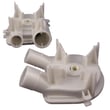
Relevant part for this model: washer drain pump WP3363394.
Why it matters
A long-drain condition can leave water in the tub, prevent spinning, and cause repeat error codes. Fixing the drain hose routing or replacing a failing pump helps protect the motor, clutch, and gear case from extra strain.
Last updated: February 2026
How to reset Kenmore 11012502100 washer?
For the Kenmore 11012502100 compact washer, the most reliable “reset” is a power reset: stop the cycle, unplug the washer for a few minutes, then restore power and restart the cycle. This clears many temporary control or cycle-stall conditions.
Quick reset steps (power reset)
- Push in the Cycle Control knob to stop the washer.
- Make sure the lid is fully closed.
- Unplug the washer (or switch the breaker off).
- Wait 2 to 5 minutes.
- Plug the washer back in (or switch the breaker on).
- Select a cycle and pull out the Cycle Control knob to restart.
If it still will not start, agitate, or spin
These checks fix the most common “looks dead” or “stuck” situations on this style of Kenmore top-load washer:
- Normal pause: some cycles pause for about 2 minutes; wait and see if it resumes.
- Lid open: the washer will not agitate or spin with the lid open.
- Extension cord: do not use one; plug directly into a wall outlet.
- Drain setup: a drain hose that is clogged or routed too high can prevent draining and spinning.
- Oversudsing: measure detergent carefully; too many suds can interrupt draining/spinning.
What “reset” means on this model
This washer uses a mechanical Cycle Control knob, so “resetting” usually means stopping the cycle and restoring power, then restarting the selected cycle.
| Situation | What to do | Why it matters |
|---|---|---|
| Washer paused mid-cycle | Wait about 2 minutes | Some pauses are normal and not a failure |
| Washer will not agitate/spin | Close lid, then restart cycle | Lid must be closed for operation |
| Washer will not drain/spin | Check drain hose routing and clogs | Poor draining prevents spin |
Where to find the exact stop/restart procedure
We list the model-specific stop and restart steps in the owner's manual.
Last updated: February 2026
How to unclog drain hose on Kenmore washer?
To unclog the drain hose on your Kenmore compact washer model 11012502100, unplug the washer, remove as much water as possible, then check the hose path for kinks and clear blockages at the standpipe/laundry tub end and at the pump connection. Reinstall the hose exactly as shown in the installation guide.
Safety first
- Unplug the washer (or switch off the breaker).
- Turn off both water faucets.
- Keep towels and a shallow pan ready for spills.
- If the washer is full of water, bail out water first to reduce flooding.
Step-by-step: clear the clog
- Check the drain hose routing: Make sure the hooked end is not straightened and the hose is not kinked.
- Clear the outlet end: Pull the hooked end from the standpipe or laundry tub; remove lint, coins, or small socks.
- Clear the hose itself: Run warm water through the hose; if needed, use a flexible drain snake carefully.
- Check the pump area: If the hose is clear but draining is still slow, inspect the pump inlet for debris. A worn or jammed pump can also mimic a clog; the replacement is the washer drain pump WP3363394.
- Reinstall correctly: Wet the inside of the straight end with tap water only, push it fully onto the drain connector until it reaches the ribbed stop, then position the clamp where marked for the clamp.
Drain hose installation details that prevent repeat clogs
The drain hose setup matters because poor routing can cause slow draining, siphoning, or leaks.
- Keep the hooked end in place; do not force extra hose down into the standpipe.
- Leave an air gap; the hose should be secure but not airtight in the standpipe.
- Do not lay excess hose in the bottom of a laundry tub.
Quick checklist
| What we check | What “good” looks like | What causes problems |
|---|---|---|
| Hooked end | Hooked, not straightened | Kinks, pinches |
| Standpipe/tub fit | Secure with an air gap | Sealed tight, siphoning |
| Hose length | No excess stuffed into pipe | Crushed or restricted flow |
Why it matters
A partially clogged drain hose can leave water in the tub, cause long cycle times, and strain the drain pump. Correct hose routing and clamp placement also helps protect floors from leakage.
Last updated: February 2026





