 Installation guide
 Owner’s manual
 Error Codes
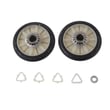


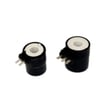
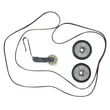
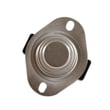
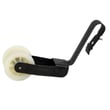
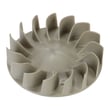
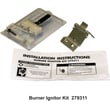
What are the parts of a dryer called?
On our Roper RGD4440VQ1 29-inch gas dryer, the main parts are typically grouped into airflow and heat parts, drum and drive parts, and controls and safety parts. Knowing the correct part names helps you match symptoms (no heat, noise, no start) to the right replacement.
- Drum and support: drum, front bearing, rear support, glides or rollers
- Drive system: drive belt, idler pulley, drive motor
- Airflow system: blower wheel, blower housing, lint screen, exhaust duct
- Gas heat system (gas models): igniter, gas valve, valve coils, radiant sensor
- Temperature and safety: operating thermostat, high-limit thermostat, thermal cut-off or thermal fuse
- Controls and switches: timer, push-to-start switch, door switch
Here are a few common part names you will see when shopping for Roper RGD4440VQ1 parts:
| System | Example part name | What it affects |
|---|---|---|
| Drive | Belt 341241 | Drum tumbling |
| Drive | Dryer idler pulley WP691366 | Belt tension, squealing |
| Airflow | Dryer blower wheel WP694089 | Air movement, dry time |
| Gas heat | Igniter 279311 | Burner ignition, no heat |
| Gas heat | Dryer valve coil kit 279834 | Burner staying lit, intermittent heat |
| Temperature | Dryer operating thermostat WP3387134 | Heat cycling, overheating |
Using the correct term helps you troubleshoot faster and avoid ordering the wrong item. For example, “no heat” on a gas dryer often points to the igniter, radiant sensor, or gas valve coils, while “thumping or squealing” often points to the belt, idler pulley, or drum support parts.
We recommend checking the exploded-view diagrams and terminology in the RGD4440VQ1 owner’s manual and the venting and installation terminology in the RGD4440VQ1 installation guide.
Last updated: February 2026
What would cause a roper dryer not to start?
For a Roper RGD4440VQ1 gas dryer that won’t start, the most common causes are a power supply problem, the door not fully closed, or a failed start circuit component (push-to-start switch, timer, motor, or a blown thermal fuse). Use the checks in the RGD4440VQ1 owner's manual first.
- Confirm the dryer is plugged into a grounded 3-prong outlet.
- Verify the household fuse is intact or the circuit breaker has not tripped.
- Make sure the door is fully closed and latching.
- Press and hold the Start button firmly.
- Confirm a cycle is selected (the dryer will not start if the dial is not set correctly).
- Avoid using an extension cord.
If power and door checks are good, these parts commonly stop the dryer from starting:
- Push-to-start switch: if it doesn’t close electrically when pressed, the motor never gets the start signal.
- Timer: worn internal contacts can prevent power from reaching the motor circuit.
- Drive motor: a seized or electrically open motor can prevent any start.
- Thermal fuse (not listed in the parts shown): if blown from overheating or restricted venting, the dryer won’t run.
| Symptom | Most likely area | What it points to |
|---|---|---|
| No sound at all | Power, door switch, start circuit | Outlet, breaker/fuse, door not latched, start switch/timer |
| Hums but won’t turn | Motor or drum drive | Motor issue, stuck drum, belt/idler problem |
| Starts then stops quickly | Overheat protection | Airflow restriction, thermal fuse issue |
A no-start condition is often a simple setup issue (power, door, cycle selection). When it is a part failure, diagnosing in the right order prevents replacing good parts and helps you correct airflow problems that can cause repeat failures.
For a step-by-step diagnostic flow, use gas dryer wont start troubleshooting video.
Last updated: February 2026
Why is my Roper dryer not drying completely?
For your Roper RGD4440VQ1 29" gas dryer, incomplete drying is almost always caused by restricted airflow (venting, lint buildup, crushed/kinked vent) or a heat system issue that cycles off too soon. Start with venting and lint cleaning, then check the heating controls and gas-ignition parts.
- Clean the lint screen before or after each load (a clogged screen slows airflow).
- Confirm you are using a 4-inch heavy metal vent, not plastic or foil; plastic and foil restrict airflow and are unsafe.
- Make sure flexible metal venting is fully extended and not kinked or crushed behind the dryer.
- Check the outside exhaust hood for a weak flap opening, lint blockage, or a bird nest.
- Avoid drying in spaces below 45°F; low temperatures extend drying time and can affect automatic cycle shutoff.
Your dryer dries fastest when it is properly installed and vented; the straightest, shortest vent run performs best. Use the venting requirements and routing guidance in the RGD4440VQ1 installation guide.
| Symptom | Most likely cause | What to do first |
|---|---|---|
| Clothes warm but still damp | Restricted vent airflow | Clean/shorten vent, remove kinks |
| Dryer runs long time | Lint buildup in vent or blower area | Clean vent and blower housing area |
| Heat seems to come and go | Burner cycling off early | Check thermostats and gas ignition parts |
If airflow is good and drying is still poor, these parts are common culprits:
- Operating thermostat: can cycle heat incorrectly; see dryer operating thermostat WP3387134.
- High-limit thermostat/thermal cut-off kit: can open from overheating (often caused by bad venting); see dryer high-limit thermostat W11050897.
- Gas ignition system: weak coils can stop the burner after it lights; see dryer valve coil kit 279834.
- Radiant sensor: can prevent consistent ignition; see dryer radiant sensor WP338906.
Poor airflow makes the dryer run hotter internally, increases cycle time, and can trip safety thermostats. Fixing venting first protects the burner system, improves drying efficiency, and reduces wear on parts like the blower wheel and motor.
Last updated: February 2026








