Installation guide
 Owner’s manual
 Error Codes



How to move a Fisher Paykel fridge freezer?
To move your Fisher & Paykel E522BRX-21639F bottom-mount refrigerator, roll it forward or backward on its built-in front and rear rollers; avoid pushing it sideways because that can damage the rollers and your floor. Follow the handling steps in the E522BRX-21639F installation guide.
Safe moving steps (recommended)
- Empty or secure loose items (bins, bottles, glass shelves) to prevent shifting.
- Turn off the ice and water supply if your unit is connected.
- Unplug by gripping the plug (not the cord); keep the cord clear so the refrigerator does not roll over it.
- Pull straight out from the wall and roll the refrigerator forward or backward only.
- If you need to reposition, make small moves and re-check that the cabinet sits stable on all feet.
- Protect floors with a thin hardboard path if you are moving across soft vinyl or delicate surfaces.
If the refrigerator feels unstable after moving
The installation instructions describe a simple stability check and correction:
- Gently push on the top front of the refrigerator.
- If a front foot lifts, roll the refrigerator back and adjust the front feet.
- If needed, place solid packing material (hardwood or plastic) under the rear roller diagonally opposite the lifting foot.
Quick do and don’t table
| Action | Do | Don’t |
|---|---|---|
| Direction of travel | Roll forward/backward | Move sideways |
| Power cord | Pull plug straight out, keep cord clear | Pull on cord or roll over it |
| Stability | Confirm all 4 feet are on the floor | Leave it rocking or twisted |
Why it matters
Moving sideways or leaving the refrigerator twisted can damage rollers, scuff flooring, and affect door alignment and closing performance.
Last updated: January 2026
What year is Fisher & Paykel E522BRX-21639F?
The Fisher & Paykel E522BRX-21639F model number by itself does not map to one single “model year”; the reliable way to date your refrigerator is by its serial number and rating label. We use the identification steps in the E522BRX-21639F owner's manual to locate the label and confirm the manufacturing date.
How to find the manufacturing date
Check the rating label and record the serial number first; then use that information to determine the build date.
- Look for the rating label inside the fresh food compartment (commonly on a side wall) or near the door opening
- Write down the model number (E522BRX-21639F) and the serial number exactly as shown
- If your unit has multiple compartments, check both the refrigerator and freezer areas for an ID label
- Compare the serial number format to the identification guidance in the manual
- If the label is worn, take a clear photo and zoom in to confirm characters
What “year” can mean (and why serial matters)
Model numbers often stay in production across multiple years, and revisions can occur without changing the model number. The serial number is what ties your specific refrigerator to a manufacturing timeframe.
| What you have | What it tells you | Best use |
|---|---|---|
| Model number (E522BRX-21639F) | Product family and configuration | Finding compatible parts and diagrams |
| Serial number | Build date and production run | Dating the unit and matching revisions |
| Purchase date | When it was bought | Warranty and ownership records |
Why it matters
Knowing the manufacturing date helps us match the correct version of parts like a door gasket, control module, or evaporator fan assembly, especially when there are mid-production changes.
If you are replacing a common wear item, matching by model is usually enough; for revision-sensitive parts, we match by serial range.
Last updated: January 2026
What is the lifespan of a Fisher & Paykel fridge?
A Fisher & Paykel refrigerator like model E522BRX-21639F typically lasts 10 to 20 years with normal household use. Consistent cleaning, correct temperature settings, and keeping doors sealing and closing properly are the biggest factors that help you reach the high end of that range.
What affects lifespan most
- Door seal condition: air leaks make the compressor run longer and wear faster.
- Condenser and airflow: dust buildup and blocked vents increase heat and run time.
- Stable installation: a twisted or unlevel cabinet can affect door alignment and closing.
- Usage habits: frequent door openings and overpacking reduce efficiency.
- Power quality: repeated outages or surges can stress the control module and inverter.
Maintenance checklist (simple, high impact)
- Keep the refrigerator and freezer at recommended temperatures in the E522BRX-21639F owner's manual.
- Clean door gaskets with mild soap and water; dry fully.
- Make sure the unit is stable and doors close smoothly; leveling guidance is in the E522BRX-21639F installation guide.
- Avoid blocking interior air vents with food containers.
- Replace worn sealing parts promptly if you notice gaps, sweating, or frost.
Quick “what to watch for” table
| Symptom | What it usually means | What we recommend |
|---|---|---|
| Warm fridge, cold freezer | Airflow issue or evaporator fan problem | Check vents; listen for fan; service if fan is silent |
| Frost buildup in freezer | Door not sealing or defrost issue | Inspect gasket; reduce door-open time |
| Doors look misaligned | Cabinet twist or leveling issue | Re-level per installation instructions |
| Runs constantly | Dirty coils, warm room, or air leak | Improve airflow; check gasket seal |
Why it matters
A refrigerator that seals well and is installed correctly runs fewer hours per day. That reduces wear on key components like the evaporator fan motor, inverter, and control module, which is how you maximize lifespan and keep food temperatures stable.
Last updated: January 2026
Why is my Fisher Paykel refrigerator dripping water on the floor?
Water on the floor around your Fisher & Paykel refrigerator model E522BRX-21639F is usually caused by a clogged or frozen defrost drain, a door that is not sealing, or the cabinet not sitting level so water runs out instead of into the drain pan. Use the steps below to pinpoint the source.
Quick checks we recommend first
- Look for water trails starting inside the fresh food section or freezer and running down to the floor.
- Confirm the doors close fully and do not bounce back.
- Check for frost buildup on the freezer back wall (often points to a drain or airflow issue).
- Verify the refrigerator is stable and level front-to-back and side-to-side.
- Inspect the water filter area and tubing (if equipped with ice and water).
Most common cause: blocked or frozen defrost drain
During normal defrost, meltwater should flow through a drain to a pan underneath. If the drain is blocked by ice or debris, water can overflow and leak onto the floor.
What to do
- Unplug the refrigerator.
- Remove items from the freezer floor area and look for ice near the drain opening.
- Melt ice with warm water (small amounts at a time) and clear debris with a flexible plastic tool.
- After clearing, confirm water flows freely to the drain pan.
Leveling and installation issues that cause leaks
If the cabinet is twisted or not stable, doors may not seal consistently and water can escape. The installation instructions for this model emphasize stability (all feet on the floor) and careful adjustment.
| What you notice | Likely cause | What to do |
|---|---|---|
| Water appears after door openings | Door not sealing, warm air causing excess frost | Clean gasket, check alignment, reduce overloading shelves |
| Water appears after defrost cycles | Drain partially blocked | Clear drain and remove ice |
| Water runs toward front corners | Refrigerator not level | Adjust front feet and re-check stability |
For model-specific leveling guidance, follow the E522BRX-21639F installation guide.
Parts that can contribute to leaking symptoms
If you find the door is not sealing well, a worn gasket can let humid air in, creating heavy frost and overflow.
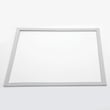
- Consider inspecting the refrigerator gasket assembly 819821P for gaps, tears, or hardened sections.
Why it matters
Floor leaks can lead to slipping hazards, warped flooring, and poor cooling performance if frost buildup restricts airflow. Fixing the drain and door seal early helps protect food temperatures and reduces compressor run time.
Last updated: January 2026