 Owner’s manual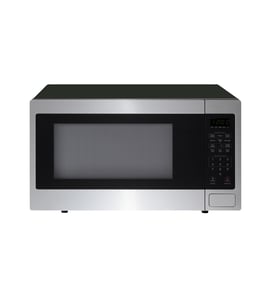

How deep is a countertop microwave?
For the Kenmore 40572123310 countertop microwave, the cabinet depth is 15.9 inches (front to back). This is the external depth of the microwave body; allow extra space behind and above the unit for safe ventilation per the owner's manual.
The manual lists these external dimensions (W x D x H):
| Measurement | Size (inches) | Size (mm) |
|---|---|---|
| Width | 20.5 | 520 |
| Depth | 15.9 | 403 |
| Height | 12.8 | 325.7 |
When you are checking fit on a counter or shelf, measure in two ways:
- Cabinet depth: back of the case to the front face (this model is 15.9 inches).
- “Overall” depth: include the door curve and handle (often adds about 0.5 to 2 inches on many countertop microwaves).
- Usable space: leave clearance so vents are not blocked.
Even if the microwave fits by dimensions, it still needs airflow.
- Leave at least 3 inches between the microwave and adjacent walls.
- Keep one side open.
- Leave at least 12 inches of open space above the microwave.
- Do not block intake or outlet vents.
Depth affects more than “will it fit.” If the microwave is pushed tight to a wall or enclosed without clearance, airflow drops, heat builds up, and performance and component life can suffer.
If you are matching parts to your exact unit, use the full model number 40572123310 when searching on the model parts list or on Sears PartsDirect.
Last updated: February 2026
How many watts is a Kenmore 1.1 cu ft countertop microwave?
For Kenmore model 40572123310, the microwave’s cooking (output) power is 1100 watts. That is the wattage that matters most for heating speed and cooking performance; the unit’s electrical input power is higher.
Here is how the two common “watt” numbers differ:
- Rated output power (microwave cooking power): 1100W
- Rated input power (power it draws from the outlet): 1550W
- Rated voltage: 120V, 60Hz
- Oven capacity listed in the manual: 1.2 cu. ft. (this model family)
| Spec type | What it means | Value for 40572123310 |
|---|---|---|
| Output power | Heating/cooking strength | 1100W |
| Input power | Electrical draw from outlet | 1550W |
- Cooking times are based on output watts; recipes often assume 900W to 1200W.
- Circuit load and nuisance tripping relate more to input watts (and what else is on the same circuit).
- If you are comparing microwaves, output wattage is the best “apples to apples” number.
We list both the input and output wattage in the specifications section of the owner's manual.
If you are shopping parts by model number or confirming you have the correct Kenmore countertop microwave variant, start with the model parts list, or search by model on Sears PartsDirect.
Last updated: February 2026
How much clearance for a countertop microwave?
For the Kenmore 40572123310 countertop microwave, we install it with at least 3 inches of clearance to adjacent walls, 12 inches of open space above, and one side left open so the intake and outlet vents can breathe. See the owner's manual for the exact placement diagram.
- Sides: Minimum 3 in. to any adjacent wall; one side must be open
- Top: Minimum 12 in. above the microwave
- Surface: Set on a level, stable countertop or shelf
- Vents: Do not cover or block any openings
- Feet/legs: Do not remove the legs from the bottom of the microwave
| Location around microwave | Minimum clearance | Notes |
|---|---|---|
| Above (top) | 12 in. | Helps prevent overheating and vent restriction |
| To adjacent wall (side) | 3 in. | One side must remain open |
| Vent openings | Keep open | Blocking vents can damage the microwave |
Proper clearance keeps airflow moving through the cabinet vents. When vents are restricted, the microwave can overheat, run poorly, or shut down during cooking.
- Plug into a standard household outlet that matches the rating label (120V, 60Hz for this model).
- Keep the microwave away from radios and TVs to reduce interference.
- Do not place it over a range or other heat-producing appliance.
- If you need replacement parts for this Kenmore model, start with the model parts list, or search by model number on Sears PartsDirect.
Last updated: February 2026
Why would a Kenmore microwave stop working?
A Kenmore microwave like model 40572123310 can stop working when it is not getting power, the door is not fully latched, or a safety device has opened (such as a fuse or thermal cutoff). Start with outlet and door checks, then follow the troubleshooting steps in the 40572123310 owner's manual.
- Confirm the microwave is plugged in firmly and the outlet has power (test with a lamp).
- Close the door fully; a misaligned door or latch can prevent starting.
- Make sure a cooking time and function are actually set (not just the clock).
- Avoid running the microwave empty; it can cause arcing or internal damage.
- If the cord or plug is damaged, stop using the microwave and replace the cord set if applicable.
| What you see | Most common cause | What to do next |
|---|---|---|
| No display, no response | No power at outlet, loose plug | Verify outlet power; reset the breaker or GFCI if tripped |
| Display works but will not start | Door not closed, wrong operation set | Re-close door; re-enter cook settings per the manual |
| Runs but does not heat | High-voltage circuit issue (fuse, thermal cutoff, magnetron circuit) | Use safe diagnostic steps; see why is my microwave not heating |
| Arcing or sparking | Non-microwave-safe items, food splatter, damaged waveguide cover | Stop use; clean cavity; remove metal; see never do these things with a microwave |
A blown fuse or opened thermal cutoff is common after a power surge, overheating, or a short. If the microwave is completely dead or dies mid-cycle, checking these safety parts is a typical next step.
- Unplug the microwave before any inspection.
- If you use a multimeter, follow safe testing practices.
- Replace only with the correct type and rating.
- If a replacement fuse blows again, a deeper electrical fault is present.
For step-by-step guidance, use how to replace a microwave fuse.
Microwaves contain high-voltage components; door interlocks and fuses are designed to prevent unsafe operation. Correct diagnosis protects the control board, prevents repeat failures, and helps you order the right replacement parts through the model parts list or Sears PartsDirect.
Last updated: February 2026


