Owner’s manual
 Error Codes




How wide is a 24.5 cu ft refrigerator?
Most 24.5 cu. ft. refrigerators are about 36 inches wide. For your Whirlpool WRS586FIEM04 side-by-side refrigerator, the exact cabinet width and required clearance are listed in the WRS586FIEM04 user guide.
Typical width and what to plan for
Even when the cabinet is “36 inches,” the space you need is usually larger because of doors, handles, and airflow clearance.
- Typical cabinet width: ~35 3/4 to 36 inches
- Typical depth: standard-depth models often extend well past cabinets once installed
- Clearance matters: you need room for door swing, leveling, and ventilation
- Measure three places: top, middle, and bottom of the opening
- Check the path in: doorways and hallways can be tighter than the final opening
Quick sizing guide (common ranges)
| What you’re measuring | Typical value for a 24.5 cu. ft. class | Why it matters |
|---|---|---|
| Cabinet width | ~36 in. | Fit between cabinets/walls |
| Opening width to target | 36 in. + clearance | Prevent rubbing and allow airflow |
| Door swing space | Varies by handle/hinge | Lets drawers and bins open fully |
How we recommend measuring
Use a tape measure and write down each number.
- Measure the opening width (wall-to-wall or cabinet-to-cabinet)
- Measure height to the lowest overhead cabinet/soffit
- Measure depth from the back wall to the front edge of counters
- Confirm doorway width on the route to the kitchen
- Plan for water line routing if you use the ice maker and dispenser
Why it matters
A refrigerator that is only 1/2 inch too wide can bind against cabinets, restrict airflow (hurting cooling performance), or prevent doors from opening fully. Using the model-specific dimensions from the manual helps you avoid installation surprises.
Last updated: January 2026
What is the most common problem with a Whirlpool refrigerator?
On the Whirlpool WRS586FIEM04 side-by-side refrigerator, one of the most common issues we see is a cooling complaint caused by poor airflow, often tied to the evaporator fan system. When the fan is not moving air across the evaporator, the refrigerator section warms up even if the freezer still feels cold.
Quick symptoms that point to an airflow (evaporator fan) problem
- Refrigerator section is warm but freezer is closer to normal
- Weak or no airflow from the refrigerator vents
- Unusual buzzing, rubbing, or rattling from the freezer area
- Frost buildup on the back freezer panel (can also indicate a defrost issue)
- Temperatures swing after door openings
What to check first (fast, no parts swapping)
- Confirm vents are not blocked by food packages.
- Listen for the evaporator fan running when the freezer door is closed (door switch held in).
- Check for heavy frost on the freezer rear panel; that can restrict airflow.
- Make sure the door is closing fully and sealing.
- Verify settings and basic troubleshooting steps in the WRS586FIEM04 user manual.
Common causes and the parts typically involved
| What you notice | Likely cause | Example part to inspect |
|---|---|---|
| Fan noise but little airflow | Damaged fan blade or ice interference | Refrigerator evaporator fan blade WP2169142 |
| Frosted-over freezer back panel | Defrost system problem | Refrigerator defrost heater WPW10495967 |
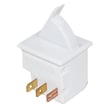
| Lights act odd, fan stops when door moves | Door switch not closing circuit | Refrigerator door switch W11396033 |
Why it matters
Airflow is what carries cold air from the evaporator to both compartments. If airflow drops, food can spoil in the fresh-food section, the compressor may run longer, and frost can build up faster.
If you’re also seeing display or control-related symptoms, use our Whirlpool refrigerator error codes guide to narrow the failure before ordering parts.
Last updated: January 2026
Why is my Whirlpool side-by-side refrigerator not making ice but water works?
If your Whirlpool WRS586FIEM04 dispenses water but will not make ice, the usual causes are the ice maker being switched off, the freezer temperature being set too warm, or restricted water flow to the ice maker side of the inlet valve. Use the WRS586FIEM04 user guide to confirm the On/Off switch location and ice-making timelines.
Quick checks that fix most “no ice” problems
- Remove the ice bin and confirm the ice maker On/Off switch is set to ON.
- Make sure the ice bin is fully seated and not jammed.
- Set the freezer colder if you have “too little ice”; recheck after 24 hours.
- After startup or changes, allow 24 hours for the first batch and up to 72 hours for full production.
- Discard the first three batches of ice after initial startup.
Why water can work when ice does not
The dispenser and ice maker often share a dual water valve, but they use different outlets. The dispenser can still flow normally even if the ice-maker outlet is weak, restricted, or intermittently sticking.
What to check next (in order)
- Freezer temperature: Ice production drops fast if the freezer is too warm.
- Fill tube and ice mold: Look for a frozen fill tube or an empty mold after a harvest cycle.
- House water supply: Confirm the shutoff valve is fully open and the supply line is not kinked.
- Inlet valve performance: If the mold stays dry, test and replace the valve if it is not opening reliably.
Symptom-to-cause guide
| What you notice | Most likely cause | What we recommend |
|---|---|---|
| No ice at all, water dispenses | Ice maker OFF or bin not seated | Turn ON; reseat bin |
| Slow ice, small or hollow cubes | Freezer too warm or low flow | Lower freezer setting; check flow |
| Ice maker cycles, mold stays dry | Weak/restricted valve outlet | Inspect/replace valve |
Parts that commonly solve this symptom
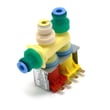
- Refrigerator water inlet valve WPW10341320 (controls water flow to dispenser and ice maker)
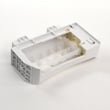
- Refrigerator ice maker W10873791 (ice maker assembly if it will not cycle or harvest)
Why it matters
Ice makers need a consistently cold freezer and a strong, timed water fill. A small temperature increase or a weak valve outlet can stop ice production while the water dispenser still seems fine.
Last updated: January 2026