Owner’s manual
 View engine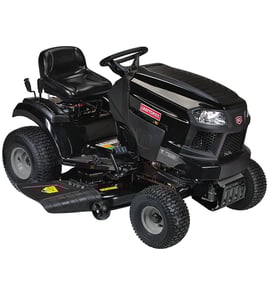


How many hours should a Craftsman riding mower last?
A Craftsman riding mower like model 917287210 typically lasts 500 to 700 engine hours with normal residential use and routine maintenance; with excellent care, many owners see up to about 1,000 hours before major wear items (deck, steering, drive) start needing more frequent repairs. Use the 917287210 owner's manual maintenance schedule to maximize life.
What affects mower life the most
- Maintenance frequency (oil changes, air filter service, blade sharpening)
- Mowing conditions (dusty yards, sandy soil, steep hills, heavy leaf buildup)
- How hard the deck works (overgrown grass, mowing too fast, low cut height)
- Storage habits (dry storage, clean deck, stabilized fuel for off-season)
- Wear parts replaced on time (belts, blades, pulleys, mandrel components)
Typical lifespan ranges (what to expect)
| Condition | Typical hours | What you’ll notice |
|---|---|---|
| Light use, basic upkeep | 300 to 500 | More vibration, uneven cut, belt slip |
| Normal use, good upkeep | 500 to 700 | Occasional belt, blade, and idler service |
| Excellent upkeep | 700 to 1,000 | More frequent deck and drive wear part replacement |
Maintenance habits that add hours
- Keep the mower deck clean; grass buildup holds moisture and accelerates corrosion.
- Avoid mowing at the lowest setting unless needed; this tractor’s cut range is about 1 to 4 inches.
- Replace worn deck-drive components before they damage other parts.
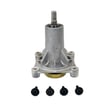
- If cut quality drops or you hear grinding from the deck, inspect the mandrel area; the lawn tractor mandrel housing 587819701 and related pulleys and blades are common wear points.
Why it matters
Engine hours are the best way to compare mower wear because they reflect actual run time, not calendar age. Hitting 500+ hours is normal for a well-kept riding mower; staying ahead of belt, blade, and deck wear prevents bigger failures later.
Last updated: February 2026
Is it worth replacing a lawn mower engine?
Replacing the engine on your Craftsman lawn tractor model 917287210 is worth it when the tractor is otherwise in solid shape (deck, transmission, steering) and the total repair cost stays well below the price of a comparable replacement tractor. If multiple major systems are worn out, replacement usually makes more sense.
Quick decision checklist
- Compare total cost: engine (or rebuild) + labor + any “while you’re in there” parts.
- Check the deck and cut quality: a rusted or damaged deck can erase the value of a new engine.
- Evaluate drive and safety systems: weak drive, brake issues, or safety switch problems add cost fast.
- Confirm the root cause: fuel, spark, wiring, or carburetor issues can mimic a “bad engine.”
- Plan for maintenance after repair: fresh fuel, clean air filter, correct oil level, and sharp blades.
What to inspect before you commit
Use the troubleshooting and maintenance guidance in the 917287210 owner’s manual to rule out common no-start and poor-running causes (fuel quality, wiring, battery/starting circuit, air filter, spark plug, and carburetor adjustment).
If your symptoms include rough cutting or vibration, inspect the deck hardware too. A worn mandrel or pulley can cause noise and poor cut even with a healthy engine.
| What you find | What it usually means | Typical next step |
|---|---|---|
| Engine cranks but will not start | Often fuel or ignition related | Fresh gasoline, check wiring, tune-up items |
| Clicking/no crank | Often battery, solenoid, or wiring | Test battery and starting circuit |
| Excess vibration while mowing | Blade or mandrel issue | Check blades, mandrels, deck level |
| Poor cut, clumping | Deck buildup, wet grass, speed too fast | Clean deck, mow dry, slow down |
Parts that commonly come up during “engine vs. repair” decisions
These are not engine parts, but they are frequent cost drivers on older tractors and can influence whether an engine swap is worth it:
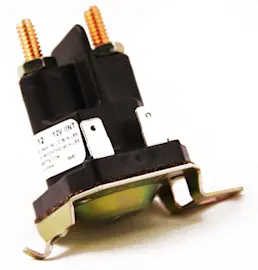
- Lawn tractor starter solenoid 582042802 (no-crank or intermittent starting)
- Lawn tractor mandrel housing 587819701 (deck spindle/mandrel wear, noise, poor cut)
- Mandrel pulley 532195945 (belt tracking and deck drive issues)
- Husqvarna lawn tractor belt, 1/2 x 101-1/6-in 592855001 (slipping, poor drive or deck performance)
Why it matters
An engine replacement can restore years of service, but only if the rest of the tractor is safe and mechanically sound. The manual also emphasizes keeping nuts/bolts tight, maintaining safety devices, and avoiding adjustments with the engine running, which helps prevent repeat failures and unsafe operation.
Last updated: February 2026
What kind of engine is in the Craftsman 917287210?
The Craftsman 917287210 lawn tractor uses a gasoline, low-emission internal combustion engine and is paired with a 42-inch mower deck (as shown in the operator information). For the exact engine brand and model installed on your tractor, match the engine ID tag to the specifications in the 917287210 owner's manual.
How to identify the exact engine on your tractor
Use the engine’s identification label, then cross-reference it in the manual:
- Find the engine ID label on the blower housing, valve cover, or near the starter
- Write down the engine manufacturer and model information (model, type, code or spec)
- Compare those numbers to the engine specifications and maintenance sections
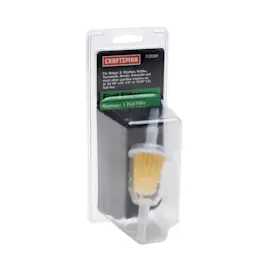
- Use the engine ID when ordering tune-up items (spark plug, air filter, fuel filter)
- Keep the engine ID with your tractor model number 917287210 for future parts lookups
What the manual confirms for this model
The operator manual for 917287210 identifies this tractor as a 42-inch mower model and notes it uses a low-emission engine design that can operate differently than older engines.
Quick reference
| Item | Craftsman 917287210 (what to expect) |
|---|---|
| Fuel type | Gasoline |
| Engine type | Low-emission, internal combustion (engine ID tag gives exact make/model) |
| Deck size | 42-inch |
| Best way to confirm exact engine | Engine ID label plus manual specifications |
Why it matters
The engine make and model determine the correct maintenance parts and settings, including spark plug type, air filter fit, oil recommendations, and adjustment procedures. Using the engine ID prevents ordering the wrong parts and speeds up troubleshooting.
Last updated: February 2026
What kind of oil do you use in a Craftsman lawn tractor?
For the Craftsman lawn tractor model 917287210, use a quality 4-cycle engine oil that meets API service classification SG-SL, and choose the viscosity based on outdoor temperature (the manual notes it ships with summer-weight oil and recommends changing viscosity for cold-weather starting). See the 917287210 owner's manual for the oil viscosity chart.
Recommended oil type and viscosity
We recommend using detergent 4-cycle engine oil and matching viscosity to the season:
- Use summer-weight oil for warm-weather mowing
- Switch to a lighter viscosity for cold-weather starting
- Use oil labeled API SG, SH, SJ, SL (or equivalent that meets SG-SL)
- Do not mix oil with gasoline (this is a 4-cycle engine)
- Check oil level on level ground before each use
Quick guide (typical small-engine practice)
| Outdoor temperature | Typical viscosity to use | Why |
|---|---|---|
| Hot weather mowing | SAE 30 (common “summer weight”) | Holds viscosity at higher temps |
| Mixed temps | 10W-30 | Better all-around starting and protection |
| Cold weather | 5W-30 | Easiest starting in low temperatures |
How often to check and change oil
The manual guidance for this tractor is straightforward:
- Check crankcase oil before starting and every 8 hours of operation
- Change oil every 50 hours of operation or at least once a year
- Tighten the oil fill cap/dipstick securely after each check
- Drain oil more freely when the engine is warm (use a suitable container)
Why it matters
Correct oil viscosity and API rating help prevent hard starting, overheating, and accelerated engine wear, especially on a riding tractor that runs hot under load while mowing a 42-inch deck.
Last updated: February 2026
What model number is the Craftsman 42 riding mower?
For the Craftsman front-engine lawn tractor model 917287210, the operator’s manual identifies it as Model No. 917.28721 with a 42-inch mower deck. On parts and service sites, that same tractor is commonly listed under the full model number 917287210.
How to match the model number on your tractor
Use these quick checks to confirm you are looking at the right Craftsman 42-inch riding mower:
- Look under the seat or on the frame for the product ID label
- Match the 917 prefix (Craftsman-built tractor family)
- Compare the manual’s short form (917.28721) to the full parts lookup form (917287210)
- Confirm the deck size is 42 in.
- Use the diagrams and specs in the 917287210 owner’s manual
Short form vs full model number (what you will see)
These two formats typically refer to the same tractor family; the full number is what we use for parts lookup.
| Where you see it | Example | What it means |
|---|---|---|
| Operator’s manual cover | 917.28721 | Manual’s model format (with a dot) |
| Parts lookup / model page | 917287210 | Full model number used for parts ordering |
Why it matters
Using the exact model number helps ensure you get the correct deck parts (blades, mandrel parts, belts) and chassis parts that fit your tractor’s 42-inch cutting deck and specific build.
Last updated: February 2026
What size belt goes on a Craftsman 917287210 42 inch deck?
For the Craftsman 917287210 with a 42-inch mower deck, the deck (mower) drive belt is typically a 1/2-inch wide belt around 101 inches long. To confirm the exact belt spec and routing for your deck configuration, match the belt callout and diagram in the 917287210 owner's manual.
How to confirm you are buying the right deck belt
We recommend verifying three things before ordering:
- Deck size: 42-inch cutting deck
- Belt width: most 42-inch Craftsman decks use a 1/2-inch belt
- Belt length: commonly about 101 inches (small variations can exist by deck build)
If your old belt is still intact, measure it end-to-end and compare to the manual’s belt listing.
Belt routing basics (what the manual shows)
The manual’s replacement steps route the belt around the deck pulleys and the electric clutch pulley:
- Remove the belt from the electric clutch pulley
- Remove the belt from both mandrel pulleys and idler pulleys
- Install the belt around mandrel pulleys and idler pulleys first
- Install the belt onto the electric clutch pulley last
- Recheck that the belt is seated in every pulley groove
A worn idler pulley or damaged mandrel can also cause repeated belt failures; inspect the deck hardware while the belt is off.
Related deck parts to inspect while replacing the belt
If the belt keeps slipping, squealing, or shredding, these parts are common culprits:
- Spindle and housing wear at the mandrels (check for wobble)
- Bent or rough idler pulleys
- Debris buildup on the upper deck surface
- Misrouted belt (off a pulley groove)
- Blade impact damage that bends deck components
Helpful parts for this model include the lawn tractor mandrel housing 587819701 and the mandrel pulley 532195945.
Quick reference table
| Item | Typical spec for this model’s 42-inch deck | What to verify |
|---|---|---|
| Deck drive belt width | 1/2 in | Belt marking or manual listing |
| Deck drive belt length | ~101 in | Manual callout and old belt measurement |
| Routing | Mandrels, idlers, clutch pulley | Diagram in manual |
Why it matters
Using the correct belt width and length keeps proper tension on the idlers and clutch pulley. The wrong belt can slip (poor cut), overheat (rubber smell), or jump off and damage pulleys and mandrel bearings.
Last updated: February 2026
What year is my Craftsman mower serial number lookup?
On Craftsman lawn tractors like model 917287210, the serial number (not the model number) is the key to identifying the build date. Many Craftsman serial formats use a date-coded pattern where the digits represent month, day, and year, but you should confirm the exact format for your tractor in the 917287210 owner's manual.
Where to find the serial number on a Craftsman riding mower
We typically see the serial number on a sticker or plate in one of these spots:
- Under the seat on the fender pan
- On the frame rail near the engine
- Near the rear hitch plate
- Under the hood near the dash tower
- On the mower deck shell (less common)
How to read common Craftsman date-coded serial numbers
A very common pattern is MMDDYY (month, day, year) within the serial number. Example: 072811 reads as July 28, 2011.
Quick reference table
| Digits in code | Meaning | Example |
|---|---|---|
| 1st and 2nd | Month (MM) | 07 = July |
| 3rd and 4th | Day (DD) | 28 = 28th |
| 5th and 6th | Year (YY) | 11 = 2011 |
If your serial number does not match MMDDYY
Craftsman tractors can use different serial formats depending on the manufacturer and production run. Use these checks:
- Look for a clearly separated 6-digit date block within a longer serial
- Compare the serial label to the identification section in the 917287210 owner's manual
- If the tractor has a 42-inch deck, confirm deck-related parts match your setup (for example, blade style and belt routing)
Why it matters
Knowing the correct year helps us match the right parts and diagrams for your 917287210, especially for wear items like blades, belts, and deck hardware that can vary by production run.
Last updated: February 2026