Owner’s manual
 Error Codes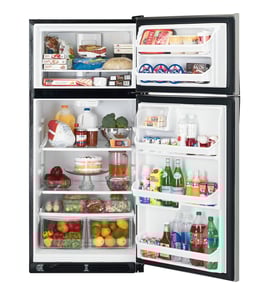


How do I tell what model Kenmore fridge I have?
To identify your Kenmore refrigerator model, look for the model and serial number label inside the fresh food (refrigerator) compartment. On Kenmore model 79579433210, the Use & Care Guide notes this ID label is on the interior liner of the refrigerator compartment; see the 79579433210 use & care manual.
Check these common label locations first (use a flashlight and wipe condensation off the liner):
- Inside the refrigerator compartment on a side wall (often upper right or upper left)
- On the ceiling of the refrigerator compartment near the light housing
- On the frame just inside the refrigerator door opening
- Less common: inside the freezer compartment on a side wall
Kenmore model numbers are typically a 3-digit prefix plus more digits. For this refrigerator, the model family shown in the manual is 795.7940* and 795.7943* (the asterisk is the color code). Your full model number will look like 79579433210 (no dots) on the label.
| What you see | What it means | Example |
|---|---|---|
| Model | Identifies the exact refrigerator design | 79579433210 |
| Serial | Identifies your specific unit | (varies) |
| 795.7943* | Model family with color code placeholder | 795.7943xx |
We use the exact model number to match the right diagrams, shelves, door bins, gaskets, and electrical parts. Even small model-number differences can change fit and wiring.
If the label is scratched or faded, take a close-up photo and zoom in. If you still cannot confirm it, compare the label text to the model format shown in the 79579433210 use & care manual.
Last updated: January 2026
How to tell cubic feet of Kenmore refrigerator by model number?
For Kenmore model 79579433210, the cubic-foot capacity cannot be identified from the model number alone using the model-specific information we have; this model’s numbering (795.7940* / 795.7943*) is a family identifier and the * is a color code, not a capacity code. The most reliable way is to look up the capacity in the 79579433210 use & care manual or calculate it by measuring the interior.
- Check the specifications section in the 79579433210 use & care manual.
- If you have the rating label inside the fresh-food compartment, compare any listed “capacity” value to the manual.
- If capacity is not listed where you’re checking, calculate interior volume (below).
- Empty the compartment you’re measuring (refrigerator section and freezer section separately).
- Measure usable interior dimensions in inches: height, width, depth (do not include door bins).
- Multiply:
H × W × Dto get cubic inches. - Divide by 1728 to convert to cubic feet.
- Measure to the nearest 1/8 inch for best accuracy.
- Measure the main cavity only; shelves and drawers reduce usable space.
- Add refrigerator + freezer cubic feet for total capacity.
| What you measure | Formula | Result |
|---|---|---|
| Interior volume (in³) | H × W × D | cubic inches |
| Cubic feet (ft³) | (H × W × D) ÷ 1728 | cubic feet |
Capacity affects food storage planning, energy use expectations, and choosing correctly sized replacement accessories (bins, shelves, and drawers) for your Kenmore top-mount refrigerator.
Last updated: January 2026
What is the average lifespan of 79579433210?
A Kenmore top-mount refrigerator like model 79579433210 typically lasts 13 years with normal household use. Keeping the condenser area clean, maintaining good door seals, and fixing water leaks quickly helps you reach that lifespan with fewer cooling and ice maker problems.
Most refrigerators fail early due to heat buildup, airflow restrictions, or moisture issues. For a top-mount design, these factors matter most:
- Dirty condenser coils or blocked airflow at the back or bottom
- Worn or leaking door gaskets that let warm air in
- Defrost system issues that cause frost buildup and poor airflow
- Water filter or water line leaks that create corrosion or ice buildup
- Frequent overloading that blocks vents and reduces circulation
Use this simple schedule to protect cooling performance and reduce strain on the compressor.
| Task | How often | Why it helps |
|---|---|---|
| Clean condenser coils and surrounding airflow path | Every 6 months | Lowers heat load and improves efficiency |
| Check door seal for gaps, tears, or looseness | Every 3 to 6 months | Prevents warm air leaks and frost |
| Replace water filter (if equipped) | Every 6 months | Helps prevent flow restriction and leaks |
| Wipe spills and clean interior | Monthly | Reduces odors and bacteria |
For model-specific care steps and cleaning guidance, follow the 79579433210 use and care guide.
If you see several of these at once, repairs can become more frequent:
- Freezer stays cold but fresh food section warms up
- Compressor runs almost constantly or is unusually loud
- Frost builds up quickly on the freezer back wall
- Water pooling under drawers or on the floor
- Door won’t stay closed or you feel air leaking around the gasket
A refrigerator that is running hot or leaking air uses more electricity and struggles to hold safe food temperatures. Simple upkeep often adds years of reliable service and helps avoid major sealed-system stress.
Last updated: March 2026