Owner’s manual


How do I tell what model my Kenmore dryer is?
Your Kenmore dryer’s model number is printed on the model and serial number label; on model 11082826102, that label is located at the top inside the dryer door well. Once you have the full model number, you can match the correct parts, wiring, and troubleshooting steps.
Where to look on Kenmore model 11082826102
Check these common label locations in this order:
- Top inside the dryer door well (most common for this model)
- Inside the door opening around the frame
- On the back panel of the cabinet
- Near the lint screen housing (some designs place labels nearby)
Use the location diagram and product record section in the 11082826102 owner's manual to confirm the exact label placement and how the model and serial number are formatted.
What the model number looks like (and why it matters)
Kenmore model numbers are typically a long string of digits. Many Kenmore dryers also start with a prefix such as 110. (a common Kenmore manufacturing prefix). Record the entire model number exactly as shown.
Why it matters
The model number determines which parts fit and which procedures apply, especially for items like the heating circuit and temperature sensing.
| What you’re doing | Why the model number is required |
|---|---|
| Ordering replacement parts | Ensures correct fit for the drum, heater, motor, and sensors |
| Looking up wiring/diagnostics | Matches the correct electrical design and component layout |
| Checking cycle features | Confirms control type and options for Auto Dry vs. Timed Dry |
Tips for writing it down correctly
- Copy every digit in order; do not shorten it.
- Record the serial number too; it helps when scheduling service.
- Take a clear photo of the label before it fades or gets scratched.
Last updated: February 2026
How to open Kenmore dryer control panel?
On the Kenmore electric dryer model 11082826102, the control panel (console) typically opens by removing the rear console screws, sliding the console slightly, then lifting it off so you can access the control bracket and wiring. Follow the screw locations and console handling notes in the 11082826102 owner's manual.
Before you start (safety and prep)
- Unplug the dryer (or switch off the breaker) before opening the console.
- Work from the back of the console when possible; most fasteners are there.
- Support the console as you lift it so you do not strain the wire harness.
- Keep screws grouped by location so reassembly is straightforward.
- If the dryer is stacked or tight to a wall, pull it forward enough to work safely.
Steps to open the control panel (common Kenmore 110-style console)
- Disconnect power.
- Move to the back of the console and remove the screws securing the console to the top or rear panel (often 1/4-inch hex-head screws).
- Slide the console back slightly (about 1 inch is common) to release tabs.
- Lift the rear of the console up, then lift it off and set it aside.
- If you need deeper access, remove the screws holding the control bracket/control board mounting and carefully position the assembly without pulling on wires.
What you will see once it is open
| Area | What it does | What to watch for |
|---|---|---|
| Timer/control board area | Runs cycles and options | Do not pull on connectors; release locking tabs first |
| Harness connectors | Carries power/signals | Take a photo before unplugging anything |
| Console tabs/clips | Holds console to top | Avoid prying hard; tabs can crack |
Why it matters
Opening the console the right way prevents broken mounting tabs, pinched wiring, and loose connections that can cause no-start symptoms or intermittent operation.
Last updated: February 2026
What are common problems with Kenmore dryers?
Common problems on a Kenmore electric dryer like model 11082826102 include no heat, long dry times, the drum not turning, and loud squealing or thumping. Most issues trace back to airflow restrictions (lint buildup or poor venting) or normal wear of drive and heating components.
Most common symptoms and what usually causes them
- Dryer runs but no heat: tripped breaker (often one of two), failed heating circuit parts, or a blown thermal cut-off from overheating.
- Long drying times: clogged lint screen, crushed or kinked vent, blocked exhaust hood, or a failing blower wheel.
- Drum will not turn: worn idler pulley, worn drum rollers, or a failing drive motor.
- Loud noise (squeal, rumble, thump): worn drum support rollers, idler pulley, or drum seal.
- Burning smell: lint accumulation in the cabinet or venting; a brief “new heat” odor can also happen after first heating.
Quick checks we recommend first (fast, high-impact)
- Clean the lint screen every load and wash it periodically if you use dryer sheets.
- Verify power: many electric dryers need two fuses/breakers; the dryer can run but not heat if one trips.
- Inspect venting: use heavy metal venting, avoid plastic or foil; fully extend flexible metal vent and remove excess to prevent sagging.
- Check the outside exhaust hood: make sure it opens freely and is not packed with lint.
Parts that commonly fix these problems on 11082826102
| Symptom | Common part to check/replace | Example part for this model |
|---|---|---|
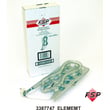
| No heat | Heating element | Dryer heating element WP3387747 |
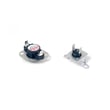
| No heat or overheating shutdown | Thermal cut-off kit | Dryer thermal cut-off fuse kit 279973 |
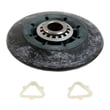
| Squealing/rumbling, drum drag | Drum rollers | Support WPW10314173 |
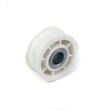
| Drum not turning, squeal | Idler pulley | Dryer idler pulley 279640 |
Why it matters
Good airflow prevents overheating, protects the heating system, and shortens dry times. The manual also warns that improper venting can cause moisture and lint to collect indoors, creating performance and indoor air quality problems.
For model-specific cleaning, venting, and troubleshooting steps, follow the 11082826102 owner's manual.
Last updated: February 2026
What size is a Kenmore Model 11082826102 dryer?
The Kenmore electric dryer model 11082826102 is a standard 27-inch class dryer. The installation diagram in the 11082826102 owner's manual shows a 27 in. width and a 38 in. minimum height for undercounter installations; plan extra space behind the dryer for the vent elbow.
Key dimensions and clearances to plan for
Use these sizing points when measuring your laundry area:
- Width: 27 in.
- Undercounter height (minimum): 38 in.
- Recommended side clearance: about 1 in. on each side (helps reduce noise transfer)
- Behind-dryer clearance (minimum): 5 1/2 in. for the exhaust vent with elbow
- Floor requirements: level within 1 in. slope under the entire dryer
Quick sizing table
| Measurement | What to plan for | Notes |
|---|---|---|
| Dryer width | 27 in. | Standard footprint for this model |
| Minimum undercounter height | 38 in. | For custom undercounter installs |
| Space behind dryer | 5 1/2 in. minimum | Allows vent elbow clearance |
| Side spacing | 1 in. recommended | Helps reduce vibration and noise |
Why it matters
Correct sizing prevents crushed venting, overheating from restricted airflow, and installation headaches. Leaving the proper rear clearance also makes it easier to service common wear items like the belt, drum rollers, and idler pulley.
Measuring tips we use
- Measure the opening width at the front and back (walls are not always square).
- Measure height to the lowest obstruction (countertop lip, shelf, or trim).
- Include the vent connection path and elbow depth in your rear clearance.
- Confirm the dryer sits level so sensor cycles tumble and dry correctly.
Last updated: February 2026