Owner’s manual
 Error Codes



What is the average lifespan of a Samsung fridge?
Most Samsung refrigerators, including the Samsung RF260BEAEWW bottom-mount style, typically last 10 to 15 years with normal household use. Consistent maintenance (cleaning coils, keeping doors sealed, and fixing cooling or ice issues early) is what most often determines whether you land closer to 10 or closer to 15.
Typical lifespan ranges (what we see most often)
| Appliance type | Typical lifespan | What shortens it fastest |
|---|---|---|
| Samsung refrigerator (average) | 10 to 15 years | Poor airflow, dirty condenser area, weak door seals |
| Most household refrigerators (all brands) | 10 to 20 years | Skipped maintenance, overheating compressor area |
What helps your RF260BEAEWW reach the high end of the range
- Keep the condenser area clean so the compressor can shed heat efficiently.
- Confirm doors close fully and gaskets seal all the way around.
- Avoid overpacking; blocked vents cause warm spots and longer run times.
- Set stable temperatures (frequent changes increase run time and frost risk).
- Address water leaks and ice buildup quickly to prevent fan and defrost problems.
For model-specific care and cleaning intervals, follow the RF260BEAEWW owner's manual.
Early warning signs that shorten lifespan
- Fridge or freezer temperatures drift, then recover repeatedly.
- Frost builds up on the back wall or you hear fan noise that comes and goes.
- Water puddles appear under crisper drawers or near the freezer.
- Doors need to be pushed to seal, or you see gaps in the gasket.
If you are chasing temperature swings, a failed sensor is a common cause; the refrigerator temperature sensor DA32-10104N is one of the components used to monitor temperatures.
Why it matters
A refrigerator that is struggling to cool runs longer and hotter, which increases wear on the compressor, fans, and control boards. Simple upkeep and quick repairs usually cost far less than replacing major cooling-system parts.
Last updated: February 2026
What is the most common problem with Samsung refrigerators?
The most common problem we see on Samsung refrigerators like model RF260BEAEWW is a cooling issue caused by frost or ice buildup around the evaporator area, which restricts airflow and makes the fresh food section warm even when the freezer still seems cold. Checking the defrost system and airflow components usually finds the cause.
Most common symptoms customers notice
- Refrigerator section warms up but freezer stays near normal
- Frost or a solid ice sheet on the back wall inside the freezer
- Fan noise changes (rubbing, buzzing) or the fan goes quiet
- Temperature swings, food spoils faster, or items freeze in the fridge
- Water pooling under crisper drawers (often tied to defrost drainage)
What typically causes it
On bottom-mount and French door designs, the most frequent root causes are in the defrost and airflow system.
| Likely cause | What it affects | Common clue |
|---|---|---|
| Defrost heater problem | Ice never melts off the evaporator | Heavy frost returns quickly after a manual defrost |
| Temperature sensor/thermistor issue | Defrost timing and temperature control | Erratic temps, defrost not initiating correctly |
| Drain restriction | Meltwater cannot exit during defrost | Ice buildup plus puddles in the fresh food section |
| Fan or airflow restriction | Cold air cannot circulate | Warm fridge, freezer “looks” fine |
Parts that often relate to these problems (RF260BEAEWW)
If troubleshooting points to a failed component, these are common matches for cooling and defrost complaints on this model:
- Refrigerator temperature sensor DA32-10104N
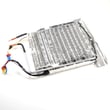
- Refrigerator defrost heater DA47-00424M
- Refrigerator drain tube DA97-04049D
For model-specific access panels, test points, and component locations, use the RF260BEAEWW owner's manual.
Why it matters
A restricted evaporator airflow problem usually gets worse over time; the compressor can run longer, temperatures drift, and ice buildup can spread into the fan area and drain path. Catching it early helps protect food and reduces repeat icing.
Last updated: February 2026
How do I find the model number on my RF260BEAEWW?
Your Samsung refrigerator’s model number is printed on the rating label; on RF260BEAEWW units it’s typically inside the fresh food compartment on a side wall near the crisper drawers, or on the ceiling near the top hinge area. Use that full model number to match parts and manuals.
Where to look on the refrigerator
Check these common rating-label locations first:
- Inside the refrigerator section on the left or right interior wall
- Near the crisper drawers (above or beside the drawers)
- On the ceiling of the fresh food compartment
- Around the door opening near the top hinge area
- On the back exterior panel (less common, but worth a quick check)
What the label looks like
The rating label is usually a white or silver sticker and may list several identifiers.
| Label item | What it’s used for | Example you might see |
|---|---|---|
| Model number | Correct parts and diagrams | RF260BEAEWW |
| Version code | Exact configuration match | Two digits after a slash or “/AA” style code |
| Serial number | Manufacturing date tracking | A longer alphanumeric string |
Tips to make sure you capture the right number
- Write down the model number exactly as printed (letters, numbers, and any slashes)
- If you see a version like “/AA-01”, record that too; it can affect part fit
- Take a clear photo of the label before ordering parts
- Use the model number when referencing diagrams in the owner's manual
Why it matters
Samsung refrigerators often have multiple versions that look the same but use different door bins, hinges, control boards, or ice maker parts. Using the full model and version code helps ensure the replacement part fits and the repair goes smoothly.
Last updated: March 2026