 Installation guide
 Owner’s manual
 Error Codes


How to tell if a dryer thermal fuse is blown?
On our Estate EGD4300TQ0 dryer, a blown thermal fuse typically shows no continuity when tested with a multimeter. Before replacing anything, we always address airflow first (lint screen and venting) because restricted airflow is the most common reason a thermal fuse opens.
- Unplug the dryer (disconnect power before servicing; see the safety notes in the EGD4300TQ0 owner’s manual).
- Access the blower housing area (thermal fuses are commonly mounted near the blower housing or exhaust duct).
- Label and remove the wires from the fuse terminals.
- Set a multimeter to continuity or lowest ohms.
- Touch probes to the fuse terminals:
- Beep or near 0 ohms: fuse is good.
- No beep or OL/infinite resistance: fuse is blown.
A thermal fuse usually blows because the dryer overheated. Fix the overheating cause first so the new fuse does not blow again.
- Clean the lint screen and confirm it is not coated with fabric softener residue.
- Check the vent hose for kinks, crushing, or long runs.
- Clean lint buildup from the exhaust duct and outside vent hood.
- Make sure the dryer is installed level and has adequate airflow around it.
| Symptom on EGD4300TQ0 | Most likely direction | What we check next |
|---|---|---|
| Dryer will not run at all | Safety circuit open (often thermal fuse) | Fuse continuity, door switch |
| Runs but shuts off mid-cycle | Overheating/airflow restriction | Venting, blower wheel |
| Long dry times, very hot cabinet | Poor airflow | Lint screen, ducting, blower |
If airflow checks out but performance is still poor, these model-compatible parts are commonly inspected during diagnosis:
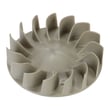
- Dryer blower wheel WP694089 (broken or loose wheel reduces airflow)
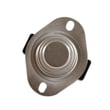
- Dryer operating thermostat WP3387134 (can contribute to overheating if it fails)
The thermal fuse is a one-time safety device designed to stop the dryer if temperatures get unsafe. Replacing it without correcting venting or airflow problems often leads to repeat failures and longer dry times.
Last updated: February 2026
What are common dryer part failures?
On the Estate EGD4300TQ0 dryer, the most common part failures show up as no heat, no tumble, long dry times, or the dryer shutting off. The usual culprits are airflow restrictions (lint and venting), wear parts in the drum drive, and heat-safety parts such as thermostats.
- Drum won’t turn: broken belt, worn idler pulley, or a failed motor
- Runs but no heat (gas model): weak gas valve coils, igniter, radiant sensor, or gas valve issues
- Takes too long to dry: crushed or kinked vent, clogged lint screen, restricted exhaust hood
- Stops mid-cycle or overheats: operating thermostat or high-limit thermostat opening due to heat buildup
- Won’t start: door switch, push-to-start switch, or a power supply issue (door not fully closed, breaker/fuse)
If symptoms match, these are frequent replacements for EGD4300TQ0:
| Symptom | Likely part | Example part for this model |
|---|---|---|
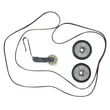
| Drum not tumbling | Drum belt or idler pulley | Dryer drum belt 341241, dryer idler pulley WP691366 |
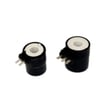
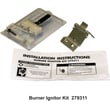
| No heat (gas) | Gas valve coils, igniter, radiant sensor | Dryer valve coil kit 279834, igniter 279311, dryer radiant sensor WP338906 |
| Overheating or cycling heat poorly | Operating or high-limit thermostat | Dryer operating thermostat WP3387134, dryer high-limit thermostat W11050897 |
| Won’t start | Door switch or start switch | Door switch WP3406105, dryer push-to-start switch WP3977456 |
These quick checks prevent repeat failures and wasted parts:
- Clean the lint screen before every load and make sure it seats firmly
- Inspect the vent path for kinks, crushing, or heavy lint buildup
- Use the straightest vent route possible and clamp joints (avoid screws into the duct)
- Confirm the dryer is level and the door closes fully
- If it will not run, verify power supply and breakers/fuses and that the door switch engages
Most “failed heat” and “long dry time” complaints start with restricted airflow, which can overheat the dryer and trip safety thermostats. Keeping venting correct helps drying performance and protects key parts.
For model-specific use, care, and venting guidance, follow the EGD4300TQ0 owner’s manual and the EGD4300TQ0 installation guide.
Last updated: February 2026
What are the main parts of a dryer?
The main parts of an Estate dryer like model EGD4300TQ0 are the drum and drive system (belt, idler pulley, motor), the airflow system (blower wheel, lint screen, venting), and the heat and safety controls (gas burner components, thermostats, sensors). For diagrams and locations, use the EGD4300TQ0 owner's manual.
- Tumble system: drum, drum baffles, belt, idler pulley; keeps clothes moving for even drying.
- Drive system: drive motor and belt; turns the drum and blower.
- Airflow system: blower wheel, lint screen, lint chute, exhaust duct; moves air through the drum and out of the home.
- Heating system (gas models): igniter, radiant sensor, gas valve and coils, burner assembly; creates and controls heat.
- Temperature and safety controls: operating thermostat, high-limit thermostat/thermal cut-off; prevents overheating.
- Door and start controls: door switch, push-to-start switch, door strike; allows safe starting and operation.
These are some of the most frequently serviced items on this model:
- Dryer drum belt 341241 (drum won’t turn, squealing, slipping)
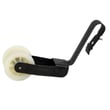
- Dryer idler pulley (belt tension, chirping or squealing)
- Dryer blower wheel (rumbling, weak airflow)
- Dryer operating thermostat (cycling heat issues)
- Gas valve coil kit (heats briefly then stops)
| Symptom | Most likely system | Parts to check first |
|---|---|---|
| Runs but no heat | Heating or safety controls | Igniter, radiant sensor, thermostats, gas valve coils |
| Long dry times | Airflow | Lint screen, lint chute, venting, blower wheel |
| Drum won’t tumble | Drive/tumble | Belt, idler pulley, motor |
| Won’t start | Door/start controls or power | Door switch, push-to-start switch, power supply |
Knowing which system matches your symptom helps you troubleshoot faster and avoid replacing the wrong part. It also supports safer operation; the manual emphasizes cleaning the lint screen regularly and keeping the exhaust area clear to reduce fire risk.
Last updated: February 2026








