Owner’s manual
 Error Codes



What is the bottom compartment of a fridge called?
In a GE PYE22KSKOSS bottom-mount refrigerator, the “bottom compartment” most often refers to the freezer compartment (the pull-out drawer at the bottom). If you mean the bottom area inside the fresh food section, that is typically a crisper drawer used for produce.
Common names you might hear
Depending on which “bottom” you mean, these are the most common terms:
- Freezer drawer or bottom freezer compartment (the large pull-out section at the very bottom)
- Crisper drawer (produce drawer in the refrigerator section)
- Pan or storage drawer (a general term some owners use for lower drawers)
- Deli drawer (on some models, a wide drawer for meats and cheeses)
Quick guide: which compartment is it?
Use this to match the name to what you are looking at.
| What you see | Most common name | What it’s for |
|---|---|---|
| Large pull-out drawer at the very bottom | Freezer drawer | Frozen food storage |
| Clear drawers at the bottom of the refrigerator section | Crisper drawers | Produce and humidity control |
| Wide, shallow drawer under shelves (if equipped) | Deli drawer | Meats, cheeses, snacks |
Why it matters
Using the right compartment name helps when you are following cleaning and care steps, adjusting storage, or looking up the correct removal and reinstallation instructions in the owner's manual. It also helps you describe issues like frost, door sealing, or drawer alignment more clearly.
Helpful tips for identifying it fast
- If it slides out from the floor level, it is the freezer drawer.
- If it is inside the refrigerator section and holds fruits and vegetables, it is a crisper drawer.
- If you are troubleshooting door-related issues (like alarms or sealing), start with the door and drawer guidance in the manual and related GE articles.
Last updated: February 2026
How to remove bottom grille on GE refrigerator?
On the GE PYE22KSKOSS bottom-mount refrigerator, the bottom grille (base grille/toe grille) typically comes off by removing any retaining screws and then pulling the grille straight out to release the locking tabs. Reinstall by lining it up and sliding it back into place.
Before you start
- Unplug the refrigerator or switch off power at the breaker (safer around wiring and fans).
- If the unit is tight to the wall, raise the front leveling legs slightly so you can pull the refrigerator straight out without scraping the floor.
- Protect the floor with cardboard or a thin panel if you need to move the refrigerator.
- Use a flashlight to spot screws and tab locations along the top edge of the grille.
Steps to remove the bottom grille
- Look along the left and right ends of the grille for Phillips-head screws (some versions use 2 screws).
- Remove the screws and set them aside.
- Grip the grille near both ends.
- Pull the grille straight toward you to pop it off the retaining clips or tabs.
- If it resists, pull from one end slightly, then the other; avoid twisting hard so the plastic tabs do not crack.
Reinstall steps
- Align the grille with the openings and tabs.
- Slide or press it into place until it sits flush.
- Reinstall the screws snugly (do not overtighten).
Quick troubleshooting if it will not come off
| What you see | Most likely cause | What we do next |
|---|---|---|
| Grille moves but will not release | Hidden screw(s) still installed | Recheck both ends and the bottom edge for fasteners |
| One side releases, other side stuck | Tab is hung up | Pull evenly with two hands, alternating sides |
| Plastic feels brittle | Cold plastic or age | Warm the room slightly and pull gently to protect tabs |
Why it matters
Removing the base grille gives access for cleaning dust, checking for water drips, and improving airflow, which helps cooling performance and can reduce compressor run time.
For model-specific handling notes and safe moving guidance, use the PYE22KSKOSS owner's manual.
Last updated: February 2026
What is the most common problem with GE profile refrigerators?
The most common GE Profile refrigerator issues are ice maker and water dispenser problems (no ice, slow water flow, leaks) and temperature or cooling complaints. On the GE PYE22KSKOSS, these symptoms usually trace back to airflow restrictions, water supply problems, or normal maintenance items like filters and coil cleaning.
Most common symptoms we see
- Ice maker not making ice or making small/hollow cubes
- Water dispenser flow is slow, spurts, or tastes off
- Water leaking under the refrigerator or inside the fresh food section
- Refrigerator is warm but freezer seems closer to normal (or vice versa)
- Door alarm beeping because a door is not sealing or closing fully
Quick checks that fix many “common problems”
Start with these basics before replacing parts:
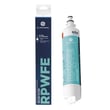
- Replace the water filter on schedule; a restricted filter commonly causes slow dispensing and weak ice production (many GE Profile models use an RPWFE-style cartridge; confirm for your unit in the owner's manual).
- Verify water supply: fully open the shutoff valve and check for a kinked water line.
- Clean condenser coils (if accessible); dirty coils can cause poor cooling and longer run times.
- Confirm door sealing: check for gaps, torn gasket areas, or bins preventing full closure.
- Reset nuisance alarms after correcting the cause.
| Problem area | What you notice | Common root cause | Best first step |
|---|---|---|---|
| Ice maker | No ice, slow ice | Filter restriction, low water pressure, frozen fill tube | Replace filter; confirm water supply |
| Water dispenser | Slow flow, sputtering | Filter restriction, air in line | Replace filter; purge air |
| Cooling | Warm temps, food spoiling | Dirty coils, blocked vents, fan/airflow issue | Clean coils; check airflow paths |
| Doors/alarm | Beeping, moisture, frost | Door not closing, misalignment | Check seal and alignment |
Why it matters
Ice and water issues can look like “the refrigerator is failing,” but they are often caused by a restricted filter or a simple water supply problem. Cooling complaints are frequently maintenance-related (coils, airflow, door sealing) and can be corrected before food safety becomes a concern.
Helpful DIY guides for GE Profile owners
- Use how to replace the water filter in a GE refrigerator for filter selection and replacement steps.
- If the alarm keeps sounding after you fix the door issue, follow how to reset the door alarm on a GE refrigerator.
- When symptoms point to a control or sensor issue, check GE refrigerator error codes to match the display code to the likely failure.
Last updated: February 2026