

How to figure out dryer model number?
Your dryer’s model number is printed on the appliance ID label. On Kenmore electric dryers like model 11096585210, we most often see that label on the door opening (door jamb) or on the back of the cabinet near the top.
Where to look first (fastest checks)
- Open the dryer door and check the frame just inside the opening (door jamb)
- Look along the inside edge of the front panel near the lint screen housing
- Check the back of the dryer cabinet near the top (upper left or upper right)
- Look on the side panel near the front edge
- If there is a lower front access panel, check behind it (less common on electric models)
What the label looks like
Most Kenmore labels include:
- Model number (example: 11096585210)
- Serial number (unique to your unit)
- Electrical rating information (volts/amps)
- Sometimes a barcode or QR-style code
Why the model number matters
We use the model number to match the correct parts and diagrams for your exact dryer configuration. That prevents ordering a look-alike part that does not fit.
Quick part-matching examples for this model
| What you’re fixing | Common part to check | Example part on this model page |
|---|---|---|
| Drum not turning | Belt or motor | Drum belt 341241, drive motor 279827 |
| No heat or weak heat | Heating circuit | Element 279838, cut-off kit 279816 |
| Door won’t start dryer | Door switch/latch | Door switch W10820036, catch 279570 |
If you can’t find the label
If the label is worn or missing, use the parts list for Kenmore 11096585210 to identify assemblies visually (door, rear panel, bulkhead) and narrow down the correct configuration.
Last updated: February 2026
What is the lifespan of a Kenmore dryer?
Most Kenmore dryers typically last 10 to 13 years. With consistent lint and vent maintenance and timely replacement of wear parts, many Kenmore electric dryers like model 11096585210 run 15 years or longer, especially when airflow stays strong and overheating is avoided.
Typical lifespan ranges (what to expect)
Lifespan depends most on heat exposure, airflow restriction, and how often the dryer runs.
- Light use (1 to 3 loads/week): often 13 to 18 years
- Average use (4 to 7 loads/week): often 10 to 13 years
- Heavy use (multiple loads/day): often 7 to 10 years
| Usage pattern | What usually wears first | Common symptom |
|---|---|---|
| Heavy loads, frequent cycles | Drum belt, motor pulley | Squealing, thumping, drum not turning |
| Restricted venting | Thermal cut-off, high-limit thermostat, heating element | No heat, shuts off early, long dry times |
| Door slamming, frequent opening | Door switch, latch/catch | Won’t start, stops when door moves |
Maintenance that extends dryer life
These steps reduce overheating and strain on the motor and heater.
- Clean the lint screen every load and wash it occasionally to remove residue
- Keep the vent run short and clear; check airflow at the outside hood
- Avoid overloading; heavy loads stretch belts and stress the drive system
- Listen for new noises and address them early (belt, rollers, blower wheel)
- If dry times increase, fix airflow first before replacing heating parts
Parts that commonly determine “end of life” (and are often worth replacing)
If your Kenmore 11096585210 tumbles poorly, overheats, or gets noisy, these are frequent fixes:
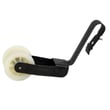
- Drum belt 341241 (drum won’t turn, slipping, squeal)
- Element 279838 (no heat or weak heat after airflow is confirmed)
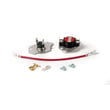
- Cut-off kit 279816 (overheating protection opens, dryer won’t heat)
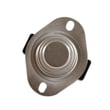
- Dryer high-limit thermostat WP3390291 (cycles heat off too soon, overheating protection)
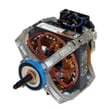
- Drive motor 279827 (hums, won’t start, intermittent tumbling)
Why it matters
A dryer that runs hot or can’t move air wears out heaters, thermostats, and wiring faster. Keeping airflow strong is the single best way to protect the heating system and extend the overall lifespan.
Last updated: February 2026
How to identify a dryer?
To identify what type of dryer you have, we start with the power and fuel connections. Your Kenmore 11096585210 is an electric dryer, which typically uses a 240-volt outlet and has no gas supply line connected to the back.
Quick checks (what to look for)
- Look at the outlet plug: electric dryers usually have a larger, heavy-duty plug (commonly 3-prong or 4-prong) for 240V.
- Check for a gas line: gas dryers have a flexible gas connector attached to the dryer.
- Look for a vent duct: most dryers (gas or electric) vent outside; venting alone does not confirm gas vs. electric.
- Check the model tag: the model number label is usually inside the door opening or on the cabinet opening.
- Confirm the model number: once you have it, match it to the parts list for the correct diagrams and parts.
Electric vs. gas dryer: fast comparison
| What you see | Electric dryer | Gas dryer |
|---|---|---|
| Power cord/outlet | 240V (larger plug) | 120V (standard-looking plug) |
| Gas connector at back | No | Yes |
| Heat source | Electric heating element | Gas burner assembly |
Why it matters
Correctly identifying gas vs. electric helps you choose the right troubleshooting steps and replacement parts. For example, electric dryers commonly use a heating element and thermostats, while gas dryers use igniters and gas valve components.
Parts that commonly relate to “no heat” on this electric model
If your dryer runs but does not heat, these model-matched parts are common suspects:
- Element 279838 (electric heat source)
- Cut-off kit 279816 (thermal safety devices)
- Dryer high-limit thermostat WP3390291 (overheat protection)
For more dryer basics and component names, we recommend: what are the main parts of a clothes dryer.
Last updated: February 2026
How to tell if a dryer thermostat is bad?
A bad dryer thermostat in your Kenmore 11096585210 typically shows up as no heat, overheating, or dry times that keep getting longer. The most reliable way to confirm it is with a multimeter continuity test on the thermostat terminals (and comparing results at room temperature versus when warmed).
Common signs the thermostat is failing
- Dryer runs but clothes stay damp (little to no heat)
- Dryer gets too hot, shuts off early, or trips a breaker
- Burning smell or unusually hot cabinet or exhaust air
- Heat cycles seem erratic (temperature swings more than normal)
- Thermal safety devices keep opening (often caused by overheating)
How we test a dryer thermostat (quick, practical method)
- Unplug the dryer (electric shock hazard).
- Access the thermostat (often on the heater housing or blower housing).
- Label and remove the wires from the thermostat terminals.
- Set a multimeter to continuity or lowest ohms.
- Test across the thermostat terminals:
- Many cycling thermostats show continuity at room temperature.
- A thermostat that reads open (no continuity) at room temperature is typically failed.
- If you can safely warm the thermostat (controlled heat), the reading should change state as it cycles.
Thermostat vs other common “no heat” causes
If the thermostat tests good, these parts are frequent culprits on electric dryers:
| Symptom | More likely cause | What to check next |
|---|---|---|
| No heat at all | Heating circuit open | Element 279838, wiring, timer contacts |
| Overheats, then stops heating | Airflow restriction or high-limit issue | Venting, lint buildup, dryer high-limit thermostat WP3390291 |
| Runs but shuts down from heat | Safety cut-off opening | Cut-off kit 279816, venting |
Why it matters
A thermostat that does not regulate temperature correctly can cause poor drying, fabric damage, and repeat failures of heat-safety parts. Before replacing anything, we always check airflow (lint screen, blower area, and vent duct) because restricted airflow can mimic thermostat problems.
For more DIY background on dryer components and how they work together, use what are the main parts of a clothes dryer.
Last updated: February 2026