Installation guide
 Owner’s manual


How to check Kenmore dryer model number?
For Kenmore gas dryer model 11071402312, we check the model number on the model and serial label. It’s typically on the dryer cabinet frame just inside the door opening, or on the back of the dryer near the top. See the 11071402312 installation guide for the “Model number” and “Serial number” fields.
Where to look first (fastest checks)
- Open the dryer door and look around the door opening on the cabinet frame
- Check the back panel near the top edge
- Look for a sticker or metal plate labeled Model and Serial
- Wipe dust off the label so the full number is readable
- Write down the full model number exactly as shown (all digits)
What the label looks like and what to record
Most Kenmore dryer labels list both items. Record both so we can match parts and diagrams correctly.
| Item on label | What it’s used for | Example format |
|---|---|---|
| Model number | Identifies the exact dryer design | 11071402312 |
| Serial number | Identifies production run details | Letters and numbers |
Why it matters
Kenmore model numbers can look similar, but small differences change the correct parts (for example, a belt, igniter, or thermostat). Using the exact model number helps us select the right replacement part the first time.
If the label is missing or unreadable
- Check for a faint “shadow” of the printing under bright light
- Take a close-up photo and zoom in to read worn characters
- If the door label is gone, the back label is often still intact
Last updated: February 2026
What size is a Kenmore Model 11071402312 dryer?
The Kenmore gas dryer model 11071402312 is approximately 27 inches wide, 27 3/4 inches deep, and 43 3/8 inches tall (cabinet size). For installation planning, we also allow extra space for the exhaust elbow and door swing; see the 11071402312 installation guide.
Dimensions and clearances to plan for
These are the key measurements we use most often when fitting the dryer into a laundry room, closet, or recessed area:
- Width: 27" (about 705 mm)
- Depth: 27 3/4" (about 705 to 737 mm shown, depending on door style)
- Height: 43 3/8" (about 1102 mm)
- Rear clearance (typical minimum): 5 1/2" behind the dryer for the vent elbow
- Closet/recessed installs: allow additional spacing for airflow and service access
Quick reference table
| Measurement | Approx. size | What it affects |
|---|---|---|
| Width | 27" | Fit between cabinets or walls |
| Depth | 27 3/4" | Space to the back wall and vent routing |
| Height | 43 3/8" | Countertop clearance, stacking space above |
| Rear clearance | 5 1/2" minimum | Room for exhaust vent elbow |
Why it matters
Correct sizing prevents crushed or kinked venting (which increases dry time) and helps avoid installation issues in tight closets. We also plan clearance so the door opens fully and the dryer can be leveled for proper tumbling.
Related installation tips (worth checking)
- Use the straightest vent path possible and avoid unnecessary 90° turns.
- Don’t use screws or duct tape that protrude into the duct; they can catch lint.
- Keep the dryer in an area above 45°F for normal automatic cycle operation.
- For garage installs, follow the minimum height and safety spacing guidance.
Last updated: February 2026
What is the PF code on a Kenmore dryer?
PF on a Kenmore dryer means power failure; the dryer detected an interruption in electrical power during a cycle. On Kenmore model 11071402312, press Stop/Clear to remove the code, then restart the cycle once power is stable.
What to do when PF appears
- Press Stop/Clear to clear the display.
- If the load is still wet, reselect the cycle and press Start.
- Check that the dryer plug is fully seated in the outlet.
- Avoid using an extension cord; plug the dryer directly into a properly grounded outlet.
- If PF happens repeatedly, test the outlet for a loose connection or voltage drop.
Quick checks that prevent repeat PF codes
Power interruptions are often caused by a weak connection, a tripped breaker, or a failing start circuit.
- Reset the household breaker (turn it fully off, then on).
- Inspect the power cord and terminal block area for heat damage (unplug first).
- If the dryer will not restart reliably, check the start switch operation.
Parts that can be involved
| Symptom with PF | Common cause | Example part for this model |
|---|---|---|
| PF shows, then dryer will not start | Start switch not closing | Dryer push-to-start switch WP3977456 |
| PF shows frequently in same outlet | Loose outlet or cord connection | Outlet/cord (house wiring item) |
| PF after a bump or door slam | Intermittent connection in control/start circuit | Start switch or wiring connection |
Why it matters
A single PF code is usually harmless, but frequent PF events can interrupt sensor cycles and leave clothes damp. Repeated power interruptions can also point to an electrical issue that should be corrected to keep the dryer running safely and consistently.
Where to confirm the control panel steps
For the exact button names and restart procedure for model 11071402312, follow the control panel instructions in the 11071402312 owner’s manual.
Last updated: February 2026
How to change a belt on a Kenmore 100 series dryer?
On Kenmore gas dryer model 11071402312, changing the drum belt means unplugging the dryer, opening the cabinet, releasing belt tension at the idler pulley, swapping the belt, then re-tensioning and reassembling so the drum turns smoothly.
Before you start (safety and prep)
- Unplug the dryer from the wall outlet.
- Shut off the gas supply valve (gas dryer safety step).
- Let the dryer cool completely.
- Protect the floor and your hands; cabinet edges can be sharp.
- Keep screws organized by panel (top, front, console).
For model-specific cabinet access and reassembly details, follow the 11071402312 installation guide.
Belt replacement steps (typical Kenmore 110-style cabinet)
- Remove the lint screen, then remove the screws that secure the lint screen housing (if equipped).
- Lift the top panel (release spring clips with a putty knife a few inches in from each front corner).
- Remove the front panel (and door switch connector if present), then lift the drum slightly to access the belt path.
- Reach under the drum to the idler pulley; push the idler to relieve tension and slip the belt off the motor pulley.
- Pull the old belt off the drum.
- Install the new belt around the drum with the grooved side against the drum.
- Route the belt through the idler pulley and around the motor pulley; rotate the drum by hand 1 to 2 turns to verify the belt tracks correctly.
- Reinstall the front panel and top, reconnect any wiring, restore gas and power, then run a short timed dry test.
Recommended replacement belt for this model: belt 341241.
Quick checks after reassembly
- Drum turns by hand without binding
- Belt stays centered on the drum
- No squealing or thumping
- Dryer starts and runs without burning smell
When to replace more than just the belt
If the belt broke due to worn rollers or a seized idler, replacing the wear items together prevents repeat failures.
| Symptom | Most common cause | What to replace |
|---|---|---|
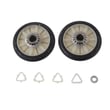
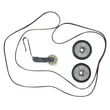
| Squealing | Worn idler/rollers | Dryer repair kit 4392065 |
| Thumping | Flat-spotted rollers | Dryer repair kit 4392065 |
| Drum hard to turn | Seized roller/idler | Dryer repair kit 4392065 |
Why it matters
A correctly installed belt keeps the drum speed steady, improves drying performance, and reduces strain on the drive motor and idler pulley.
Last updated: February 2026
How much does it cost to replace a heating element in a Kenmore dryer?
For the Kenmore gas dryer model 11071402312, you typically will not replace an electric “heating element”; heat is produced by the gas burner system. If your dryer is not heating, the cost usually comes from replacing ignition or safety parts (plus labor), not an element.
Typical cost ranges (parts and labor)
Here are common price ranges customers see for a no-heat repair on a Kenmore gas dryer like 11071402312:
- DIY parts only: about $15 to $300+, depending on what failed
- Professional repair total: about $150 to $400 (trip, diagnosis, parts, labor)
| Repair scenario (gas dryer) | Common parts involved | Typical parts cost | Typical total with labor |
|---|---|---|---|
| No ignition (no flame) | Igniter, radiant sensor | $25 to $70 | $150 to $350 |
| Heats briefly then stops | Operating thermostat, thermal cut-off | $15 to $50 | $150 to $350 |
| Gas valve issue | Valve assembly or burner assembly | $150 to $300+ | $250 to $450 |
Parts that commonly fix “no heat” on this model
If your Kenmore 11071402312 tumbles but does not heat, these model-matched parts are frequent fixes:
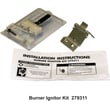
- Igniter 279311 (lights the burner)
- Dryer radiant sensor WP338906 (confirms flame/heat at the burner)
- Dryer operating thermostat WP3387134 (regulates drum temperature)
- Dryer thermal cut-off fuse kit W11050897 (opens if overheating occurs)
- Gas burner W10823508 or valve assembly 279923 (when the gas valve or burner assembly fails)
Quick checks before you buy parts
These checks often solve “no heat” without replacing anything:
- Clean the lint screen and confirm strong airflow at the outside vent hood
- Verify the gas supply shutoff valve is fully open
- Run the dryer for 5 minutes and check for heat at the door opening
- Confirm the cycle and temperature settings are not “air fluff” or “no heat”
- If the dryer overheats or takes too long, inspect the vent for kinks or blockage
Why it matters
Gas dryers can stop heating for safety reasons (overheating, poor venting, flame sensing). Fixing airflow and replacing the correct burner-related part prevents repeat shutdowns and helps drying times return to normal.
For model-specific operating and heating checks, follow the steps in the 11071402312 installation guide.
Last updated: February 2026
How do I know if my Kenmore dryer thermal fuse is blown?
On Kenmore gas dryer model 11071402312, a blown thermal fuse commonly shows up as a dryer that will not start, or a dryer that runs but won’t heat. The sure way to confirm is to unplug power and test the fuse for continuity with a multimeter, then fix the overheating or airflow problem that caused it.
Common symptoms you can check first
- Dryer won’t start even though the door is closed and the outlet has power
- Dryer starts and tumbles but there’s no heat (gas burner never ignites)
- Cycle stops early or acts “dead” after a short run
- Burning smell or very hot cabinet (often tied to restricted venting)
- Lint buildup around the lint screen housing or exhaust duct
How we recommend testing the thermal fuse (safe, accurate)
- Unplug the dryer (and shut off gas if you’re opening the cabinet). Follow the safety steps in the 11071402312 installation guide.
- Access the thermal fuse (location varies by design; it’s often on the blower housing or exhaust duct).
- Remove at least one wire from the fuse terminal.
- Set a multimeter to continuity or ohms and test across the fuse terminals.
What the meter reading means
| Meter result | What it means | Next step |
|---|---|---|
| Beep or near 0 ohms | Fuse is good | Keep troubleshooting (door switch, start switch, motor, timer) |
| No beep or OL/infinite | Fuse is blown | Replace the fuse and correct airflow/overheating cause |
Why the fuse blows (and what to fix so it doesn’t happen again)
A thermal fuse is a one-time safety device; it opens when the dryer overheats. Overheating is usually caused by poor airflow.
- Clean the lint screen and lint screen housing
- Check the vent for kinks, crushing, or long runs
- Clear the outside vent hood and confirm strong airflow
- Clean lint from the blower area if accessible
- Run the installation checklist airflow checks in the 11071402312 installation guide
Parts that are often involved in “no heat” complaints
If your fuse tests good but the dryer still won’t heat, these model-compatible parts are common suspects:
- Dryer thermal cut-off fuse kit W11050897 (overheat protection components)
- Dryer operating thermostat WP3387134 (temperature regulation)
- Dryer radiant sensor WP338906 (confirms burner flame)
- Igniter 279311 (lights the gas)
Why it matters
Replacing a blown fuse without fixing the venting or overheating cause often leads to repeat failures, longer dry times, and higher gas use.
Last updated: February 2026