Installation guide
 Owner’s manual


What is an electric dryer?
An electric dryer uses a 240-volt power supply to heat air with an internal heating element, then a blower moves that hot air through tumbling clothes to dry them and exhaust moisture through the vent. For your Crosley CED7006GW0, wiring and grounding details are in the CED7006GW0 installation guide.
How an electric dryer dries clothes
Electric dryers rely on a few core systems working together:
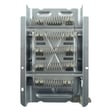
- Heating element creates heat (common replacement: dryer heating element 279838)
- Blower wheel pushes air through the drum and out the exhaust
- Drum and drive system tumbles the load for even drying
- Thermostats and fuses regulate temperature and protect against overheating
- Vent system carries moist air outside (restricted venting causes long dry times)
Power and electrical basics (what to expect)
Most electric dryers like the Crosley CED7006GW0 are designed around these typical requirements:
| Item | Typical electric dryer requirement | Why it matters |
|---|---|---|
| Supply voltage | 240 VAC | Needed for the heater to produce heat |
| Circuit | Dedicated dryer circuit | Prevents nuisance trips and low heat |
| Protection | 2 fuses or a 2-pole breaker | Dryer can run but not heat if one side trips |
Quick checks if the dryer runs but has no heat
If the drum turns but clothes stay damp, these are the most common causes:
- One leg of the 240V supply is out (tripped breaker or blown fuse)
- Vent or lint screen is restricted (poor airflow)
- Failed heater or heat control parts (element, thermostat, thermal cut-off)
- Incorrect cycle or temperature selection
Why it matters
Knowing whether you have an electric dryer helps you troubleshoot correctly. Electric models often “run” even when heat is missing because they can lose half the 240V supply; airflow problems also make electric dryers take a long time to dry.
Last updated: January 2026
What are common dryer part failures?
On the Crosley CED7006GW0 dryer, the most common part failures usually show up as no heat, won’t start, won’t tumble, or loud/unusual noises. Many of these problems trace back to airflow restrictions (lint buildup) that cause overheating and repeated safety shutoffs; see the CED7006GW0 owner’s manual for model-specific troubleshooting steps.
Most common failures and what you’ll notice
- No heat or weak heat: clothes stay damp; cycle runs but doesn’t dry well
- Won’t start or stops quickly: drum never begins turning; controls respond but motor doesn’t run
- Won’t tumble: motor runs but drum doesn’t move, or you hear a hum
- Unusual sounds: squealing, thumping, scraping, or rattling
- Overheating symptoms: very hot cabinet, burning smell, repeated thermal cutoffs
Parts that commonly fail on this model
These are frequent culprits for the symptoms above on dryers like the CED7006GW0:
| Symptom | Common failing part | Example part for this model |
|---|---|---|
| No heat | Heating circuit component | Dryer heating element 279838 |
| Won’t start | Door safety circuit | Dryer door switch WP3406107 |
| Long dry times | Airflow and temperature control | Dryer operating thermostat WP3387134 |
| Overheats then quits heating | Safety limit device | Dryer high-limit thermostat WP3977767 |
| Squealing or thumping | Wear items in drum support/drive | Dryer repair kit 4392065 |
Quick checks we recommend before replacing parts
- Confirm power: many electric dryers can tumble with a partial power issue; the manual notes electric dryers typically need 240 volts and may use two fuses/breakers.
- Make sure the door fully closes: a misaligned strike or a bad door switch can prevent starting.
- Press and hold Start: the manual notes the PUSH TO START control may need to be held until the drum begins moving.
- Check airflow: clean the lint screen and verify the vent is not crushed or clogged.
- Listen for clues: clicking can be normal on gas models; scraping/rattling often points to items caught at drum edges.
Why it matters
Catching airflow problems early helps prevent overheating that can damage the heating element, thermostats, and wiring. It also restores normal dry times and reduces repeat failures.
Last updated: January 2026
How do you fix a dryer that only blows cold air?
If your Crosley dryer model CED7006GW0 runs but only blows cold air, the most common fixes are restoring full power (electric models need two fuses or a 2-pole breaker), confirming the correct 240-volt supply, and correcting airflow restrictions. Use the CED7006GW0 owner's manual troubleshooting steps to narrow it down fast.
Quick checks that solve most “no heat” complaints
- Reset both sides of the breaker (or replace both fuses); the drum can tumble with only one leg of power.
- Confirm 240 VAC supply at the outlet (electric dryers require 240-volt power).
- Clean the lint screen and inspect the vent run for crushing or heavy lint buildup.
- Verify vent size is 4-inch (102 mm) diameter and connections are secure.
- Check room temperature; proper cycle operation requires temperatures above 45°F (7°C).
Likely failed parts (after power and venting are confirmed)
If power and airflow are correct, heat is usually lost due to a failed heating or safety component.
| Symptom | Common cause | Example part for CED7006GW0 |
|---|---|---|
| Tumbles, no heat at all | Open heating circuit | Dryer heating element 279838 |
| Heats briefly, then stops | Overheating from restricted airflow or a thermostat issue | Dryer high-limit thermostat WP3977767 |
| No heat and dryer may stop mid-cycle | Safety cut-off opened | Amana dryer thermal cut-off fuse kit, 309-degree f W10900067 |
Why it matters
A dryer that blows cold air is often a power or venting issue, not just a bad heater. Fixing airflow first helps prevent repeat failures of the heating element, high-limit thermostat, and thermal cut-off.
What we recommend doing next
- Start with the breaker/fuses and 240-volt verification.
- Confirm the vent is 4-inch and not kinked; avoid crushing the vent when moving the dryer.
- If airflow and power are good, test the heater and thermostats for continuity and replace the failed component.
Last updated: January 2026
What connections does a dryer need?
For the Crosley CED7006GW0 dryer, you need the correct electrical connection (a dedicated 30-amp dryer circuit using a 3-wire or 4-wire power supply connection) and, if it is a gas setup, a 3/8-inch NPT gas supply connection. Always follow the wiring and hookup details in the CED7006GW0 installation guide.
Connections you may need (depending on electric vs. gas)
- Electrical supply: Single-phase 120/240V, 60 Hz (or 120/208V if specified on the rating plate) on a separate 30-amp circuit, fused on both sides of the line.
- Power cord type: 3-wire or 4-wire power supply connection.
- Gas supply (gas models/installations): Dryer gas pipe is 3/8-inch male pipe thread (3/8-inch NPT).
- Venting: A properly installed exhaust vent to the outdoors (required for safe drying performance).
- No extension cord: Do not use an extension cord for the dryer.
3-prong vs. 4-prong dryer cord (what to use)
Many installations use a 4-wire connection, especially in homes built after 1996, remodeled dryer circuits after 1996, and mobile homes.
| Cord type | Typical where used | What changes at the terminal block |
|---|---|---|
| 4-wire (4-prong) | Newer homes, remodeled circuits, mobile homes | Neutral and ground are separated; cabinet is isolated from neutral |
| 3-wire (3-prong) | Older installations where allowed by code | Neutral and ground are bonded per the installation instructions |
Why it matters
Using the right electrical and gas connections helps prevent nuisance shutdowns, poor heating, and unsafe conditions. A correct 4-wire or 3-wire hookup also ensures the dryer cabinet is grounded the way your local code requires.
Quick checklist before you start
- Confirm whether your installation requires 3-wire or 4-wire.
- Verify you have a dedicated 30-amp dryer circuit.
- If connecting gas, confirm the dryer uses a 3/8-inch NPT connection and use the correct adapter fittings.
- Avoid extension cords and damaged power cords.
- Follow the step-by-step terminal block and gas hookup instructions in the CED7006GW0 installation guide.
Last updated: January 2026