Owner’s manual
 Error Codes


How to tell cubic feet of Kenmore refrigerator by model number?
For Kenmore model 79570329310, the model number alone usually does not state the exact cubic-foot capacity; the most reliable way is to look up the capacity in the 79570329310 owner's manual or estimate it by measuring the usable interior space and converting cubic inches to cubic feet.
Best ways to find the cubic feet
- Check the manual/specs first: Capacity is typically listed in the specifications section of the 79570329310 owner's manual.
- Look for a rating label: Some refrigerators list total capacity on a product label (often inside the fresh food section or on a side wall).
- Estimate by measurement: Measure the interior and convert to cubic feet (best when you need a quick approximation).
- Use the model prefix as a clue (not a guarantee): Kenmore 795 models are commonly LG-built; the digits still do not reliably encode capacity.
How to estimate cubic feet by measuring
- Empty the compartment enough to measure accurately.
- Measure width x depth x height of the usable interior space in inches.
- Multiply to get cubic inches.
- Divide by 1,728 to convert to cubic feet.
Quick conversion table
| What you have | Convert to | Formula |
|---|---|---|
| Cubic inches | Cubic feet | cubic inches ÷ 1,728 |
| Inches (W x D x H) | Cubic inches | W x D x H |
Tips so your estimate is closer to “real” capacity
- Measure each compartment separately (fresh food and freezer), then add them.
- Use usable space, not the outer cabinet size.
- Expect your estimate to differ from the published rating because shelves, ducts, and bins reduce usable volume.
Why it matters
Knowing cubic feet helps you compare refrigerators accurately, choose the right storage accessories, and confirm whether a replacement unit will meet your household needs without guessing based on the model number.
Last updated: January 2026
How to tell if a Kenmore refrigerator compressor is bad?
On Kenmore refrigerator model 79570329310, a bad compressor usually shows up as poor cooling (fresh food and freezer warming), long run times, clicking or buzzing from the compressor area, or repeated tripping of the breaker. Confirm the basics first (power, airflow, condenser cleanliness) before replacing major sealed-system parts.
Quick checks we recommend first
- Verify the temperature settings and give the unit 24 hours to stabilize after changes.
- Clean dust from the condenser area; restricted airflow can mimic compressor failure.
- Listen at the back lower area: repeated clicking every few minutes often points to a start/overload issue.
- Check that the condenser fan runs when the compressor is running.
- Look for heavy frost on the rear freezer panel; that can indicate a defrost or airflow problem instead of a compressor.
Symptoms and what they usually mean
| What you notice | Most common cause | What to check next |
|---|---|---|
| Fridge warm, freezer warm, compressor hot | Compressor not starting or locked | Start device/overload, power supply |
| Clicking, then silence, repeats | Overload tripping | Wiring, start components, compressor amps |
| Runs constantly but won’t reach temp | Low efficiency or airflow issue | Condenser coil, fans, door seals |
| Buzzing/humming gets louder than normal | Mechanical wear | Confirm airflow and temps, then diagnose sealed system |
Parts that are commonly involved
If diagnosis points to the sealed system, these are the model-matched parts we see most often in compressor-related repairs:
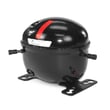
- Refrigerator compressor TCA38091801
- Refrigerator compressor overload protector 6750CL0001D
- Refrigerator condenser coil ACG73964501
Why it matters
A compressor replacement is a high-cost repair and is only the right fix when airflow, fans, and controls are working correctly. Ruling out simpler causes first helps avoid replacing the compressor when the real issue is a fan motor, dirty condenser, or a defrost/airflow problem.
For model-specific diagnostic steps and access instructions, use the 79570329310 owner's manual.
Last updated: January 2026
Why is my Kenmore refrigerator leaking underneath?
On Kenmore refrigerator model 79570329310, leaking underneath is usually caused by a defrost drain that’s clogged or frozen, so meltwater can’t reach the drain pan and instead spills to the floor. A cracked drain pan or a water supply leak can also drip under the cabinet.
Quick checks that fix most leaks
- Unplug the refrigerator and pull it out so you can inspect underneath.
- Look for a sheet of ice or water in the freezer bottom; this points to a blocked defrost drain.
- Check the drain pan for cracks, warping, or overflow.
- Inspect the water line and fittings at the back for slow drips.
- If the leak happens only when dispensing water or making ice, focus on the filter and inlet valve.
Most common causes and what to do
| What you notice | Most likely cause | What we recommend |
|---|---|---|
| Water appears after defrost cycles; ice under freezer bin | Clogged or frozen defrost drain | Flush the drain with hot water (turkey baster works well) and clear debris with a flexible cleaner |
| Water only when using dispenser or ice maker | Water filter not seated, cracked filter, or leaking valve | Reseat/replace the filter; inspect valve and tubing connections |
| Water in a puddle even when not using water/ice | Drain pan cracked or shifted | Reposition or replace the pan if damaged |
Parts that commonly relate to this symptom
If you confirm the leak is tied to the defrost drain path or the water system, these model-matched parts are often involved:
- Refrigerator drain tube 5251JA3003D (helps route defrost water to the pan)
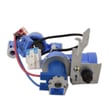
- Lg refrigerator water inlet valve AJU72992601 (can seep or drip at the valve body or fittings)
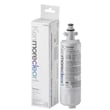
- Genuine Kenmore refrigerator water filter 9690 AGF80300801 (a damaged or mis-seated filter can leak at the head)
Why it matters
Water under the refrigerator can damage flooring and can also lead to ice buildup in the freezer, restricted airflow, and warmer temperatures. Fixing the drain or water supply leak early helps protect the evaporator area and keeps cooling consistent.
For model-specific access points and cleaning steps, follow the 79570329310 owner's manual.
Last updated: January 2026