Installation guide
 Owner’s manual


What size is a Kenmore Model 110C61402311 dryer?
The Kenmore electric dryer model 110C61402311 is approximately 27 inches wide, 27 3/4 inches deep, and 43 3/8 inches tall (cabinet size). For installation, plan extra room for venting and door swing as shown in the 110C61402311 installation guide.
Even when the cabinet fits, the installation space needs additional clearance for airflow, exhaust routing, and service access.
- Cabinet dimensions: 27" W x 27 3/4" D x 43 3/8" H
- Typical minimum clearance behind dryer for vent elbow: 5 1/2"
- Closet/recess installs need ventilation openings and side clearances
- Side or bottom exhaust adds an internal 90° turn, which affects vent length
- Keep the dryer in a dry area and above 45°F for normal automatic cycle operation
| Measurement | What it represents | What to allow for install |
|---|---|---|
| Width | Cabinet width | Add side clearance if in a closet/recess |
| Depth | Cabinet depth | Add space for vent connection (often 5 1/2" behind) |
| Height | Cabinet height | Ensure leveling and overhead clearance |
Correct sizing prevents crushed venting, poor airflow, and longer dry times. Proper clearance also helps the drum tumble correctly and keeps sensor cycles working as designed.
- Use the straightest vent path possible
- Avoid 90° turns when you can
- Use clamps to seal joints (not duct tape)
- Use only rigid or flexible metal venting (no foil vent)
Last updated: February 2026
How much does it cost to replace a heating element in a Kenmore dryer?
For a Kenmore electric dryer like model 110C61402311, replacing the heating element typically costs $25 to $120 for the part and $150 to $350 total if you hire a technician (part plus labor). If you do it yourself, your cost is usually the part and basic supplies.
- Heating element part: $25 to $120 (higher when sold as a complete heater box assembly)
- DIY supplies: $0 to $20 (terminals, screws, vacuum/brush for lint)
- Professional labor: $100 to $250 (varies by area and access)
- Service call/diagnostic fee: often $0 to $100 (sometimes applied to the repair)
| Repair approach | What you pay for | Typical total |
|---|---|---|
| DIY replacement | Part only (plus small supplies) | $25 to $140 |
| Technician replacement | Part + labor + possible service call | $150 to $350 |
- Element style: bare element vs. element in a heater housing
- Why it failed: restricted venting can overheat the heater and blow safety fuses
- Extra parts needed: if wiring ends are heat-damaged, a wire/terminal kit may be needed
- Time on site: stacked installs, tight closets, or long vent runs increase labor time
If your dryer overheated or stopped heating, these parts are commonly replaced together to prevent repeat failures:
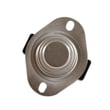
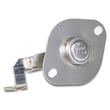
- Dryer thermal cut-off fuse kit 279816 (safety cut-off that opens if temperatures get too high)
- Dryer operating thermostat WP3387134 (helps regulate normal drum temperature)
- Dryer heating element wire kit 279457 (helps when terminals or leads are heat-damaged)
A new heating element will not last if airflow is restricted. Cleaning the lint screen path and verifying proper venting protects the heater, thermostats, and thermal cut-off from overheating.
For model-specific access steps and electrical safety notes, follow the 110C61402311 installation guide.
Last updated: February 2026
How do I know if my Kenmore dryer thermal fuse is blown?
On a Kenmore electric dryer model 110C61402311, a blown thermal fuse commonly shows up as a dryer that will not start, or a dryer that runs but has no heat. The sure way to confirm is a continuity test with a multimeter after unplugging the dryer.
- Dryer will not start even though the door is closed and the cycle is selected
- Motor hums briefly, then stops (some failures present this way)
- Dryer tumbles but produces no heat (depending on which safety device opened)
- Cycle seems normal but clothes stay damp and cool
- You recently had poor airflow (clogged lint screen or crushed vent)
- Unplug the dryer (electric shock risk).
- Access the fuse location using the disassembly steps in the 110C61402311 installation guide.
- Pull the wires off the fuse terminals (grab the connector, not the wire).
- Set your multimeter to continuity or the lowest ohms setting.
- Touch a probe to each terminal.
| Meter result | What it means | What to do next |
|---|---|---|
| Beep or near 0 ohms | Fuse is good | Keep troubleshooting airflow, thermostat, heater circuit |
| No beep or OL/infinite | Fuse is blown (open) | Replace the fuse and correct the overheating cause |
If overheating caused the failure, we typically address the safety devices as a set so the new fuse does not fail again.
- Dryer thermal cut-off fuse kit 279816 (common overheat protection parts)
- Dryer operating thermostat WP3387134 (helps regulate drum temperature)
- Dryer high-limit thermostat WP3977767 (backup limit if temps climb too high)
A thermal fuse opens to stop the dryer from operating safely when temperatures get too high, which is often triggered by restricted venting. Replacing the fuse without fixing airflow (lint buildup, long vent run, crushed duct) leads to repeat failures.
Last updated: February 2026
How do I tell what model my Kenmore dryer is?
Your Kenmore dryer’s model number is printed on the model and serial rating plate; on model 110C61402311, you’ll typically find that plate in the door opening (door well). Once you have the full model number, we can match the correct parts, diagrams, and specifications.
Check these common locations on Kenmore dryers:
- Inside the dryer door opening on the frame (often called the door well)
- On the back panel of the dryer cabinet
- Near the lint screen housing area (varies by design)
- On a metal plate or durable sticker labeled “Model” and “Serial”
For the exact label location and what it looks like on your unit, use the 110C61402311 owner’s manual.
Kenmore model numbers are a mix of numbers and sometimes letters. Use the entire model number exactly as shown, including any suffix digits.
- Ensures the right replacement parts fit (belt, thermostat, motor, door parts)
- Helps confirm electrical requirements and venting guidance
- Prevents ordering the wrong version of a part that looks similar
- Copy the model number and serial number exactly
- Take a clear photo of the rating plate for reference
- If the label is worn, use a flashlight and view from an angle to read stamped text
| Label field | What it’s used for |
|---|---|
| Model number | Matching parts and diagrams for your exact dryer |
| Serial number | Identifying production details for service and support |
| Electrical info | Confirming power supply requirements |
If you’re troubleshooting noise or a drum that won’t turn, the model number lets us match common wear items like the belt 341241 and the dryer idler pulley WP691366 to your exact Kenmore dryer.
Last updated: February 2026