Owner’s manual
 Error Codes



What is the life expectancy of a bottom freezer refrigerator?
A bottom-freezer (bottom-mount) refrigerator like the KitchenAid KRFC300ESS03 typically lasts 15 to 20 years with normal household use. Keeping the condenser area clean, maintaining good door seals, and following the care steps in the KRFC300ESS03 owner's manual helps you reach the upper end of that range.
Typical lifespan and what affects it
Most bottom-mount refrigerators run longer when the sealed system and airflow stay healthy.
- Usage and load: frequent door openings and overpacking increase run time
- Airflow: blocked vents cause warm spots and longer compressor cycles
- Door sealing: worn gaskets let in humid air, creating frost and temperature swings
- Cleaning habits: dust buildup around the condenser area raises operating temps
- Water and ice system upkeep: clogged filters and low water flow can strain the ice maker
Quick maintenance checklist (high impact)
Use these habits to extend life and reduce repairs:
- Set stable temps and avoid frequent large adjustments (wait about 24 hours between changes)
- Keep food from blocking interior air vents
- Clean spills and odors promptly to protect liners and components
- Make sure doors close fully and sit level
- Replace worn door gaskets when you see gaps, tearing, or persistent condensation
What “major system” coverage usually includes
Many KitchenAid models include longer limited coverage on the sealed refrigeration system (parts such as compressor, evaporator, condenser, dryer, and tubing). That matters because sealed-system repairs are the most expensive.
| Component group | Examples | Why it matters |
|---|---|---|
| Sealed refrigeration system | compressor, evaporator, condenser, dryer | Drives cooling; most costly repairs |
| Airflow/cooling fans | evaporator fan motor, fan blade | Prevents warm fridge and freezer temps |
| Door sealing | door gaskets | Prevents moisture intrusion and frost |
Why it matters
A realistic 15 to 20 year expectation helps you decide whether to repair or replace when issues show up. If your KRFC300ESS03 is under 10 years old, repairs that restore airflow, sealing, or temperature control often make strong sense.
Last updated: February 2026
What is the advantage of a bottom mount fridge?
A bottom-mount refrigerator like the KitchenAid KRFC300ESS03 keeps the fresh-food compartment at eye level, so you reach everyday items with less bending. The freezer stays in the lower drawer, which helps organize frozen foods while keeping the most-used section easiest to access.
Key advantages you will notice day to day
- Less bending for fresh food: milk, produce, and leftovers sit higher.
- Better visibility: shelves are easier to scan quickly.
- Freezer drawer organization: baskets and dividers make it easier to sort frozen items.
- Door closing and alignment adjustments: this style commonly uses front leveling screws to help doors close smoothly.
- Good fit planning: you can plan clearances for walls and water line connections (if equipped).
What to plan for with a bottom-mount design
Bottom-mount models trade “easy freezer access” for “easy refrigerator access.” If you use the freezer many times a day, you will bend more often.
| Feature | Bottom-mount benefit | Possible tradeoff |
|---|---|---|
| Fresh-food access | Most-used items are higher | None for most households |
| Freezer access | Drawer can hold bulky items | More bending to reach items |
| Door alignment | Leveling screws help doors close evenly | May need periodic adjustment |
Why it matters
Most households open the refrigerator section far more than the freezer. Putting fresh food at a comfortable height reduces strain and makes it easier to keep food visible, which can cut down on forgotten items and waste.
Helpful model-specific tip: door closing and alignment
If the doors do not close easily or look uneven, follow the leveling and alignment steps in the KRFC300ESS03 owner's manual. Proper leveling helps the doors seal correctly and keeps temperatures stable.
Last updated: February 2026
What is the most common problem with a KitchenAid refrigerator?
For KitchenAid refrigerators like model KRFC300ESS03, the most common issues we see are ice maker and water system problems (no ice, slow ice, leaks) and cooling complaints caused by airflow restrictions (dirty condenser coils, fan issues) or door sealing problems. Use the KRFC300ESS03 owner's manual troubleshooting section to narrow it down fast.
Most common symptoms (and what they usually point to)
- Ice maker not making ice or making small cubes: water supply restriction, filter/head issue, or ice maker failure
- Water leaking inside or under the refrigerator: clogged/iced drain path, loose water line connection, or inlet valve seepage
- Refrigerator warm but freezer cold (or uneven temps): evaporator fan airflow problem or frost buildup from a defrost issue
- Noisy operation (buzzing, clicking, rattling): fan blade hitting ice, fan motor wear, or condenser area vibration
- Doors not sealing well: gasket not seating, door alignment, or torn gasket
Quick checks we recommend before replacing parts
- Confirm temperatures: set fresh food to about 37°F and freezer to about 0°F.
- Check airflow: make sure vents are not blocked by food packages.
- Clean condenser coils: dust buildup is a top cause of poor cooling and longer run times.
- Inspect door gaskets: look for gaps, tears, or areas not gripping paper.
- Verify water supply (for ice/water issues): shutoff valve fully open; line not kinked.
Parts that commonly solve these problems on KRFC300ESS03
| Symptom | Common part to check | Example from this model’s parts |
|---|---|---|
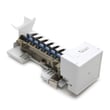
| No ice / intermittent ice | Ice maker assembly | Refrigerator ice maker W10884390 |
| Warm temps / airflow noise | Evaporator fan motor or blade | Refrigerator evaporator fan motor W11024089, refrigerator evaporator fan blade WP2169142 |
| Water at bottom / puddles | Drain path components | Extension-dr W10619951 |
| Water dispenser/ice fill issues | Water inlet valve | Refrigerator water inlet valve assembly WPW10420083 |
| Door not sealing | Door gasket | Whirlpool refrigerator door gasket (gray) W10443320 |
Why it matters
Ice maker and cooling problems often share the same root causes: restricted airflow or restricted water flow. Fixing the underlying cause first helps prevent repeat failures and protects the compressor from excessive run time.
Last updated: February 2026
How to get KitchenAid replacement parts?
For your KitchenAid KRFC300ESS03 bottom-mount refrigerator, the fastest way to get the right replacement part is to look up parts by model number first, then match the part by name and part ID before ordering. This helps ensure fit and avoids ordering a similar-looking part that will not work.
The quickest way to order the correct part
- Find the model number on the refrigerator’s model/serial tag and use KRFC300ESS03 when searching.
- Identify the failed part by symptom (no ice, leaking water, warm fridge, door not sealing).
- Cross-check the part listing by part name and part ID (not just a photo).
- If the repair involves wiring, water lines, or sealed system components, follow the safety steps in the KRFC300ESS03 owner's manual.
- Order the part and keep your receipt and install notes for your records.
Common KRFC300ESS03 parts customers replace
Here are examples of model-matched parts that are commonly ordered for this refrigerator:
| Symptom | Likely part category | Example model-matched part |
|---|---|---|
| Ice maker not making ice | Ice maker assembly | Refrigerator ice maker W10884390 |
| Water dispenser slow or no water | Water inlet valve | Refrigerator water inlet valve assembly WPW10420083 |
| Door not sealing, moisture or frost | Door gasket | Whirlpool refrigerator door gasket (gray) W10443320 |
| Warm fridge, fan noise, poor airflow | Evaporator fan motor/blade | Refrigerator evaporator motor W11024089 |
Water filter note (helps avoid repeat problems)
If you are troubleshooting water flow or ice production, replacing the filter on schedule prevents low flow and valve strain.
- Use the correct filter type for your configuration.
- Flush several gallons after installing a new filter.
- If you see air spurting, purge the line before judging performance.
For step-by-step instructions, use our guide: how to replace the water filter in a KitchenAid refrigerator.
Why it matters
KitchenAid refrigerators often have multiple part revisions that look similar. Matching by KRFC300ESS03 plus the exact part ID (for example, W10884390 for the ice maker) prevents wrong-part returns and gets your refrigerator cooling, sealing, and making ice again faster.
Last updated: February 2026
Why is my KitchenAid bottom freezer frosting up?
Frost buildup in the freezer on your KitchenAid KRFC300ESS03 almost always happens when warm, humid air is getting into the freezer compartment. The most common causes are a door that is not sealing tightly, frequent door openings, or moisture left on packages and bins.
Quick checks that fix most frosting
- Make sure the freezer drawer closes fully every time (no bags or baskets blocking it).
- Inspect the door gasket for gaps, tears, or areas that look flattened.
- Wipe moisture off food containers before loading them.
- Limit long door openings; plan what you need before opening the drawer.
- Confirm the refrigerator is level so the door self-closes consistently.
Common causes and what to do
| What you notice | Likely cause | What we recommend |
|---|---|---|
| Frost mainly near the front/edges | Air leak at the seal | Clean the gasket and mating surface; warm the gasket with a hair dryer on low to reshape it |
| Frost after grocery loading | Moisture introduced | Dry packaging; avoid putting warm food in the freezer |
| Heavy frost plus poor cooling | Airflow issue (fan/ice blockage) | Check for ice blocking vents; listen for the evaporator fan running |
| Frost plus water/ice clumps | Defrost drain issue | Look for ice buildup under the freezer floor; clear the drain path |
Parts that often solve air-leak or airflow problems
If the seal is damaged or not holding shape, replacing the gasket is a common fix. If you hear unusual fan noise or airflow seems weak, the evaporator fan parts are worth checking.
- Whirlpool refrigerator door gasket (gray) W10443320
- Refrigerator evaporator motor W11024089
- Refrigerator evaporator fan blade WP2169142
Why it matters
Frost acts like insulation and restricts airflow, so temperatures swing and the compressor runs longer. Fixing the air leak or airflow problem helps prevent freezer burn, improves ice production, and reduces energy use.
Model-specific reference
For KRFC300ESS03 door alignment, leveling guidance, and cleaning recommendations, follow the steps in the KRFC300ESS03 owner's manual.
Last updated: February 2026
How to remove drawers from KitchenAid bottom freezer?
For KitchenAid bottom-mount refrigerator model KRFC300ESS03, you remove the freezer drawer front by fully opening the drawer, loosening (not removing) the four screws that attach the drawer glides to the drawer front, then lifting the drawer front up and off the screws. Follow the steps in the KRFC300ESS03 owner's manual.
Steps to remove the freezer drawer front
- Open the freezer drawer to full extension.
- Have a second person support the drawer front (recommended for safe handling).
- Loosen the four screws attaching the drawer glides to the drawer front (3 to 4 turns).
- Lift the drawer front upward to disengage it from the screws.
- Set the drawer front on a protected surface to avoid scratches.
Reinstalling the drawer front (quick guide)
- Slide the drawer glides out.
- Insert the top screws into the slots in the drawer brackets.
- Pull the brackets toward you to seat the bottom screws into the brackets.
- Tighten all four screws completely.
| Task | What you do | Key detail |
|---|---|---|
| Remove drawer front | Loosen 4 glide screws, lift up | Leave screws in the drawer front |
| Reinstall drawer front | Hang top, seat bottom, tighten | Tighten evenly so the front sits square |
Tools and prep that help
- #2 Phillips screwdriver or 1/4-inch hex driver (use what matches your screw heads)
- Work gloves (better grip on the drawer front)
- Towel or cardboard (to protect the finish)
Why it matters
Removing and reinstalling the drawer front correctly keeps the freezer sealing properly, prevents rubbing or misalignment on the glides, and helps avoid frost buildup and temperature swings.
Last updated: February 2026