Owner’s manual
 Error Codes


Can I adjust the height of my refrigerator?
Yes. On Kenmore refrigerator model 59676509500, you adjust height by leveling the cabinet: remove the toe grille, then turn the front and rear adjustment screws to raise or lower the refrigerator until it sits level side-to-side and slightly higher in front.
How to adjust the height (leveling steps)
- Unplug the refrigerator or switch off power for safety.
- Remove the toe grille (grasp firmly and pull outward to unclip).
- Remove the bottom hinge cover(s) to access the adjustment points.
- Turn the front adjustment screws to raise or lower the front.
- Turn the rear adjustment screws to raise or lower the rear.
- Use a carpenter’s level; set the front about 1/4 inch higher than the back and confirm it is level side-to-side.
- Turn the stabilizing legs clockwise until they are firmly against the floor, then recheck level.
For the exact locations of the screws and the recommended leveling position, follow the steps in the 59676509500 owner's manual.
Quick reference: what to adjust
| What you’re changing | What to turn | Goal |
|---|---|---|
| Front height | Front adjustment screws | Raise or lower the front edge |
| Rear height | Rear adjustment screws | Raise or lower the back edge |
| Final stability | Stabilizing legs | Transfer weight to legs so the unit does not rock |
Why it matters
Proper leveling helps the doors close and seal correctly, reduces vibration and noise, and supports consistent cooling. If the refrigerator is not level, you can also see issues like doors drifting open or uneven gasket contact.
Last updated: February 2026
How do I tell what model Kenmore fridge I have?
For Kenmore refrigerator model 59676509500, the model number is printed on the model and serial number sticker inside the fresh food (refrigerator) section. On this model, that sticker is located on the left interior wall. See the 59676509500 owner's manual for the exact label location and how to record it.
Where to look first (fastest checks)
- Open the refrigerator door and check the left wall inside the refrigerator compartment
- Look for a model and serial number sticker (often a white or silver label)
- Use a flashlight; labels can be hard to read in low light
- Write down the full model number and serial number exactly as shown
- Take a photo of the label for parts ordering and service records
What the label typically includes
Most Kenmore model and serial labels list these fields:
| Label item | What it’s used for |
|---|---|
| Model number | Matching the correct parts diagrams and replacement parts |
| Serial number | Identifying production details for service and support |
| Purchase date (you add this) | Tracking warranty and maintenance history |
Why it matters
We use the model number to match the correct Kenmore parts for your exact refrigerator design. Even small model-number differences can change which ice maker, door gasket, thermistor, or control parts fit.
If you still cannot find the sticker
- Check for a label that may be partially covered by shelves or bins
- Clean the area gently; smudges can hide digits
- Confirm you are looking in the refrigerator section, not the freezer drawer
Last updated: February 2026
How many cubic feet is my Kenmore refrigerator by model number?
Your Kenmore bottom-mount refrigerator model 59676509500 has its exact cubic-foot capacity listed in the model specifications section of the 59676509500 owner's manual. The most reliable on-appliance method is reading the model and serial number sticker inside the fresh food section on the left wall, then matching that model to the spec page in the manual.
Fast ways to find the cubic feet for model 59676509500
- Check the specifications section in the 59676509500 owner's manual.
- Locate the model and serial number sticker inside the refrigerator section (left wall) and confirm the model is 59676509500.
- If you are comparing similar Kenmore 596.7650xxxx units, use the manual to avoid mixing capacities across close model numbers.
- If you are measuring for a cabinet opening, use the manual’s installation guidance for clearances (capacity and exterior size are different).
What “cubic feet” means (and what it does not)
Cubic feet is the interior storage volume of the refrigerator and freezer combined. It is not the same as exterior width, height, or depth, and it does not tell you how much usable space you get after shelves, bins, and the ice maker are installed.
| Spec you need | What it helps with | Where to look |
|---|---|---|
| Cubic feet (capacity) | Comparing storage size between refrigerators | 59676509500 owner's manual |
| Exterior dimensions | Fit in a kitchen opening | 59676509500 owner's manual |
| Required clearances | Airflow and door swing | 59676509500 owner's manual |
Why it matters
Knowing the correct cubic-foot capacity helps you compare Kenmore refrigerators accurately, choose the right replacement unit, and set realistic expectations for storage, especially in a bottom-mount design with a pullout freezer drawer.
Last updated: February 2026
How to read Kenmore model numbers?
Kenmore model numbers tell us who built the appliance and which design family it belongs to. For Kenmore refrigerator model 59676509500, the 596 prefix identifies the manufacturer, and the remaining digits narrow down the exact series and feature set used to match the right parts and manual.
Where to find the model number on this refrigerator
On Kenmore 59676509500 bottom-mount refrigerators, we look for the model and serial label inside the fresh food (refrigerator) section on the left wall. Use the full model number exactly as shown when ordering parts or checking specifications in the 59676509500 owner's manual.
How to interpret a Kenmore model number (quick guide)
Most Kenmore model numbers follow a pattern that helps us identify the build source and the product variation.
- Prefix (first 3 digits): identifies the manufacturer (for example, 596)
- Core digits: identify the base design/series
- Suffix digits: identify feature and production variations
- Full number matters: even one digit off can point to a different parts list
Common Kenmore refrigerator prefixes (examples)
These prefixes are used to identify who manufactured the Kenmore unit, which is why they matter for parts compatibility.
| Kenmore prefix | What it’s used for | Why it matters |
|---|---|---|
| 596 | Manufacturer identifier | Helps match the correct parts diagrams and components |
| 106 | Manufacturer identifier | Helps match the correct parts diagrams and components |
| 795 | Manufacturer identifier | Helps match the correct parts diagrams and components |
| 253 | Manufacturer identifier | Helps match the correct parts diagrams and components |
Why it matters for parts and troubleshooting
We use the complete model number to ensure the right fit for items like door gaskets, thermistors, and ice maker components. For example, if you are diagnosing ice production issues, matching the correct ice maker for your exact model avoids wiring and mounting mismatches (see refrigerator ice maker D7824706Q if you are replacing the assembly).
Helpful tip when writing it down
- Copy the model number directly from the label (do not rely on the sales receipt)
- Record the serial number too; it helps identify production changes
- Keep the model number handy when checking settings and features in the manual
Last updated: February 2026
How to tell if a Kenmore refrigerator compressor is bad?
On Kenmore refrigerator model 59676509500, a bad compressor usually shows up as poor or no cooling with the unit trying to run (humming, clicking, or running constantly) but temperatures never recover. Before condemning the compressor, we confirm power, controls, airflow, and start components using the checks in the 59676509500 owner's manual.
Quick symptoms that point toward a compressor problem
- Refrigerator and freezer are warm even though the unit runs for long periods
- Repeated clicking every few minutes (start attempt, then overload trips)
- Compressor is very hot to the touch after trying to run (use caution)
- Compressor is silent while interior lights work and fans may run
- You hear normal fan airflow but cooling never improves
Rule out common non-compressor causes first
Many “bad compressor” complaints are actually airflow, defrost, or start-device issues.
- Dirty condenser coils reduce cooling and can make run times excessive
- Door not sealing causes constant running and warm temps
- Defrost mode can stop the compressor temporarily; the manual notes waiting about 40 minutes to see if it restarts
- Evaporator fan issues can cause warm refrigerator temps even if the compressor runs
- Start components (overload/relay/capacitor) can click and prevent the compressor from starting
What we check (in order)
| Check | What you’re looking for | What it suggests |
|---|---|---|
| Power and controls | Unit plugged in, controls on | Not a compressor issue if power is missing |
| Defrost wait | Compressor restarts within ~40 minutes | Normal defrost cycle |
| Airflow | Strong airflow from vents, fan running | Weak airflow points to fan/ice blockage |
| Condenser cleanliness | Coils not packed with dust | Dirty coils mimic compressor failure |
| Start attempt | Click-hum-click pattern | Often start device or compressor locked |
When replacement becomes likely
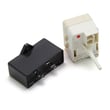
If the compressor repeatedly tries to start and trips off, or it runs but never cools after airflow and defrost issues are corrected, compressor replacement is a common next step. For this model, the listed compressor is refrigerator compressor W10160407.
Why it matters
A compressor diagnosis affects cost and downtime. Confirming basics like defrost timing, airflow, and start behavior prevents replacing an expensive sealed-system part when a simpler fix (like cleaning coils or replacing a start component) restores cooling.
Last updated: February 2026
What are the common problems with Kenmore Elite refrigerators?
Common problems we see on Kenmore Elite refrigerators include warm temperatures (cooling failure), water leaks, and ice maker or dispenser issues. On Kenmore model 59676509500, the most frequent root causes are airflow restrictions, dirty condenser coils, door sealing problems, and defrost or water-supply issues; our 59676509500 owner's manual outlines several of these checks.
Most common symptoms and what usually causes them
- Not cooling or running too warm: dirty condenser coils, blocked air vents, frequent door openings, controls set too warm
- Frost buildup or temperature swings: defrost cycle issues (heater, thermostat, sensor), doors not sealing
- Water leaking: clogged/iced drain path, poor water line connection, low water pressure, kinked tubing
- Ice maker not making ice: low water pressure, freezer too warm, frozen fill tube, ice maker failure
- Interior light problems: failed door/light switch
Quick checks we recommend first (in order)
- Confirm temperatures: set refrigerator to about 37°F and freezer to about 0°F.
- Check airflow: make sure rear air grille and vents are not blocked by food.
- Clean condenser coils: dirty coils are a top cause of poor cooling.
- Inspect door seal: look for gaps, tears, or doors held open by bins or oversized containers.
- If leaking or ice issues: verify household water pressure is 35 to 100 psi and avoid self-piercing saddle valves (both are called out in the manual).
Model 59676509500: common parts involved
| Symptom | Part that often fixes it | What it does |
|---|---|---|
| No ice, small cubes, intermittent ice | Refrigerator ice maker D7824706Q | Cycles and harvests ice cubes |
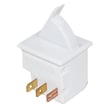
| Light stays off or won’t turn off | Refrigerator light switch W11396033 | Signals door open/closed to the light |
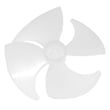
| Warm fridge section, weak airflow | Refrigerator evaporator fan blade WP2169142 | Moves cold air through the compartments |
Why it matters
Cooling and ice maker complaints often start with simple issues (airflow, coils, door seal, water pressure). Fixing those early prevents food spoilage, reduces compressor run time, and helps the refrigerator maintain stable temperatures.
Last updated: February 2026
What's the average lifespan of a Kenmore refrigerator?
Most Kenmore refrigerators last 10 to 15 years. For Kenmore model 59676509500, lifespan depends most on routine care (airflow, clean coils, good door sealing) and fixing small cooling or ice maker issues before they strain the sealed refrigeration system; see the 59676509500 owner's manual for model-specific care and operating guidance.
Typical lifespan and what to expect
In normal household use, we see these ranges most often:
- 10 to 15 years: typical, with basic maintenance
- 15 to 20 years: common when coils are kept clean and temperatures stay stable
- Under 10 years: usually tied to heavy use, poor airflow, dirty condenser area, or repeated cooling/defrost problems
| Refrigerator area | What usually wears first | What you can do | When it becomes a bigger repair |
|---|---|---|---|
| Cooling airflow | Evaporator fan blade, frost buildup | Keep vents clear, avoid overpacking | Warm fridge, weak freezer performance |
| Door sealing | Door gasket | Clean and inspect gasket, confirm doors close fully | Moisture, frost, longer run times |
| Defrost system | Defrost heater, defrost thermostat | Watch for frost on back wall, address early | Ice buildup blocks airflow |
| Ice system (if equipped) | Ice maker | Keep water supply steady, clear jams | No ice, leaking, slow production |
Maintenance that adds years (and saves food)
These habits make the biggest difference in real-world lifespan:
- Vacuum dust from the condenser area regularly (more often with pets)
- Keep the refrigerator and freezer not overpacked so air can circulate
- Wipe and inspect door seals; stop air leaks early
- Keep temperatures steady; avoid frequent long door openings
- Clean spills promptly, especially around drawers and door bins
Why it matters
A refrigerator that runs longer to hold temperature wears out components faster. Good airflow and tight door sealing reduce run time, help prevent frost issues, and lower the chance of expensive cooling-system strain.
Last updated: February 2026
Where is the water filter on a Kenmore bottom freezer refrigerator?
On Kenmore bottom-mount refrigerators like model 59676509500, the water filter is typically located inside the fresh food (refrigerator) compartment, most often in the upper-right corner or in the base grille area. Your exact filter location and access steps are shown in the 59676509500 owner's manual.
How to find it quickly
Check these common filter locations on bottom-freezer Kenmore models:
- Upper-right interior: a small filter housing with a flip-down or push-button door
- Upper-left interior: less common, but still possible
- Base grille (toe-kick): filter twists out or pulls straight out near the floor
- Ceiling of fresh food section: filter door near the light housing
- No filter installed: some setups use an inline filter behind the refrigerator instead
What to do once you locate the filter
Most Kenmore bottom-mount filters install in one of two ways:
- Push-in style: push the cartridge in until it seats; close the filter door
- Twist-in style: insert and rotate (usually a quarter-turn) until it locks
- Flush water after replacement: dispense and discard several cups of water to clear air and carbon fines
- Check for leaks: look around the filter housing for drips after the first few minutes
Quick comparison: push-in vs twist-in
| Filter style | What you feel | Typical removal | Common symptom if not seated |
|---|---|---|---|
| Push-in | A firm “click” or stop | Press release button or pull straight out | Door will not close or water drips |
| Twist-in | Resistance, then lock | Turn back and pull out | Slow flow or leaking at housing |
Why it matters
A correctly located and fully seated water filter helps maintain normal water flow to the dispenser and ice maker. The manual also notes that refrigerators with water filters need adequate supply pressure (a minimum of 35 psi is commonly required for proper operation).
Related help
- If you are replacing the filter and still have low flow or ice maker issues, follow the steps in how to prevent water dispenser and ice maker problems.
Last updated: February 2026