Installation guide
 Owner’s manual


Where is the part number on a Kenmore dryer?
On Kenmore dryer model 11061402310, the model and serial information (what you use to match the correct parts) is typically on a label around the door opening, usually on the door jamb or the inside edge of the front panel. Confirm the exact label location in the 11061402310 installation guide.
Where to look first
Check these common label spots on Kenmore electric dryers:
- Door opening (door jamb) on the cabinet front
- Inside the door itself (along the edge)
- Front panel opening near the lint screen housing
- Rear panel label (less common, but possible)
- Inside the lower access panel area (if your design has one)
What you will see on the label
Most Kenmore dryers list several identifiers. Here is what each one is used for:
| Label item | What it’s for | When you need it |
|---|---|---|
| Model number | Identifies the exact dryer design | Always, before ordering parts |
| Serial number | Identifies production run details | When a part changes by serial range |
| Electrical ratings | Confirms voltage/amps | When troubleshooting power or installing |
Why it matters
Kenmore dryers often share similar looks across different series, but internal parts can vary by model and sometimes by serial range. Using the label information helps us match the correct belt, heating element, thermostat, or motor the first time.
Quick tip if you’re ordering common wear parts
If your dryer is squealing, not tumbling, or takes too long to dry, these are common parts customers replace after confirming the model number:
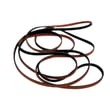
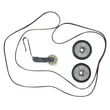
- Belt 341241 (drum won’t turn, slipping, thumping)
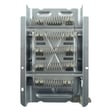
- Dryer element 279838 (no heat or weak heat)
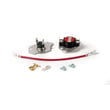
- Dryer thermal cut-off fuse kit 279816 (no heat, overheats, shuts down)
Last updated: February 2026
What is the PF code on a Kenmore dryer?
PF on a Kenmore dryer means power failure during a cycle. On Kenmore model 11061402310, it typically appears after a brief outage, a loose plug, or a momentary drop in voltage; clear it and then confirm the dryer has a solid 240-volt supply.
How to clear the PF code
- Press Stop/Cancel once to clear the display.
- Restart the cycle.
- If PF returns, stop using the dryer until you check the power supply and cord connection.
What usually causes PF (and what to check first)
- Loose power cord at the outlet (dryer plug not fully seated)
- Tripped breaker (one side of the 240V circuit can trip and the dryer may still run oddly)
- Worn outlet or damaged cord (heat marks, melted plastic, intermittent power)
- Extension cord use (not recommended for dryers)
- Home power flicker (storms, overloaded circuit, shared circuit)
Quick electrical checklist (safe, no tools)
- Make sure the dryer is plugged directly into the wall outlet (no extension cord).
- Check the breaker: a dryer needs a dedicated 30-amp, 120/240V circuit.
- If the plug or outlet looks scorched or feels loose, unplug the dryer and have the outlet and cord inspected.
| What you see | What it points to | What to do |
|---|---|---|
| PF after a storm/outage | Utility interruption | Clear PF and restart |
| PF happens randomly | Loose outlet/cord or breaker issue | Inspect outlet/cord, check breaker |
| PF repeats every cycle | Unstable supply or wiring problem | Have an electrician verify the circuit |
Why it matters
A PF code is more than an “annoying reset”; repeated power interruptions can stop heating mid-cycle and can indicate a loose connection that may overheat. The installation requirements and grounding details in the installation guide help you confirm the correct 3-wire or 4-wire hookup and proper electrical supply.
Last updated: February 2026
How much does it cost to replace a heating element in a Kenmore dryer?
For Kenmore electric dryer model 11061402310, replacing the heating element typically costs $50 to $150 for the part and $150 to $350 total if you hire service (part plus labor). If the dryer has no heat due to a power supply issue, the “repair” can be $0.
Typical cost breakdown
- DIY parts-only: usually $50 to $150 (heating element plus any damaged wiring)
- Service call + labor: commonly $100 to $250 labor, depending on access and local rates
- Total installed cost: typically $150 to $350
| Scenario | What you pay for | Typical total |
|---|---|---|
| DIY element replacement | Part(s) only | $50 to $150 |
| Pro repair (standard) | Part(s) + labor | $150 to $350 |
| “No heat” but element is OK | Electrical/venting correction | $0 to $200 |
What to check before buying a heating element
The installation instructions for this dryer note that if you do not feel heat after about 5 minutes, you should check the home power supply first because many electric dryers use two fuses or two breakers. Use the steps in the 11061402310 installation guide.
- Confirm the dryer is on a separate 30-amp circuit
- Check both breakers (or fuses) are on and not tripped
- Run the dryer for 5 minutes, then open the door and feel for heat
- Clean the lint screen and verify airflow; restricted venting can overheat and damage heating circuits
Parts that often get replaced with the element
If the element failed from overheating or poor airflow, we often see other heat-related parts replaced at the same time.
- Dryer element 279838 (the heater itself)
- Dryer thermal cut-off fuse kit 279816 (safety cut-off components)
- Dryer operating thermostat WP3387134 (temperature regulation)
- Dryer high-limit thermostat WP3977767 (overheat protection)
- Dryer heating element wire kit 279457 (burned terminals or brittle wiring)
Why it matters
A “no heat” symptom is not always a bad heating element. Verifying power (both breakers) and airflow first prevents unnecessary parts purchases and helps avoid repeat failures from overheating.
Last updated: February 2026
How do I know if my Kenmore dryer thermal fuse is blown?
On Kenmore electric dryer model 11061402310, a blown thermal fuse commonly shows up as a dryer that will not start or runs with no heat. The sure way to confirm is to unplug the dryer and test the fuse for continuity with a multimeter, following the access steps in the 11061402310 installation guide.
Quick symptoms to look for
- Dryer will not start (no motor run)
- Dryer tumbles but produces no heat
- Cycle runs but clothes stay damp and cool
- Dryer stops mid-cycle (often after overheating)
- Burning smell or very hot cabinet (stop using it and check venting)
How we confirm a blown thermal fuse (continuity test)
- Unplug the dryer (or switch off the breaker) before opening any panels.
- Access the thermal fuse area (location varies by design; the 11061402310 installation guide helps with safe access and setup basics).
- Remove at least one wire from the fuse terminal.
- Set your multimeter to continuity or ohms.
- Test across the fuse terminals:
- Good fuse: continuity (beep) or near 0 ohms
- Blown fuse: no beep or OL/infinite resistance
What usually causes the fuse to blow (fix this first)
A thermal fuse is a safety device; it opens when the dryer overheats. Before replacing parts, correct the overheating cause.
- Crushed, kinked, or excessively long vent duct
- Lint buildup in the vent, blower housing, or lint screen chute
- Blocked exterior vent hood (stuck flap, bird nest)
- Weak airflow from a damaged blower wheel
Parts that are often involved
If airflow is good and the fuse still opens, these parts are commonly checked in the heating circuit:
| Part | What it affects | When it’s suspect |
|---|---|---|
| Dryer thermal cut-off fuse kit 279816 | Safety cut-off for overheating | No heat, repeated overheating events |
| Dryer operating thermostat WP3387134 | Regulates normal drum temperature | Overheating or temperature swings |
| Dryer high-limit thermostat WP3977767 | Backup limit control | Heater shuts off too early or overheats |
Why it matters
Running a dryer with restricted venting can overheat the heater box and wiring, causing repeated fuse failures and longer dry times. The installation checklist also calls out making sure the vent is not crushed or kinked and verifying heat after startup.
Last updated: February 2026