Owner’s manual
 Error Codes


What are the common problems with Kenmore Elite refrigerators?
Common problems on the Kenmore Elite 79574077610 bottom-mount refrigerator include not cooling or running warm (often airflow, dirty coils, or defrost-cycle related), frost or ice buildup that restricts airflow, ice maker or water dispenser issues caused by low water pressure or a used-up filter, and occasional noise from fans or the sealed system. For model-specific checks and diagnostics steps, use the 79574077610 owner's manual.
Most common symptoms and what they usually point to
- Refrigerator and freezer not cooling: controls set to OFF, demo mode enabled, or unit in a normal defrost cycle (wait about 30 minutes after defrost).
- Too warm after setup or moving: normal pull-down time; it can take up to 24 hours to reach set temps.
- Frost buildup or uneven temps: blocked air vents, frequent door openings, or doors not sealing/closing fully.
- Slow water dispensing: exhausted water filter.
- Ice maker not making enough ice: freezer set too warm (target is 0°F), doors opened too often, doors not fully closed, or low water pressure.
Quick checks we recommend first (fast, no tools)
- Confirm the temperature controls are ON and demo mode is OFF.
- Make sure air vents inside both compartments are not blocked by food packages.
- Reduce long door openings; warm, humid air quickly raises temps and adds frost.
- Verify the room temperature stays within typical operating limits (about 55°F to 110°F).
- If water flow is weak, replace the filter and retest.
Water and ice specs to keep in mind
| Item | Typical requirement for this model | Why it matters |
|---|---|---|
| Water pressure | 20 to 120 psi | Low pressure can reduce ice production and slow dispensing |
| Freezer temp for ice | 0°F | Warmer temps reduce ice output |
| Water flow (service) | 0.5 gpm | Helps confirm supply is adequate |
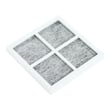
If you are due for a filter, the model uses the genuine Kenmore refrigerator water filter 9980 AGF80300805.
Why it matters
Most “not cooling” and “not making ice” complaints are caused by setup or airflow issues (controls, demo mode, blocked vents, door habits) or water supply limits (pressure, filter). Fixing those first prevents unnecessary sealed-system repairs.
Last updated: February 2026
Where to find model number on Kenmore Elite fridge?
On your Kenmore Elite refrigerator model 79574077610, the model and serial number are printed on an identification label inside the fresh food (refrigerator) compartment, typically on the interior liner. Use that label any time you’re ordering parts or checking the Use & Care information in the owner's manual.
Most common places to check
Look for a white or silver sticker label in one of these spots:
- Inside the refrigerator compartment on a side wall (interior liner)
- On the wall behind the lower crisper drawer area
- Along the door opening frame (near the hinges)
- Under the front grille or kick plate area (less common for the ID label)
Quick steps to find it fast
- Open the refrigerator door and scan the side walls at eye level first.
- If you don’t see it, pull out the crisper drawers and look at the back wall behind them.
- Use a flashlight; the label can be hard to read in low light.
- Write down both the model and serial number; you often need both for service and parts matching.
What the label looks like
The label usually includes:
| Item on label | What it’s used for |
|---|---|
| Model number (example: 79574077610) | Matching parts and diagrams |
| Serial number | Production details and service reference |
| Electrical ratings | Verifying power requirements |
Why it matters
Kenmore Elite refrigerators share similar styling across multiple series (including 795.7407* variants), so the exact model number on the identification label is what ensures you get the correct parts, such as a water filter or ice maker assembly.
Last updated: February 2026
What size is Kenmore refrigerator model 79574077610?
For Kenmore Elite refrigerator model 79574077610 (795.7407* series), the exact exterior dimensions and total capacity depend on the specific color/variant. We list the precise measurements and clearance requirements in the 79574077610 owner's manual, which is the best source for the correct size for your exact unit.
What “size” usually means for this model
When customers ask for the “size” of a bottom-mount refrigerator like the Kenmore Elite 79574077610, it typically refers to one or more of these:
- Overall exterior dimensions (width, depth, height)
- Total capacity (cubic feet)
- Installation clearances (space needed around the cabinet)
- Door swing and pull-out drawer clearance (space needed to fully open)
How to confirm the exact dimensions for your refrigerator
Use these quick checks so you get the right measurement for delivery, cabinetry, or a replacement decision:
- Check the model/serial label inside the fresh food compartment to confirm 79574077610.
- Use the dimensions and installation section in the 79574077610 owner's manual.
- Measure your current unit with a tape measure:
- Width: cabinet edge to cabinet edge
- Height: floor to top of hinge cover (if present)
- Depth: doors closed; note whether you include handles
- If you are fitting into a cutout, measure the opening in three places (top, middle, bottom) to catch out-of-square cabinets.
Typical measurement notes (so you measure the right way)
| Measurement | What to include | Common mistake |
|---|---|---|
| Width | Cabinet; sometimes handles if they protrude past the cabinet | Measuring only the door face |
| Depth | Decide: cabinet-only vs. doors/handles included | Forgetting handle depth |
| Height | Floor to top; include hinge cover if it sits above the cabinet | Measuring to the top of the door only |
Why it matters
Getting the “size” right prevents delivery surprises, door clearance issues, and airflow problems that can affect cooling performance. Proper spacing also helps components like the condenser area run efficiently.
Last updated: February 2026
What is the average lifespan of a Kenmore Elite refrigerator?
Most Kenmore Elite refrigerators, including model 79574077610, typically last 10 to 15 years with normal household use and basic maintenance. Keeping airflow clear, doors sealing tightly, and the cooling system clean helps you get the full expected life from the compressor and sealed system.
Typical lifespan and what to expect
For a modern bottom-mount refrigerator like this Kenmore Elite 795.7407* series, the most common ownership timeline looks like this:
- 0 to 5 years: Mostly routine items (water filters, light bulbs, minor adjustments)
- 5 to 10 years: Higher chance of fan, sensor, or ice maker issues
- 10 to 15 years: Cooling-system wear becomes more likely; repair decisions matter more
- 15+ years: Many units still run, but major repairs can become less cost-effective
What affects lifespan the most
These factors have the biggest impact on how long your refrigerator runs reliably:
- Condenser cleanliness and airflow (dust buildup makes the compressor run longer)
- Door gasket condition (warm air leaks increase run time and frost)
- Stable temperatures (avoid frequent door opening and overloading with hot food)
- Water system upkeep (filter changes help protect the dispenser and ice maker)
- Power interruptions and moves (follow the handling guidance in the 79574077610 owner's manual)
Maintenance checklist (simple, high impact)
Use this short list to extend life and reduce cooling stress:
- Vacuum dust from the condenser area regularly
- Keep food organized to reduce door-open time
- Confirm doors close fully and seals are clean
- Replace the water filter on schedule; use genuine Kenmore refrigerator water filter 9980 AGF80300805
- If the unit was moved or stored on its side, let it stand upright before powering on (per the manual)
Repair vs. replace: a practical guide
| If your fridge is... | A repair usually makes sense when... | Replacement is often smarter when... |
|---|---|---|
| Under 10 years old | The issue is a valve, sensor, ice maker, or control | Multiple systems are failing at once |
| 10 to 15 years old | The fix is straightforward and parts are available | A major sealed-system repair is needed |
| Over 15 years old | It is a minor issue and performance is otherwise strong | Cooling performance is inconsistent or repairs are frequent |
Why it matters
A refrigerator that runs longer than normal to maintain temperature uses more energy and puts extra wear on the sealed system. Basic upkeep helps the compressor cycle normally and can add years to the service life.
Last updated: February 2026
Why is my refrigerator not getting cold at the bottom?
If your Kenmore Elite 79574077610 is warm at the bottom, the most common causes are blocked airflow (items covering vents), control settings such as Demo Mode, or poor heat release from dusty condenser coils. Use the steps below and confirm control settings in the 79574077610 owner's manual.
Quick checks that fix most “warm bottom” complaints
- Make sure cooling is turned ON (not set to OFF on models that have that option).
- Disable Demo Mode if it is enabled.
- After installation or moving, allow up to 24 hours for temperatures to stabilize.
- Clear blocked air vents; rearrange food so air can circulate.
- Reduce long or frequent door openings; warm, humid air raises compartment temperature.
Clean the condenser area (common cause)
Dirty coils make it harder to shed heat, so the refrigerator section can warm, including the lower shelves and crisper area.
- Unplug the refrigerator.
- Vacuum and brush the coil and grille area.
- Restore power; recheck temperatures after several hours.
If the coil is damaged, the model-specific replacement is the refrigerator condenser coil ACG73645004.
If the bottom is warm but the top feels colder
This pattern points to airflow restriction or frost buildup around the evaporator area.
| What you notice | Likely issue | First action |
|---|---|---|
| Weak airflow at vents | Vent blockage or fan airflow problem | Clear vents, listen for fan |
| Frost on back wall | Defrost/airflow restriction | Move food, check for frost |
| Temps improve after defrost | Frost returning | Inspect for recurring frost |
Why it matters
Bottom-mount refrigerators depend on steady airflow; when vents are blocked or coils are dirty, temperatures stratify and food in the lower fresh-food area can warm into an unsafe range.
Last updated: February 2026