Installation guide
 Owner’s manual
 Error Codes


Is Kenmore Elite high end?
Yes. Kenmore Elite is Kenmore’s higher-end line, positioned above standard Kenmore models and typically built with more premium features, finishes, and performance options. For your Kenmore washer model 11016882503, the exact feature set depends on the specific series and controls listed in the 11016882503 owner's manual.
Kenmore Elite models commonly add upgrades that matter in day-to-day use, such as:
- More cycle and temperature options for better fabric care
- Higher-capacity tubs or improved load handling (varies by model)
- Quieter operation features (cabinet insulation, improved suspension)
- More advanced dispensers and rinse options
- More robust components in key drive and wash systems
We recommend checking the model badge and the documentation for your exact naming.
- Look for “Elite” on the console, lid, or model/serial tag
- Match the full model number exactly: 11016882503
- Compare the listed cycles, water level selections, and dispenser style in the manual
- Confirm installation requirements and electrical/water specs in the install guide
| What to check | Where you’ll see it | Why it matters |
|---|---|---|
| Branding (Elite vs standard) | Console or model tag | Confirms product tier and feature expectations |
| Cycle selections | Control panel and manual | More options usually indicates a higher-tier design |
| Dispenser setup | Under lid/rim area | Elite lines often add convenience features |
| Installation requirements | Install guide | Helps prevent noise, vibration, and “walking” |
Knowing whether your washer is Kenmore Elite helps set expectations for features and also helps you choose the right replacement parts (for example, lid switch, drain pump, or drive components) when troubleshooting performance issues.
Last updated: January 2026
How to do a hard reset on a Kenmore washer?
A hard reset on your Kenmore washer model 11016882503 is usually as simple as removing power long enough for the control to fully clear, then restarting a cycle. For this model, we recommend a power reset first, then a basic start/stop reset using the cycle control knob as described in the 11016882503 owner's manual.
- Turn the washer OFF.
- Unplug the power cord (or switch the breaker OFF).
- Wait 2 minutes.
- Restore power.
- Set a normal cycle and start the washer.
These model-appropriate checks often solve what looks like a “stuck” control.
- Make sure the lid is fully closed; many top-load Kenmore washers will not spin with an open lid.
- Stop the washer by pushing in the cycle control knob, then restart by pulling the knob out (this matches the start/stop method in the manual).
- Confirm the washer is level; excessive vibration can interrupt operation. The 11016882503 installation guide shows how to level the cabinet and tighten the leveling-foot locknuts.
- If the washer will not spin or drain after a reset, inspect the drain path for clogs (standpipe, laundry tub, drain hose routing).
- If the washer acts like the lid is open even when it is shut, a failed lid switch is a common cause.
| Symptom after reset | Most common cause | Part to consider |
|---|---|---|
| Won’t spin, won’t agitate | Lid safety circuit not closing | Washer lid switch assembly WP8318084 |
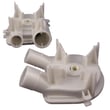
| Hums but won’t drain | Pump jammed or failing | Washer drain pump WP3363394 |
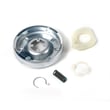
| Motor runs but basket/agitator doesn’t move | Drive coupling worn | Washer motor coupling 285753A |
A true hard reset clears temporary control “logic” issues after a power flicker or interrupted cycle. If the same problem returns immediately, the washer is usually reacting to a real condition (lid switch, drain problem, out-of-level vibration) rather than needing repeated resets.
Last updated: January 2026
What is the most expensive part on a washer?
On the Kenmore 11016882503 washer, the most expensive repairs are usually the wash basket (drum) and the drive system that turns it (gear case and related components). These parts are large, labor-intensive to access, and often replaced as assemblies rather than repaired.
On many top-load Kenmore washers like 11016882503, the highest-cost items tend to be the components that move the basket and handle heavy mechanical loads.
- Wash basket (drum): large part, costly to ship and replace
- Gear case / transmission: major drive component, high labor to access
- Drive motor: expensive electrical component
- Control panel: can be costly if the issue is electronic
- Clutch and drive hardware: usually mid-range, but can add up with labor
Here are a few commonly higher-priced parts listed for Kenmore 11016882503 to help set expectations:
| Part type | Example part from this model | Why it can cost more |
|---|---|---|
| Wash basket (drum) | Basket W10389328 | Large assembly; major teardown |
| Gear case / transmission | Gear 3360629 | Core drive component; labor-heavy |
| Drive motor | Washer drive motor WP8529935 | High-cost motor assembly |
| Controls | Control panel 8566631 | Electronics and overlays |
If the washer is noisy, vibrating, or going off-balance, the cause can be simple (leveling, load size) or it can point toward wear in major moving parts. Checking the basics first can prevent replacing an expensive assembly unnecessarily.
We recommend ruling out common, low-cost causes first:
- Confirm the washer is level and all feet are firmly on the floor
- Evenly distribute the load; avoid overloading above the basket holes
- Verify shipping materials were removed (common source of vibration)
- Listen for normal sounds (gear engagement, pump humming during drain)
- Review setup and operating checks in the 11016882503 owner's manual
Last updated: January 2026
How to unclog drain hose on Kenmore washer?
On Kenmore washer model 11016882503, we unclog the drain hose by unplugging the washer, draining any standing water, then removing and flushing the hose to clear lint, coins, or small clothing items. Reinstall the hose at the correct height with an air gap to prevent repeat drain problems.
- Unplug the washer before moving it or removing hoses.
- Turn off both water taps.
- Keep towels and a shallow pan ready for water spill.
- Use gentle tools only; corrugated hoses puncture easily.
- Drain the tub: Lower the end of the drain hose into a bucket or floor drain to let gravity empty the water.
- Remove the hose: Pull the corrugated drain hose out of the cabinet and disconnect it from the drain path (at the pump connection).
- Clear and flush:
- Run hot tap water through the hose.
- Work out debris with a flexible drain snake or straightened coat hanger (light pressure).
- Check the standpipe or laundry tub drain; a slow house drain can mimic a hose clog.
- Reinstall correctly: Route the hose without kinks and secure it as shown in the 11016882503 installation guide.
The manual specs for this model matter for reliable draining.
- Keep the top of the drain hose at least 39 inches (99 cm) above the floor.
- Do not raise the drain outlet above 96 inches (244 cm).
- Do not tape or seal the hose to the standpipe; it needs an air gap.
| Setup item | Correct for 11016882503 | If incorrect |
|---|---|---|
| Hose height | 39 to 96 inches | Won’t drain, siphoning, slow drain |
| Standpipe fit | Secure but loose (air gap) | Backflow, slow drain |
| Hose routing | No kinks or pinches | Pump strain, poor draining |
If the hose is clear but draining is still slow, the pump can be jammed or worn. A common replacement for this model is the washer drain pump WP3363394.
A restricted drain hose can leave water in the tub, make the cycle seem stuck, and overwork the drain pump. Correct hose height and an air gap also prevent siphoning and dirty water returning to the washer.
Last updated: January 2026