 Installation guide
 Owner’s manual


How to hard reset a Kenmore dryer?
To hard reset your Kenmore gas dryer model 11070222510, unplug the dryer (or turn off the breaker) for 1 to 5 minutes, then restore power and try a cycle. This clears many temporary control glitches, but it will not fix airflow, door, or heating safety issues.
Hard reset steps (safe, quick)
- Turn the dryer OFF.
- Unplug the power cord (or switch the dryer circuit breaker OFF).
- Wait 1 to 5 minutes.
- Restore power.
- Close the door fully, then press and hold Start until you hear the drum begin moving.
- If the dryer was stored or moved, follow the power and gas shutoff guidance in the 11070222510 owner's manual.
If it still will not start after a reset
The manual points to a few common causes that a reset will not solve:
- Door not fully closed.
- Start button not pressed firmly or held long enough.
- House fuse blown or breaker tripped.
- For gas models: supply line shut-off valve not open.
Quick checks
| Symptom | What to check first | What it points to |
|---|---|---|
| No response at all | Outlet, breaker, cord | Power supply issue |
| Clicks but no run | Door fully latched | Door switch or latch issue |
| Runs but no heat | Gas shut-off valve open | Gas supply or ignition issue |
Why it matters
A hard reset only clears the control state. If the dryer is not running or not heating because of power, door-latch, gas supply, or airflow problems, the dryer needs a basic inspection and correction, not repeated resets.
Last updated: January 2026
Does a gas dryer need a special outlet?
For Kenmore gas dryer model 11070222510, you typically do not need a special 240-volt dryer outlet. This model uses a standard 120-volt, 60 Hz grounded 3-prong outlet on a dedicated 15- or 20-amp circuit (no adapters or extension cords). See the 11070222510 installation guide.
What outlet and circuit we recommend
- Use a grounded 3-prong (120V) outlet within about 2 ft of either side of the dryer
- Put the dryer on a separate 15- or 20-amp circuit
- Use a time-delay fuse or circuit breaker
- Do not use an adapter
- Do not use an extension cord
Quick comparison: gas vs. electric dryer power
| Dryer type | Typical outlet | Typical circuit | What’s “special” |
|---|---|---|---|
| Gas dryer (like 11070222510) | 120V grounded 3-prong | 15 or 20 amp | Standard household outlet, dedicated circuit recommended |
| Electric dryer | 240V dryer receptacle | Often 30 amp | Higher voltage outlet and heavier cord |
Why it matters
The 120V outlet powers the motor, controls, and igniter system, and proper grounding reduces shock risk. A dedicated 15- or 20-amp circuit also helps prevent nuisance trips that can stop a cycle mid-dry.
If you’re having power-related symptoms
If the dryer will not start, trips the breaker, or runs but behaves erratically, check these common items first:
- Outlet is grounded and wired correctly
- Breaker/fuse is not weak or tripping under load
- Cord is fully seated in the outlet (no loose fit)
- No extension cord in use
- Dryer is installed per the 11070222510 installation guide
Last updated: January 2026
How to figure out dryer model number?
For your Kenmore gas dryer, the model number is printed on the model and serial tag; on model 11070222510, it’s typically found around the door opening (door frame) or on the cabinet. Use the exact model number to match the right parts and instructions in the 11070222510 owner's manual.
Where to look on a Kenmore dryer
Check these common label locations first:
- Door frame or the inside rim of the door opening (most common)
- Inside the door area near the lint screen housing (varies by design)
- Back of the dryer cabinet
- Behind the lower front access panel (common on many gas dryers)
- Side panel edge near the front of the cabinet
What the model tag looks like (and what to write down)
On the tag, we recommend recording these items exactly as shown:
- Model number (example: 11070222510)
- Serial number (helps confirm production series for some parts)
- Type (gas dryer) and any electrical rating info
Quick ID checklist
| Item on tag | Why it matters | Example format |
|---|---|---|
| Model number | Ensures correct part fit and diagrams | 110.70222510 or 11070222510 |
| Serial number | Helps narrow revisions and date range | Letters and numbers |
| Gas info plate details | Helps with installation and service checks | BTU rating, etc. |
Why it matters
Kenmore model numbers that start with 110 are part-family identifiers; a single digit difference can change the belt, igniter, thermostat, or drum support parts that fit. Using the exact model number helps us match items like the belt 341241 correctly.
After you find it: best next steps
- Compare the tag model number to what’s on your receipt or old parts box
- Use the model number to follow venting and clearance guidance in the 11070222510 installation guide
- If you’re ordering parts, match by model first, then confirm by part diagram location
Last updated: January 2026
What are common problems with Kenmore dryers?
Common problems on Kenmore dryers like model 11070222510 include no heat, the dryer not starting, long dry times, and unusual noises. Many of these issues trace back to airflow restrictions (lint buildup or venting), simple setup problems (door not fully closed, dryer not level), or worn drive and heat-system parts.
Most common symptoms and what usually causes them
- Dryer will not run: door not fully closed, start button not held long enough, or a tripped breaker or blown fuse (electric models can tumble but not heat)
- No heat (gas dryer): gas supply valve closed, ignition system issue, or a safety device opened due to overheating
- Long dry times: clogged lint screen, restricted venting, or poor airflow
- Loud thumping or rattling: small items caught at the drum edge, or a load that is balled up
- Vibration: dryer not level or leveling legs not installed correctly
Quick checks we recommend first (fast, no parts)
- Clean the lint screen and confirm strong airflow at the outside vent hood.
- Confirm the door closes firmly and the cycle actually starts (hold Start until the drum moves).
- For gas models, confirm the gas shutoff valve on the supply line is fully open.
- Level the dryer front-to-back and side-to-side; recheck after moving it.
- Check pockets for coins, buttons, or clips that can get trapped at the drum edges.
Common parts involved (when a repair is needed)
| Symptom | Commonly involved part | Example part for this model |
|---|---|---|
| Drum not turning | Drum belt or drive system wear | Belt 341241 |
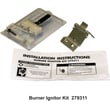
| No heat (gas) | Ignition component | Igniter 279311 |
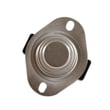
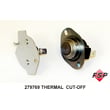
| Overheats or shuts heat off | Thermostat or thermal cut-off | Dryer operating thermostat WP3387134 |
Why it matters
A restricted vent or clogged lint screen can cause long dry times and overheating, which can trip safety devices and create repeat failures. Fixing airflow and leveling first often prevents unnecessary part replacement.
For model-specific operating and troubleshooting steps, use the 11070222510 owner’s manual.
Last updated: January 2026








