Owner’s manual


How to hard reset a Kenmore dryer?
For the Kenmore electric dryer model 11068932792, a hard reset is simple: unplug the dryer (or switch the breaker OFF) for about 1 minute, restore power, then set the timer and press PUSH TO START. This clears many temporary power or control issues; if it still will not run, troubleshoot the start and safety circuits next using the 11068932792 owner's manual.
Hard reset steps (safe, quick)
- Turn the cycle selector (timer) to OFF.
- Unplug the dryer from the outlet; or turn the dryer breaker OFF.
- Wait 60 seconds.
- Restore power.
- Set a Timed Dry cycle and a temperature setting.
- Close the door firmly and press PUSH TO START.
If it still will not start after the reset
These checks match the most common “won’t run” causes for this style of Kenmore dryer:
- Door not fully closed: the dryer will not run if the door switch is not made.
- Start button not pressed firmly: press and hold PUSH TO START briefly.
- Controls not set to an ON position: reselect the cycle and temperature.
- Power problem: reset tripped breakers or replace blown fuses (use time-delay fuses where applicable).
- Restricted airflow: clean the lint screen and check the venting for kinks or clogs.
What a reset can and cannot fix
A hard reset helps when the dryer is “confused” after a power flicker or an interrupted cycle. It will not fix a failed part.
| Symptom after reset | Most likely direction | What to do next |
|---|---|---|
| Nothing happens at all | Power, door switch, start circuit | Verify breaker/fuse, door closure, control settings |
| Motor hums but drum will not turn | Belt or drum support issue | Inspect drum support rollers and idler system |
| Runs but no heat | Heating circuit problem | Check heating element and safety thermostats/fuses |
Why it matters
Resetting first prevents unnecessary part replacement. If the dryer still will not run, the next steps (power, door switch, airflow) target the exact conditions that commonly stop a dryer for safety and performance.
Last updated: February 2026
What size is a Kenmore 11068932792 dryer?
The Kenmore 11068932792 is a 27-inch wide electric dryer. For exact cabinet dimensions and required installation clearances (including the recommended space behind the dryer for venting), we follow the specifications shown in the 11068932792 owner's manual.
What “27-inch wide” means
This model is built on a standard full-size platform. In most laundry rooms, that means it fits the same footprint as many other 27-inch Kenmore and Whirlpool-built dryers.
Typical sizing expectations for a 27-inch dryer:
- Width: about 27 inches
- Height: commonly around 38 to 44 inches (varies by console style and leveling legs)
- Depth: commonly around 27 to 30 inches (not including the vent connection)
- Door swing: plan space so the door can open fully
Installation clearance you should plan for
Even if the cabinet fits, the vent and cord need room. The manual notes that most installations need clearance behind the dryer for the vent.
Recommended planning checklist:
- Leave at least 5 inches behind the dryer for the vent connection
- Make sure the vent is not crushed or kinked
- Confirm the location allows the dryer door to fully open
- Keep the dryer in an area above 45°F for proper automatic cycle operation
- Install on a level floor; adjust leveling legs as needed
Quick reference table
| Measurement | What to use for planning |
|---|---|
| Dryer width | 27 inches (model platform size) |
| Rear clearance | At least 5 inches for venting |
| Temperature | Above 45°F for normal cycle performance |
Why it matters
Correct sizing is not just about fitting the cabinet into a closet; it helps prevent airflow restrictions. Proper vent clearance reduces long dry times and helps protect key heating and safety components such as the dryer thermal fuse WP3390719 and dryer heating element WP3387747.
Last updated: February 2026
Is it worth replacing the heating element in a dryer?
Yes; for a Kenmore 11068932792 electric dryer, replacing a failed heating element is usually worth it because the part cost is typically far less than replacing the whole dryer, and it can restore normal drying performance when the rest of the machine is in good shape. See the 11068932792 owner's manual for the recommended heat-cycle check and troubleshooting steps.
When replacement makes sense
Replacing the heater is a strong choice when the dryer tumbles normally but does not heat, or heat is weak and inconsistent.
- The dryer runs but clothes stay damp (no heat)
- You have proper airflow at the outside vent hood after cleaning lint
- The cycle is not set to AIR DRY/AIR FLUFF
- The drum turns and the timer advances normally
- The dryer is otherwise in good condition (drum support rollers, belt, motor sound normal)
What to check before you buy a heating element
Our manual troubleshooting for “Not drying satisfactorily” points to a few common non-part causes first, especially airflow and power supply.
| Symptom | Common cause | What we do first |
|---|---|---|
| Dryer runs, no heat | One house fuse blown or breaker tripped (electric dryers can run on 120V but need full 240V to heat) | Reset breaker, check both legs of power |
| Long dry times | Restricted venting or crushed/kinked vent | Clean venting, confirm strong airflow |
| No heat on some cycles | Wrong setting (AIR DRY/AIR FLUFF) | Select a heated cycle |
| Heat cuts out | Overheating from poor airflow; safety devices open | Fix venting before replacing parts |
Parts that are commonly replaced with (or instead of) the element
If you confirm the dryer has proper airflow and correct voltage, heat problems often involve the heater circuit parts.
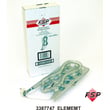
- Dryer heating element WP3387747 (the heater itself)
- Dryer thermal fuse WP3390719 (opens if the dryer overheats)
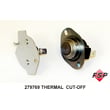
- Cut-off kit 279769 (thermal cut-off components used in the heater housing area)
- Dryer high-limit thermostat WP3390291 (limits heater temperature)
- Thermistor WP8577274 (temperature sensing on some cycles)
Why it matters
A new heating element can fail early if the real issue is restricted exhaust airflow. The manual specifically calls out checking air movement at the outside exhaust hood and cleaning the exhaust system when airflow is weak; fixing venting first protects the new heater and helps drying times.
Last updated: February 2026
What are signs of a bad dryer heating element?
A failing heating element in your Kenmore 11068932792 electric dryer usually shows up as no heat or very slow drying, even though the drum tumbles normally. You may also notice a hot or “electrical” odor, but a brief odor on first use can be normal (see the 11068932792 owner's manual).
Common symptoms you can see (and what they point to)
- Dryer runs but clothes stay damp or cold: heating element may be open (burned out) or not getting power.
- Dry times suddenly get much longer: weak heat, restricted airflow, or a cycling temperature problem.
- Burning smell with poor drying: element coil can sag and contact metal housing, or lint is overheating.
- Breaker trips when heat turns on: element can short to the heater housing.
- Heat for a few minutes, then no heat: often airflow restriction or a safety device opening (thermal fuse or cut-off).
Quick checks before replacing parts
- Run a timed heat cycle (not Air Dry). After about 5 minutes, open the door and check for heat (the manual uses this as a basic heat check).
- Clean the lint screen before every load; a blocked screen increases drying time and can contribute to overheating.
- Check airflow: weak airflow at the outside vent hood can mimic a bad element.
- Confirm power: electric dryers typically need full 240V supply; a partial power loss can let the motor run with little or no heat.
Parts commonly involved in “no heat” on this model
| Symptom | Most likely area | Example part on this page |
|---|---|---|
| No heat at all, tumbles normally | Heater circuit | Dryer heating element WP3387747 |
| No heat and dryer shuts down or won’t restart until cooled | Overheat protection | Dryer thermal fuse WP3390719 |
| Overheats or cycles heat oddly | Temperature sensing | Thermistor WP8577274 |
Why it matters
Running with low heat or restricted airflow wastes energy, extends cycle times, and can overheat components. The manual also warns that operating with a damaged or blocked lint screen can cause overheating and damage.
Last updated: February 2026
How do I know if my dryer start switch is bad?
If your Kenmore electric dryer model 11068932792 will not start when you press PUSH TO START, a bad start switch is a common cause, especially if the dryer only runs while you hold the button. First confirm the correct start sequence in the 11068932792 owner's manual.
Symptoms that point to a bad start switch
Look for one or more of these signs:
- You press PUSH TO START and nothing happens
- The dryer runs only while you keep the button pressed
- The button feels sticky, loose, or does not click consistently
- The dryer will not restart unless you press PUSH TO START again
- Power is on and controls are set, but the motor never engages
Rule out the basics first (no-start checklist)
The manual notes the dryer will not run unless these conditions are met:
- Door is closed tightly (opening the door stops the dryer)
- Cycle selector (timer) is set to a drying cycle or air setting, not OFF
- Power supply is on; reset the breaker or replace blown fuses
- PUSH TO START is pressed firmly
| What you observe | Most likely area to check | What it means |
|---|---|---|
| No sound at all | Power, door switch, start switch | Start circuit is not completing |
| Hums but won’t run | Motor, drum/blower jam, start circuit | Motor is energized but can’t turn |
| Runs only while holding button | Start switch | Switch is not closing properly |
How we test the start switch (continuity)
- Unplug the dryer or shut off power at the breaker.
- Access the console and locate the push-to-start switch (use the manual for panel access).
- Label wires and remove them from the switch terminals.
- Meter test on continuity/ohms:
- Not pressed: open (no continuity)
- Pressed: closed (continuity, near 0 ohms)
Why it matters
The start switch completes the start circuit to the drive motor; if it cannot close electrically, the drum will not begin turning even when the timer and temperature controls are set.
Last updated: February 2026