Owner’s manual
 Error Codes


Does the Whirlpool WRB322DMBM00 have a water filter?
No. The Whirlpool WRB322DMBM00 bottom-mount refrigerator does not use a built-in refrigerator water filter for drinking water or ice; any water quality depends on your home supply or an external inline filter.
How to confirm on your model
We recommend checking the feature list and diagrams in the WRB322DMBM00 owner's manual. On models without a built-in filter, you will not find a filter housing, filter cap, or a “replace filter” indicator.
Quick checks you can do:
- Look for a filter door or twist-out cap inside the fresh food compartment (usually upper right, upper left, or base grille area).
- Check for a “Filter Reset” button or filter status light on the control panel.
- Inspect the rear lower area for a factory filter head and short cartridge.
- If you only see an air vent or return duct, that is for airflow, not filtration.
What to do if you want filtered water anyway
If your WRB322DMBM00 is connected to a water line for an ice maker, filtration is typically handled by a household system or an inline filter installed on the supply line.
| Option | Where filtration happens | Best for |
|---|---|---|
| Whole-home filter | At the main water entry | Filtering all cold water taps |
| Under-sink filter | At the kitchen cold line | Drinking water at the sink |
| Inline refrigerator filter | Behind the fridge on the supply line | Ice maker water quality |
For step-by-step guidance, use how to replace the water filter in a Whirlpool refrigerator and apply the same “shut off water, relieve pressure, check for leaks” process to an inline setup.
Why it matters
Installing the wrong filter type or searching for a non-existent filter location wastes time and can lead to unnecessary disassembly. Knowing this model does not use a cartridge filter helps you focus on the water supply, ice maker performance, and leak-free connections.
Last updated: February 2026
What is the life expectancy of a Whirlpool refrigerator?
A Whirlpool refrigerator like model WRB322DMBM00 typically lasts 10 to 18 years. With steady maintenance (good airflow, clean condenser area, tight door seals, and stable temperatures), many units reach the mid to upper end of that range.
What affects lifespan the most
- Condenser cleanliness and airflow (dust buildup makes the compressor work harder)
- Door gasket condition (air leaks cause longer run times and frost issues)
- Ice maker and water system health (leaks and clogs create avoidable wear)
- Temperature settings and loading habits (overpacking blocks vents)
- Power quality (surges and frequent outages stress the control board)
Maintenance schedule we recommend
Use your WRB322DMBM00 owner's manual for model-specific care steps and intervals.
| Task | How often | Why it helps |
|---|---|---|
| Vacuum dust from the condenser area and grille | Every 6 to 12 months | Reduces compressor run time |
| Check door seal for gaps and clean it | Every 3 to 6 months | Prevents warm air leaks |
| Keep vents clear inside fresh food and freezer | Monthly | Maintains even cooling |
| Level the refrigerator so doors close on their own | As needed | Protects gaskets and prevents sweating |
Signs your refrigerator is nearing end-of-life
- Food temperatures swing even after adjusting controls
- The unit runs almost constantly or gets unusually loud
- Frost builds up quickly in the freezer or airflow feels weak
- Water shows up under the unit or inside the fresh food section
- Ice production becomes inconsistent (if equipped)
Parts that commonly extend usable life
Replacing a worn part early often prevents bigger failures.
- If cooling airflow is weak or noisy, the evaporator fan system is a common fix area (for example, refrigerator evaporator fan motor W11024089).
- If the freezer door is leaking air, replacing the correct gasket can restore efficiency (for example, refrigerator freezer door gasket (gray) W10443316).
Why it matters
A refrigerator that runs longer than it should uses more electricity and puts extra strain on high-cost components like the compressor and electronic control board. Simple upkeep and timely part replacement usually deliver the longest service life.
Last updated: February 2026
What is the most common problem with a Whirlpool refrigerator?
The most common Whirlpool refrigerator problem is a cooling complaint (food not staying cold enough or freezer warming up). On the Whirlpool WRB322DMBM00, the most frequent root causes are airflow and heat-transfer issues such as dirty condenser coils, an evaporator fan problem, or frost buildup from a defrost issue; all of these reduce cooling performance.
Quick checks we recommend first
- Confirm the controls are set correctly and the doors fully close.
- Clean condenser coils and the grille area; restricted airflow is a top cause of warm temps.
- Listen for the evaporator fan in the freezer; no fan sound often points to a fan motor or blade issue.
- Look for heavy frost on the freezer back panel; that often indicates a defrost system problem.
- Check door gaskets for gaps, tears, or sections not sealing.
Common symptoms and the parts that often fix them
| Symptom | Most likely area | Example part for WRB322DMBM00 |
|---|---|---|
| Refrigerator warm, freezer OK | Airflow from freezer to fresh food | Refrigerator evaporator motor W11024089 |
| Both sections warm | Heat not being rejected, control issue | Refrigerator electronic control board WPW10503278 |
| Frost blanket on freezer panel | Defrost system not clearing ice | Refrigerator defrost heater WP12729128 |
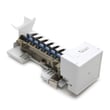
| Ice maker not making ice | Ice maker module or water supply | Refrigerator ice maker assembly W10884390 |
| Water leaking inside or under unit | Drain system or inlet valve | Extension-dr W10619951 or refrigerator water inlet valve WPW10498976 |
Why it matters
Cooling problems usually start small (longer run times, soft ice cream, warm milk) and can quickly lead to food spoilage and compressor strain. Fixing airflow, defrost, or sealing issues early is the fastest way to restore stable temperatures.
Where to confirm model-specific steps
Use the WRB322DMBM00 owner's manual for control settings, cleaning guidance, and any model-specific troubleshooting steps before replacing parts.
Last updated: February 2026