Owner’s manual
 Error Codes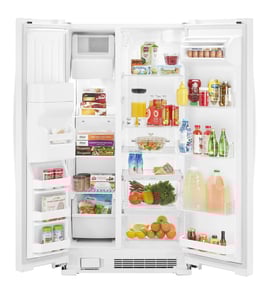

How big is a 23 cubic feet refrigerator?
A 23 cu. ft. refrigerator is a full-size unit; most are about 36 inches wide and roughly 69 to 71 inches tall, with depth varying by design and handle style. For the GE GSS23GSKKCSS, use the GSS23GSKKCSS owner's manual to confirm the exact cabinet and clearance dimensions for your installation.
Typical size ranges you can expect
Most 23 cu. ft. refrigerators (including many side-by-side models) fall into these common ranges:
- Width: 35 to 36 inches
- Height: 68 to 71 inches
- Depth (cabinet only): 28 to 31 inches
- Depth (with doors/handles): often several inches deeper than the cabinet
- Required space: add clearance for airflow and water line connections
What the manual tells us for 23 cu. ft. GE installations
GE installation guidance for 23 cu. ft. models commonly calls for small but important clearances for airflow and hookups. Use these as planning targets, then match them to your exact configuration in the manual:
| Measurement type | Typical planning target | Why it matters |
|---|---|---|
| Width | ~36 in. | Cabinet opening fit |
| Height | ~70 in. | Overhead cabinet clearance |
| Side clearance | ~1/8 in. each side | Door swing and airflow |
| Top clearance | ~1 in. | Heat dissipation |
| Back clearance | ~1/2 in. | Air circulation and water line |
Why it matters (before you measure the opening)
A “23 cu. ft.” rating describes interior storage volume, not the outside footprint. Two 23 cu. ft. refrigerators can differ a lot in depth depending on door bins, hinges, handles, and whether it is counter-depth.
Quick measuring checklist
- Measure the opening width at the front and back
- Measure height to the lowest overhead cabinet/trim
- Measure depth to the wall, then account for baseboards and the water line
- Plan for door swing and space to remove drawers/shelves
- Confirm clearances and leveling steps in the GSS23GSKKCSS owner's manual
Last updated: February 2026
How to reset GE refrigerator control board?
To reset the control board on a GE GSS23GSKKCSS side-by-side refrigerator, we recommend a power reset: unplug the refrigerator (or switch off the breaker) for 5 minutes, then restore power. This clears many temporary control glitches and also exits showroom mode on this model.
Quick reset steps (recommended)
- Unplug the refrigerator from the wall outlet (or turn the circuit breaker off).
- Wait 5 minutes.
- Plug it back in (or turn the breaker on).
- Confirm the display and interior lights come back on.
- Allow the refrigerator time to stabilize; normal cooling can take up to 24 hours after power is restored.
If it still is not running or looks “off”
The manual troubleshooting guidance for this GE platform points to a few common causes that look like a control problem but are not.
- Defrost cycle: wait about 30 minutes; the refrigerator may not run during defrost.
- Controls set to 0 (off): move the freezer control to a colder setting.
- Outlet or breaker issue: verify the outlet has power; reset the breaker if tripped.
- Showroom mode: unplug and plug back in (the power reset above is the fix).
What you should see after a successful reset
| Item | Normal result | What it suggests if not normal |
|---|---|---|
| Interior lights | Turn on when door opens | Power supply or door switch issue |
| Fans/compressor | May start after a short delay | Defrost cycle, control setting, or component issue |
| Temperatures | Improve gradually | Allow up to 24 hours after reset |
Why it matters
A power reset is the safest first step because it restores the electronic control board to a clean startup state without disassembly. If symptoms continue after the reset and basic checks, the issue is often in a related system (cooling airflow, sensors, or a failed board).
For model-specific control locations and operating instructions, use the GSS23GSKKCSS owner's manual. For diagnostic help when the display shows a fault, use GE refrigerator error codes.
Last updated: February 2026
What is the most common problem with a GE refrigerator?
The most common GE refrigerator problem is a cooling complaint (warm fridge or freezer), usually tied to airflow or heat removal issues such as dirty condenser coils, a failing evaporator fan, or frost buildup from a defrost problem. On the GE GSS23GSKKCSS, ice maker and water dispenser issues are also frequent.
Most common symptoms we see
- Refrigerator section is warm but freezer seems closer to normal
- Freezer is warm and ice cream is soft
- Unit runs a lot or seems louder than usual
- Frost or snow buildup on the freezer back wall
- Ice maker is slow or not making ice
- Water dispenser flow is weak
Quick checks that fix many “not cooling” calls
- Confirm settings: Make sure temperature controls were not bumped.
- Clean condenser area: Dust on coils reduces heat transfer and causes poor cooling.
- Listen for the evaporator fan: When the freezer door switch is held closed, you should typically hear the fan running.
- Check for blocked vents: Overpacked shelves can block airflow between compartments.
- Look for defrost clues: Heavy frost on the freezer rear panel points to a defrost system issue.
Parts that commonly relate to these problems (for GSS23GSKKCSS)
| Symptom | Common cause | Example part for this model |
|---|---|---|
| Warm temps, poor airflow | Evaporator fan not moving air | Refrigerator evaporator fan motor WR60X10307 |
| Temps swing, inconsistent cooling | Sensor reading incorrectly | GE profile refrigerator temperature sensor WR55X10025 |
| Frost buildup, warm fridge | Defrost system not terminating properly | Refrigerator defrost bi-metal thermostat WR50X10065 |
| No ice or no water | Water supply not opening correctly | Refrigerator water inlet valve WR57X30890 |
| Slow water, odd taste | Clogged/expired filter | GE refrigerator water filter XWFE |
Why it matters
Cooling and ice maker problems often share the same root causes: restricted airflow, poor heat removal, or water flow restrictions. Fixing the underlying issue protects food temperatures, reduces run time, and helps prevent repeat failures.
Helpful model-specific references
- Use the GSS23GSKKCSS owner’s manual to confirm temperature settings, filter location, and normal operating sounds.
- If you’re troubleshooting dispenser or ice issues, follow steps from how to disassemble the ice and water dispenser on a GE refrigerator.
Last updated: February 2026