 Installation guide
 Owner’s manual


What is the capacity of the wtw8000dw2?
The Whirlpool WTW8000DW2 washer has a 5.3 cu. ft. capacity, which is considered a large-capacity top load washer. That size is designed to handle bulky items (like comforters) and larger mixed loads while still using HE detergent as specified in the WTW8000DW2 owner's manual.
What 5.3 cu. ft. means for everyday loads
A 5.3 cu. ft. basket typically supports fewer loads per week because you can wash more at once. To get the best cleaning and rinsing performance, we recommend loading correctly so clothes can circulate around the washplate.
- Load items in loose heaps evenly around the washplate (not tightly packed)
- Use HE (High Efficiency) detergent only
- Avoid adding extra water; the washer senses the load and adds the right amount
- For heavy lint, sand, or pet hair, select Extra Rinse when available
- Mix item sizes (small and large) to reduce tangling and improve balance
Quick capacity guide (common comparisons)
| Capacity range | Typical use case | What you can expect |
|---|---|---|
| 3.5 to 4.4 cu. ft. | Standard capacity | Regular family loads, fewer bulky items |
| 4.5 to 5.2 cu. ft. | Large capacity | Bigger loads, some bulky items |
| 5.3 cu. ft. (WTW8000DW2) | Extra-large capacity | Bulky items and larger mixed loads |
Why it matters
Capacity affects how much you can wash at once, but loading technique affects results just as much. Overpacking can reduce rinsing efficiency and cleaning performance, even in a 5.3 cu. ft. washer.
Last updated: February 2026
What is the life expectancy of a Whirlpool Cabrio washer?
Whirlpool Cabrio washers like the Whirlpool WTW8000DW2 typically last 10 to 14 years with normal household use. With consistent care (proper loading, correct detergent, and routine cleaning), it is common to reach the upper end of that range before major drive, suspension, or control issues make repairs less practical. See the WTW8000DW2 owner's manual for the maintenance routine and operating tips.
Typical lifespan and what affects it
Most Cabrio-style high-efficiency top-load washers land in this range because they use a low-water wash system and rely on components like the drive system, lid lock, and suspension to run smoothly.
Key factors that extend life:
- Avoid chronic overloading and tightly packed loads
- Use HE detergent and measure it carefully
- Run the Clean Washer cycle regularly
- Keep the washer level to reduce vibration and wear
- Address small issues early (slow drain, off-balance, lid not locking)
Signs your Cabrio washer is nearing end of life
If you see these symptoms repeatedly, the washer is often wearing in high-stress areas (drain, spin, suspension, or controls):
- Won’t drain or leaves water in the tub
- Won’t spin or spins inconsistently
- Loud grinding, rubbing, or repeated banging
- Lid won’t lock or the cycle stops mid-wash
- Frequent error codes or unresponsive controls
Common wear parts on WTW8000DW2 (examples)
These are some of the parts that commonly come up when performance drops on this model:
| Symptom | Often-related part | Example part for WTW8000DW2 |
|---|---|---|
| Won’t drain / slow drain | Drain pump or drain hose | Washer drain pump W10876600 |
| Won’t start / stops | Lid lock | Washer lid lock assembly W10810403 |
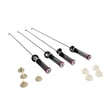
| Excessive shaking / off-balance | Suspension | Damper assembly, tub suspension (set of 4-includes suspension bushings and suspension balls) W11130356 |
| Poor agitation / abnormal wash action | Washplate | Impeller W10752283 |
Why it matters
A realistic life expectancy helps you decide when maintenance and a targeted repair make sense versus when multiple major components (drive, tub, controls) point toward replacement planning. Regular cleaning and correct loading also improve cleaning results in HE low-water operation.
Last updated: February 2026
What problems are common with the WTW8000DW2?
Common problems we see with the Whirlpool WTW8000DW2 washer include off-balance vibration or “walking,” long fill or no-fill, long drain or no-drain, and lid lock related start issues. These symptoms often trace back to load/leveling setup, drain hose installation, or failing components such as the drain pump or lid lock.
Most common symptoms and what usually causes them
- Vibration, rocking, or stopping during spin: unbalanced load, washer not level, feet not locked
- Won’t fill or fills too slowly: closed faucets, clogged inlet screens, kinked inlet hoses, water valve issue
- Won’t drain or leaves clothes wet: drain hose installed incorrectly, clogs, drain pump problem
- Won’t start or stops mid-cycle: lid not closed, lid lock failure, control communication faults
- Residue in dispenser drawer: detergent/additive buildup that needs routine cleaning
Quick checks we recommend first (before replacing parts)
- Level the washer and lock the feet; a solid, flat floor matters.
- Load items in loose heaps evenly around the washplate; avoid single heavy items.
- Confirm hot and cold faucets are fully on.
- Check inlet hose screens for debris and straighten any kinks.
- Verify drain hose setup:
- Standpipe insertion should be 4.5 in (114 mm) or less.
- Drain hose end height should be 96 in (2.4 m) or less.
- Remove clogs; do not tape over the drain opening.
Error codes you may see on this model
Many WTW8000DW2 issues show up as fill, drain, or lid lock codes. Use the troubleshooting and code list in the owner's manual to match the code to the fix.
| What you notice | Common display code | What it points to |
|---|---|---|
| Takes too long to fill | F8E1 or LF | Water supply or fill restriction |
| Takes too long to drain | F9E1, drn, or dr | Drain restriction or pump system issue |
| Lid won’t lock/unlock | F5E2 or F5E3 | Lid lock or lid obstruction |
Parts that commonly solve these problems
If the basic checks do not fix it, these model-matched parts are frequent solutions:
- Drain problems: washer drain pump W10876600
- Lid lock and start issues: washer lid lock assembly W10810403
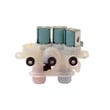
- Fill problems: washer water valve W11220230
- Excessive shaking: damper assembly, tub suspension (set of 4-includes suspension bushings and suspension balls) W11130356
Why it matters
Catching fill, drain, and off-balance problems early helps prevent repeat shutdowns, reduces wear on the drive system, and protects the control from stress caused by repeated long-fill or long-drain conditions.
Last updated: February 2026





