Owner’s manual


Where is the model number on a Kenmore washer?
On Kenmore washer model 11028912790, the model number is printed on a rating label attached to the washer cabinet. You will typically find it around the lid opening area, behind the control panel, or on the cabinet side near the bottom edge; on front-load models it’s often in the door opening.
Most common places to check
- Lift the lid and look around the lid opening (top rim of the cabinet)
- Check the back of the control panel
- Look on the left or right cabinet side near the bottom front edge
- If your washer is front-load style, check the door jamb (inside the door opening)
- If the washer is in a tight space, use a flashlight and take a phone photo to read the label
What the label looks like
The label usually includes the model number and serial number, plus electrical information.
| Label location | What you’ll see | When it’s most likely |
|---|---|---|
| Lid opening rim | Model and serial | Most top-load Kenmore washers |
| Back of console | Model and serial | Some console designs |
| Cabinet side near bottom | Model and serial | When the top rim label is missing |
| Door opening (front-load) | Model and serial | Most front-load washers |
Why it matters
We use the exact model number to match the correct parts and diagrams for your washer, especially for common repairs like a no-spin issue (often tied to the lid switch, drive coupling, or clutch).
For model-specific identification details and label examples, use the 11028912790 owner's manual.
Last updated: January 2026
What is the average lifespan of a Kenmore washer?
A Kenmore washer typically lasts 10 to 15 years. For Kenmore model 11028912790, lifespan depends most on load size, water quality, and how quickly you address wear items like the lid switch, drain pump, and drive components; routine care keeps it closer to the high end.
Typical lifespan by washer type
Most Kenmore washers fall into these ranges:
| Washer type | Typical lifespan | Notes |
|---|---|---|
| Top-load (traditional) | 12 to 15 years | Simpler drive system; often longer life with basic maintenance |
| Front-load | 10 to 12 years | More seals and bearings; maintenance matters more |
What shortens washer life fastest
We see these issues reduce lifespan more than anything else:
- Chronic overloading (stresses the drive system and suspension)
- Running unbalanced loads repeatedly (wears clutch, drive block, and basket support)
- Slow leaks left unchecked (corrosion and bearing damage)
- Poor draining (pump strain and standing water odors)
- Hard water buildup (valves and internal passages)
Parts that commonly affect “end of life” decisions
If your washer won’t spin, won’t drain, or won’t start, these are common repair points on this style of Kenmore washer:
- Washer lid switch WP3949238: prevents spin/agitate if the lid is not sensed as closed
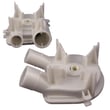
- Washer drain pump WP3363394: drains water; failures often cause no-drain or slow-drain symptoms
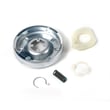
- Coupling 285753A: connects motor to transmission; a frequent wear item on many Kenmore 110 top-load designs
- Clutch 285785: helps the basket reach spin speed; wear can cause weak or no spin
Why it matters
Knowing the 10 to 15 year average helps you decide whether to repair or replace. If your 11028912790 is within that window, replacing a single failed part is often the most cost-effective path, especially when the tub and gear case are still in good shape.
For model-specific use and care steps (load sizing, cycle selection, cleaning), follow the 11028912790 owner’s manual.
Last updated: January 2026
How to hard reset kenmore washer?
To hard reset your Kenmore washer model 11028912790, unplug it (or switch the breaker off) for 2 minutes, then restore power and select a normal cycle to confirm the control responds. This clears many temporary control glitches and restores normal operation.
Hard reset steps (recommended)
- Turn the washer OFF.
- Unplug the power cord (or turn the laundry circuit breaker OFF).
- Wait 2 minutes.
- Restore power.
- Lift and close the lid once, then select a cycle and press Start.
- If the washer still will not start, move to the checks below.
If it still will not run: quick checks that mimic a “reset” problem
Many “needs a reset” symptoms are actually a safety or power-interrupt issue.
- Confirm the outlet has power (test with a lamp).
- Make sure the lid is fully closed; a failed lid switch can stop agitation and spin.
- Cancel the cycle by turning the timer knob to OFF, then reselect the cycle.
- Check that the drain hose is not shoved too far down the standpipe (can cause siphoning and odd behavior).
- If the tub is full of water and will not drain, the pump may be jammed.
Common parts involved when a reset does not fix it
| Symptom | Most common cause | Part to consider |
|---|---|---|
| Won’t start, no spin/agitate | Lid safety circuit not closing | Washer lid switch WP3949238 |
| Hums but won’t drain | Pump jammed or failed | Washer drain pump WP3363394 |
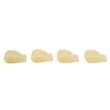
| Agitates weakly or slips | Worn agitator dogs | Agitator dog 80040 |
Why it matters
A hard reset clears a stuck control state, but it will not bypass safety circuits. If the washer immediately stops again after power is restored, focusing on the lid switch, drain system, and drive components saves time and prevents repeat shutdowns.
For model-specific operating steps and cycle-cancel details, use the 11028912790 owner’s manual.
Last updated: January 2026
How to unclog drain hose on Kenmore washer?
To unclog the drain hose on your Kenmore washer model 11028912790, we recommend unplugging the washer, draining any standing water, then removing the drain hose and flushing it out to clear lint, coins, or small clothing items. Reinstall the hose securely to prevent leaks.
Safety and prep
- Unplug the washer from the outlet.
- Turn off both water supply valves.
- Have towels and a shallow pan ready for water.
- If the tub is full, bail out water first or drain through the hose into a bucket.
- Wear gloves; debris in the hose can be sharp.
Step-by-step: clear the clog
- Pull the washer forward and access the rear.
- Locate the drain hose where it connects to the pump and where it exits to the standpipe or laundry tub.
- Place a pan under the pump connection; loosen the clamp and remove the hose.
- Check both ends for obstructions; remove visible debris by hand.
- Flush the hose with hot tap water; for stubborn clogs, gently work a plastic zip tie, flexible brush, or small drain snake through the hose.
- Reinstall the hose and clamps; make sure the hose is not kinked.
- Run a short drain and spin cycle to confirm strong draining and no leaks.
What to check if it still will not drain
- Pump blockage or failure: A jammed or worn pump can mimic a clogged hose; inspect or replace the washer drain pump WP3363394.
- Kinked or crushed hose: Replace a soft, split, or permanently kinked hose with the correct drain hose WPW10358149.
- Lid switch not closing: Many top-load Kenmore washers will not drain or spin if the lid switch is faulty; test the washer lid switch WP3949238.
Quick reference: symptoms and likely causes
| Symptom | Most likely cause | What we recommend |
|---|---|---|
| Hums but does not drain | Pump jammed | Check pump inlet, then consider pump replacement |
| Drains slowly | Partial hose clog | Remove hose and flush thoroughly |
| Drains but leaks | Loose clamp or cracked hose | Reseat clamp or replace hose |
Why it matters
A restricted drain hose forces the drain pump to work harder, which can lead to longer cycle times, poor spin performance, and water left in the tub. Clearing the restriction early helps protect the pump and prevents repeat clogs.
For model-specific access panels, hose routing, and clamp locations, follow the 11028912790 owner’s manual.
Last updated: January 2026