 Owner’s manual


What is the capacity of the LG wt5001cw?
The LG WT5001CW top-load washer has a 4.5 cu. ft. capacity. That is the tub size used to estimate how much laundry this model can handle per load; actual usable space varies a bit with cycle, water level, and load type. See the WT5001CW manual for cycle and loading guidance.
A 4.5 cu. ft. LG washer like model WT5001CW is typically considered a large-capacity top-load washer. For best wash performance, we recommend:
- Load items loosely; do not pack them down
- Keep bulky items (blankets, comforters) balanced around the washplate
- Use the correct cycle for the fabric and soil level
- Use HE detergent and measure carefully to avoid oversudsing
- If the washer struggles to balance, reduce the load size and redistribute
Use this as a simple rule of thumb for the WT5001CW:
| Load type | Typical fit in 4.5 cu. ft. | Best practice |
|---|---|---|
| Everyday mixed laundry | Large load | Leave space at the top for tumbling |
| Towels | Medium to large | Mix sizes; avoid all heavy bath towels |
| Bulky bedding | 1 large item (varies) | Use Bulky/Bedding cycle if available |
Capacity affects cleaning and spin performance. Overloading can cause poor agitation, out-of-balance spinning, and extra wear on suspension and drive components.
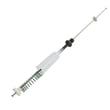
If you are troubleshooting balance or vibration issues, the washer suspension rod and spring assembly 4902FA1665W is one of the model-specific parts commonly involved in stabilizing the tub during spin.
Last updated: January 2026
Can I fix an IE error myself?
Yes, in many cases you can fix an IE (inlet error) on your LG WT5001CW by correcting a water-supply issue such as closed valves, kinked hoses, or clogged inlet screens. If water supply checks out, the problem can be a failed fill component like the inlet valve; use the WT5001CW manual for model-specific guidance.
IE typically indicates the washer is not detecting enough water entering the tub within the expected time.
- Make sure both hot and cold supply valves are fully open.
- Confirm the fill hoses are not kinked, crushed, or frozen.
- Verify the home water pressure is adequate at the washer hookups.
- Remove and rinse the small inlet screens where the hoses connect to the washer.
- Try a power reset: unplug for 1 minute, then restart a normal cycle.
If the washer still shows IE after the steps above, a fill-control part may be sticking, clogged internally, or not opening electrically.
Common part-related suspects on this model include:
- LG washer water inlet valve AJU75152601 (controls water flow into the washer)
- Water-level sensing components (pressure switch and hose) if the washer misreads the fill level
| What you observe | Most likely cause | What to do |
|---|---|---|
| No water enters at all | Closed valve, kinked hose, clogged screen, failed inlet valve | Check supply and screens; test/replace valve if needed |
| Slow fill, then IE | Partially clogged screen or low pressure | Clean screens; confirm pressure |
| Overfilling or odd fill behavior | Water-level sensing issue | Inspect air hose routing and connections |
Running with an IE condition can stop cycles mid-wash and can also lead to poor cleaning because the washer cannot reach the correct water level for load sensing and agitation.
Last updated: January 2026
How many years does a LG washing machine last?
Most LG washers, including the LG WT5001CW, commonly last about 10 to 15 years with normal household use and consistent maintenance. Real-world lifespan varies most with load size, detergent habits, and how quickly small issues (noise, leaks, draining problems) get fixed; see the WT5001CW manual.
- Overloading (stresses the drive system, suspension, and tub support)
- Poor leveling (increases vibration and wear on suspension components)
- Detergent overuse (can cause residue, odors, and drainage issues)
- Hard water (buildup can affect valves and sensors)
- Ignoring early symptoms (small problems become major repairs)
- Run periodic tub-clean cycles and wipe the lid and tub ring area dry
- Use HE detergent and measure carefully (more is not better)
- Keep the washer level and re-check if it starts walking or banging
- Inspect fill hoses for bulges or leaks and replace when worn
- Address draining or spin issues early (standing water is a red flag)
| If your WT5001CW has… | Usually makes sense to… | Why |
|---|---|---|
| Minor leak, slow fill, or intermittent no-fill | Repair | Often a single component or hose issue |
| Won’t spin, loud grinding, or repeated out-of-balance | Diagnose first | Could be suspension, hub, or drive-related |
| Lid won’t lock or cycle won’t start | Repair | Commonly a switch/lock problem |
A washer’s “expected life” is an average, not a guarantee. Simple habits (proper loading, correct detergent, and fast troubleshooting) reduce strain on high-wear parts like the lid lock, suspension, and drive components.
If your WT5001CW won’t start or won’t complete a cycle, a common fix is checking the washer lid lock EBF61674802 along with the lid alignment and wiring.
Last updated: January 2026
What are the disadvantages of an LG top load washing machine?
LG top-load washers like model WT5001CW can be less consistent at deep stain removal than some front-load designs, and they are more sensitive to load balance, which can lead to vibration, noise, or spin interruptions. They also rely on electronic controls that can be costly to diagnose.
- Stain removal variability: Bulky loads (comforters, towels) can “float” and not tumble as aggressively, especially on low-water cycles.
- Unbalanced load issues: Off-balance loads can cause banging, walking, or repeated rebalancing attempts that extend cycle time.
- Higher water use than many front-loaders: Many top-loaders use more water to saturate large loads, even with load-sensing.
- More noise during spin: High-speed spin plus an uneven load can be louder than expected.
- Electronics complexity: Control boards, sensors, and lid-lock systems add convenience but can increase repair complexity.
We can’t confirm every feature variation for WT5001CW from the model identifier alone, but these checks apply to this LG top-load platform and are supported by the operating guidance in the WT5001CW manual.
- Use the cycle intended for bulky/bedding and avoid overfilling the tub.
- Load items loosely and evenly around the washplate; do not pack items down.
- Use HE detergent and measure carefully; too much detergent can reduce cleaning and cause residue.
- Run periodic tub-clean maintenance to reduce odor and buildup.
- If the washer stops spinning due to balance, redistribute the load and restart.
If the washer is consistently failing to spin, won’t lock, or repeatedly throws balance-related behavior, a component may be contributing.
| Symptom | More likely a usage issue | More likely a part issue |
|---|---|---|
| Banging only with blankets/towels | Yes | Sometimes |
| Won’t spin and lid won’t lock | No | Yes |
| Repeated rebalancing on normal loads | Sometimes | Yes |
| Water level seems wrong | Sometimes | Yes |
For part-related causes on WT5001CW, common suspects include the washer lid lock EBF61674802 (spin safety), suspension components, or water-level sensing.
Understanding these tradeoffs helps you choose better cycles, load size, and detergent habits; it also helps you recognize when symptoms are normal top-load behavior versus a developing issue with the lid lock, suspension, or sensing system.
Last updated: January 2026


