Owner’s manual
 Error Codes



Does KitchenAid make a 33 inch wide refrigerator?
Yes. KitchenAid makes 33-inch wide refrigerators in several configurations (commonly French door and bottom-freezer). Your KSCS25FKSS00 is a counter-depth side-by-side model; for exact cabinet cutout and clearance guidance, use the KSCS25FKSS00 owner's manual.
- Measure the opening width in three places (top, middle, bottom).
- Check door swing clearance (handles, adjacent walls, islands).
- Allow airflow clearance around the cabinet (top, sides, rear).
- Confirm water line access if you want ice and water.
- Plan for delivery path clearance (doorways, turns, stairs).
Most 33-inch refrigerators are designed for a 33-inch nominal opening, but the actual cabinet width and required clearances vary by model and handle style.
| Measurement to check | What to measure | Why it matters |
|---|---|---|
| Opening width | Wall-to-wall at the cabinet | Prevents binding during install |
| Depth | Wall to front of counters/doors | Avoids doors sticking out too far |
| Door swing | Door arc with handles | Prevents hitting walls/cabinets |
| Water hookup | Valve location and tubing route | Ensures ice maker/dispenser can be supplied |
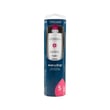
If you choose a 33-inch KitchenAid model with a dispenser or ice maker, plan for proper water supply conditions and routine filter maintenance.
- Typical household water pressure range is 30 to 120 psi.
- Flush and purge the dispenser after filter changes.
- Replace filters on schedule to protect flow and taste.
For step-by-step filter guidance, use how to replace the water filter in a KitchenAid refrigerator.
A refrigerator that is “33-inch wide” can still require extra clearance for doors, handles, and airflow. Verifying measurements up front prevents installation delays and helps the unit cool efficiently.
Last updated: January 2026
What causes a KitchenAid refrigerator to stop cooling?
On KitchenAid model KSCS25FKSS00, loss of cooling is most often caused by poor heat release (dirty condenser coils), weak airflow (evaporator fan issue or blocked vents), or a control or power interruption. Start with airflow and power checks, then move to the sealed-system and defrost basics.
- Confirm the refrigerator has steady power; avoid outlets that can be switched off, and do not use an extension cord.
- If your unit is on a GFCI outlet, reset it and monitor for nuisance tripping (this can shut the refrigerator off and cause warming).
- Make sure the temperature controls are set correctly for room conditions.
- Clear packages away from interior air vents so cold air can circulate.
- If you just loaded a lot of warm groceries, allow several hours for temperatures to recover.
For models with digital controls, the manual recommends turning the unit OFF then ON to reset the controls. Use the steps and control locations in the KSCS25FKSS00 owner's manual.
If you hear little or no fan noise from the freezer area, cooling can drop quickly because cold air is not being moved through the compartments. In that case, evaporator fan troubleshooting is the next best step.
| Symptom | Most likely area to check | What to do next |
|---|---|---|
| Fridge and freezer both warm | Power, controls, condenser airflow | Verify outlet, reset controls, clean coils, ensure rear/bottom airflow |
| Freezer cold, fridge warm | Airflow/vents, damper area | Clear vents, avoid overpacking, check for frost blocking airflow |
| Frost buildup, weak airflow | Defrost system | Check for heavy frost; defrost components may be involved |
A refrigerator removes heat continuously. When coils are clogged, airflow is blocked, or power/control resets occur, temperatures rise and food quality can be affected. Catching airflow and power issues early also helps prevent longer run times and extra wear on the compressor.
If troubleshooting points to a specific failure, these model-matched parts are commonly involved:
- Refrigerator evaporator fan blade WP2169142 (air movement across the evaporator)
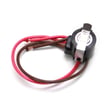
- Refrigerator defrost bi-metal WPW10225581 (defrost temperature sensing and protection)
Last updated: January 2026
What is the most common problem with a KitchenAid refrigerator?
On the KitchenAid KSCS25FKSS00, the most common issues we see are ice maker and water-dispensing problems, followed closely by cooling complaints caused by airflow restrictions or frost buildup. These symptoms often trace back to water supply conditions, a failing ice maker assembly, or an evaporator fan issue.
- Ice maker stops making ice or makes small/hollow cubes
- Water dispenser flow is slow or sputters
- Freezer is cold but fresh food section is warm
- Frost buildup on the freezer back wall
- Unusual fan noise from the freezer area
Start with the basics before replacing parts:
- Confirm the household water pressure is in the typical operating range (many KitchenAid units specify 30 to 120 psi); low pressure commonly causes small cubes and slow fill.
- Replace the water filter on schedule and purge air after filter changes.
- Clean condenser coils and confirm the condenser fan is running.
- Make sure vents inside the refrigerator and freezer are not blocked by food packages.
- Look for signs of a defrost problem (heavy frost, reduced airflow).
For model-specific operating guidance and water supply requirements, use the KSCS25FKSS00 owner's manual.
If the symptoms match, these are frequent repair paths for this model:
| Symptom | Common cause | Example part for KSCS25FKSS00 |
|---|---|---|
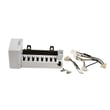
| No ice or intermittent ice | Ice maker failure | Ice maker assembly 4317943 |
| Frost buildup, warm fridge | Defrost system issue | Refrigerator defrost bi-metal WPW10225581 |
| Warm temps, fan noise | Evaporator fan blade damaged or loose | Refrigerator evaporator fan blade WP2169142 |
Ice maker and cooling problems can look similar at first, but the fix is very different. Verifying water supply and airflow first helps prevent unnecessary part replacement and gets temperatures and ice production back to normal faster.
Last updated: January 2026