Owner’s manual
 Error Codes


How many cubic feet is my Kenmore refrigerator model 79579043310?
The exact cubic-foot capacity for Kenmore Elite refrigerator model 79579043310 is listed on the model’s rating label and in the 79579043310 owner’s manual. Most Kenmore 795 (LG-built) bottom-mount refrigerators are commonly in the 20 to 22 cu. ft. range.
Check these spots first (no tools needed):
- Inside the fresh food compartment on a side wall near the crisper drawers
- Ceiling area inside the refrigerator section near the light cover
- Behind the crisper drawers on the back wall
- Door jamb area (hinge side) on some versions
- In the 79579043310 owner’s manual under “Parts and Features” or “Specifications”
The “795” at the start of the model number identifies the manufacturer family (commonly LG-built for Kenmore). It does not directly state cubic feet.
| What you see | What it tells you | What it does not tell you |
|---|---|---|
| 79579043310 | Model identity and series | Exact cubic feet |
| “795” prefix | Manufacturer family | Capacity |
| Rating label “Total volume” | Exact capacity | N/A |
Knowing the true cubic feet helps us match the right refrigerator parts and accessories (like shelves, bins, and airflow covers) and it also helps when comparing energy use and storage space across bottom-mount models.
If your display shows an error or you are troubleshooting cooling, use the Kenmore 795 model bottom freezer refrigerator error codes guide to narrow down the issue before replacing parts.
Last updated: February 2026
How to find Kenmore Elite fridge model number?
On Kenmore Elite refrigerators like model 79579043310, the model number is printed on a rating label inside the fresh food compartment or freezer area. Common spots include the inside wall, inside the door frame, behind the lower crisper drawer, or behind the kick plate; confirm the exact location in the 79579043310 owner's manual.
- Inside the refrigerator compartment on a side wall near the front
- On the inside door frame (fresh food door)
- Behind or just above the lower crisper drawer area
- Inside the freezer compartment on a side wall
- Behind the toe grille or kick plate at the bottom front
The rating label usually includes:
- Model number (for example, 79579043310)
- Serial number (unique to your unit)
- Electrical information (voltage and amps)
- Sometimes a manufacturing date code
| Item | What it tells you | When you need it |
|---|---|---|
| Model number | Which design and parts fit | Ordering parts, looking up diagrams, manuals |
| Serial number | Your specific unit’s build info | Service history, warranty, technician diagnostics |
Kenmore model numbers determine the exact fit for parts like the ice maker, door switch, or water inlet valve. Using the full model number from the label helps us match the correct replacement part the first time.
Last updated: February 2026
How to tell if a Kenmore refrigerator compressor is bad?
On Kenmore Elite model 79579043310, a bad compressor usually shows up as poor cooling with long run times, repeated clicking as it tries to start, or a compressor that gets very hot while the refrigerator and freezer stay warm. First rule out airflow, door sealing, and power issues before condemning the sealed system.
- Confirm the unit has power and the interior lights and controls respond.
- Make sure both doors close fully and the gaskets seal all the way around.
- Check for heavy dust on the condenser cover and vents; clean with a vacuum attachment (do not remove the condenser coil area panel).
- Note recent causes of long run time: frequent door openings, adding warm food, or a hot room.
- Verify the room temperature is reasonable; this model should not be operated above 110°F.
At about 70°F room temperature, it is normal for the compressor to run roughly 40% to 80% of the time. In warmer conditions, it will run more often.
| What you notice | More likely normal | More likely a compressor or sealed-system issue |
|---|---|---|
| Runs a lot on hot days | Yes | Not by itself |
| Clicking every few minutes, little or no cooling | No | Yes |
| Compressor very hot and fridge still warm | No | Yes |
| Warm compressor and no sound at all | No | Possible (also check start device/control) |
- Refrigerator and freezer both warm even after several hours of running
- Repeated clicking or buzzing from the compressor area (start attempt then shutoff)
- Compressor overheats and shuts down, then tries again later
- No steady “hum” from the compressor when cooling is needed
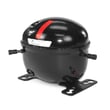
If you suspect the compressor itself, the correct replacement for this model is the refrigerator compressor TCA38091801.
A compressor diagnosis affects cost and repair approach. Many “not cooling” complaints are caused by dirty condenser airflow, door sealing problems, or temperature conditions, while true compressor or sealed-system failures typically require specialized tools and sealed-system service.
For model-specific troubleshooting steps and operating guidance, use the 79579043310 owner’s manual.
Last updated: February 2026
What are the common problems with Kenmore Elite refrigerators?
Common problems on the Kenmore Elite refrigerator model 79579043310 include weak or warm cooling, frost buildup from defrost issues, noisy or stopped fans, door sealing and alignment problems, interior light failures, and ice maker or water dispensing troubles. Our 79579043310 owner's manual troubleshooting section helps match symptoms to the most likely cause.
- Not cooling or warm temperatures: dirty condenser coil, failed compressor start components, or a failing compressor
- Freezer frosting up or refrigerator warming: defrost sensor or defrost system problem, blocked air vents
- Noisy operation: evaporator fan motor or condenser fan issues, ice buildup contacting the fan
- Doors hard to open or not closing well: dirty or sticky gaskets, cabinet not level, hinge wear
- Lights not working: LED interior lighting failure
- Ice maker or water issues: low water pressure, clogged filter, or a failing inlet valve
- Confirm settings: refrigerator about 37°F, freezer about 0°F.
- Clean airflow paths: clear packages from vents; vacuum dust from the condenser area.
- Check door seal and leveling: clean gaskets; if doors are hard to open, wait about a minute after closing to let pressure equalize (a normal vacuum effect).
- Listen for fans: a steady fan sound is normal; grinding or intermittent noise points to ice contact or a worn fan motor.
- For water and ice: verify the supply valve is fully open and the water line is not kinked.
| Symptom | Common part to inspect/replace | Example model-matched part |
|---|---|---|
| No ice or no water fill | Water inlet valve | Lg refrigerator water inlet valve AJU73753101 |
| Warm temps, fan noise, poor airflow | Evaporator fan motor | Lg refrigerator evaporator fan motor 4681JB1027C |
| Door not sealing, moisture, frost | Freezer door gasket | Refrigerator freezer door gasket ADX73350955 |
Cooling, defrost, and airflow problems can quickly lead to food spoilage and heavy frost that strains the sealed system. Door seal and leveling issues also waste energy and make temperature swings more likely.
Last updated: February 2026
What does DH mean on Kenmore Elite refrigerator?
On Kenmore Elite refrigerator model 79579043310, dH (often shown as Er dH) indicates a defrost heating problem. The refrigerator is detecting that the defrost heater is not warming the evaporator as expected, which can lead to frost buildup and poor cooling if it continues.
- Unplug the refrigerator before removing panels or touching wiring.
- Check for heavy frost on the rear freezer panel (a common sign of a defrost failure).
- Make sure the freezer door closes tightly and the gasket is sealing.
- Confirm the temperature settings are normal (freezer around 0°F, refrigerator around 37°F).
- Review the troubleshooting steps in the 79579043310 owner’s manual.
In this Kenmore (LG-built) bottom-mount design, the defrost system relies on several parts working together:
| Likely cause | What you may notice | What to do next |
|---|---|---|
| Defrost sensor issue | Frost returns quickly after a manual defrost | Test/inspect the sensor and wiring; replace if failed (example part: defrost sensor assembly 6615JB2005N) |
| Evaporator area airflow problem | Warm refrigerator section, noisy fan, uneven temps | Check for ice blocking airflow; inspect the evaporator fan |
| Control not initiating defrost | Repeating dH code, cooling problems persist | Follow diagnostic steps in the manual; consider professional service |
When the defrost heater does not do its job, frost can blanket the evaporator coil and block airflow. That forces longer run times, warmer temperatures, and can eventually stop cooling in the fresh food section.
- Use our model-family troubleshooting info for display codes: Kenmore 795 model bottom freezer refrigerator error codes
Last updated: February 2026
What is the average lifespan of a Kenmore Elite refrigerator?
A Kenmore Elite refrigerator like model 79579043310 typically lasts 10 to 15 years. Regular maintenance (cleaning condenser coils, keeping door gaskets sealing, and fixing cooling issues early) is what most often determines whether it reaches the high end of that range.
Most modern bottom-mount and French door refrigerators fall into a similar life expectancy range, but real-world lifespan depends on how hard the sealed system and airflow components have to work.
- Dirty condenser coils make the compressor run hotter and longer
- Worn door gaskets let warm, humid air in and increase frost and run time
- Poor airflow (blocked vents, overpacked shelves) causes temperature swings
- Water and ice system leaks can create corrosion and electrical issues
- Frequent power interruptions can stress the control board and compressor start components
Use this simple schedule to keep your Kenmore Elite 79579043310 running efficiently; for model-specific care steps, follow the 79579043310 owner's manual.
| Task | How often | What you’re preventing |
|---|---|---|
| Clean condenser coils | Every 6 to 12 months | Overheating, long run times |
| Check/clean door gaskets | Every 3 to 6 months | Frost, warm temps, moisture |
| Verify temps (fresh food/freezer) | Monthly | Food spoilage, ice melt/refreeze |
| Replace water filter (if equipped) | About every 6 months | Slow water flow, bad taste/odor |
If your refrigerator is within the typical 10 to 15-year window, repairs are often worthwhile when the issue is isolated (fan motor, sensor, door seal). Sealed system or compressor problems are bigger decisions.
| Symptom | Common cause | Typical next step |
|---|---|---|
| Warm fridge, freezer OK | Airflow or evaporator fan issue | Diagnose fan and defrost system |
| Warm freezer and fridge | Sealed system or compressor issue | Professional diagnosis recommended |
| Frost buildup, moisture | Door seal leak | Inspect gasket and door alignment |
A refrigerator’s lifespan is mostly about compressor run time and temperature stability. Keeping coils clean and seals tight reduces strain on the sealed system, which is the most expensive part of the appliance.
Last updated: February 2026
Why is my Kenmore Elite refrigerator leaking from the bottom?
Water leaking from the bottom of your Kenmore Elite refrigerator model 79579043310 is usually caused by a clogged defrost drain that overflows into the base, or a water supply connection that is seeping and running down behind the unit. Start by checking the drain path and then inspect the water line and valve area using the 79579043310 owner's manual.
- Defrost drain clogged or frozen: Meltwater cannot reach the drain pan, so it spills into the cabinet base and out onto the floor.
- Water line connection leaking: A loose compression nut or ferrule can drip and track down to the bottom (often looks like a “mystery” leak).
- Water inlet valve leaking: The valve can seep slowly even when not dispensing; inspect the lg refrigerator water inlet valve AJU73753101.
- Cracked or loose dispenser/ice maker tubing: Small splits can leak only during fill cycles.
- Door left ajar or gasket not sealing: Excess frost can create heavy defrost water that overwhelms a partially restricted drain.
- Unplug the refrigerator and pull it out enough to see the back lower area.
- Look for the water source:
- Clear water near the back usually points to the water supply or valve.
- Water that appears after a defrost cycle often points to the defrost drain.
- Check the water line fittings: The manual notes to turn the water on at the shutoff valve and tighten any connections that leak.
- Inspect the inlet valve area for mineral tracks, wet insulation, or a slow drip.
- Check door sealing: Make sure doors close fully and nothing is holding them open.
| What you notice | Most likely cause | Best next check |
|---|---|---|
| Puddle appears even when not using dispenser | Seeping inlet valve or fitting | Valve and compression fittings |
| Leak shows up after heavy frost or warm/humid days | Defrost drain restricted | Drain opening and drain tube |
| Water only during ice maker fill | Ice maker tube or valve | Fill tube, valve outlet |
Bottom leaks can damage flooring and also lead to ice buildup in the freezer compartment or airflow problems that affect cooling. Fixing the source early helps protect the sealed system and prevents repeat puddles.
Last updated: February 2026
Why is my refrigerator not getting cold at the bottom?
If your Kenmore Elite refrigerator model 79579043310 is warm at the bottom, the most common causes are restricted airflow (blocked vents or an overpacked compartment), doors being opened too often or not sealing, or temperature settings that need a small adjustment. Start with airflow and door sealing checks, then confirm control settings in the 79579043310 owner’s manual.
- Make sure interior air vents are not blocked by food containers (rearrange items so air can circulate).
- Avoid overpacking the fresh food section; cold air needs space to move.
- Reduce long door openings; warm, humid air raises compartment temperature.
- Confirm doors close fully and do not pop open after shutting.
- If you recently loaded a lot of groceries or hot food, let temperatures recover (cooling run time increases).
The manual notes that temperatures can rise slightly during or right after an automatic defrost cycle; wait about 30 minutes after defrost ends and recheck temperatures. If the refrigerator is still warm, adjust the temperature control one increment at a time and allow time to stabilize (several hours is typical). Refer to the 79579043310 owner’s manual for the exact control procedure.
If airflow is clear and settings are correct but the bottom stays warm, these issues are common on bottom-mount designs:
- Evaporator fan not moving cold air (often noise changes or weak airflow)
- Frost buildup from a defrost problem
- Sealed system or compressor performance issue
| Symptom you notice | Likely area | Example part for this model |
|---|---|---|
| Weak/no airflow in fresh food section | Evaporator fan | Lg refrigerator evaporator fan motor 4681JB1027C |
| Clicking, overheating, intermittent cooling | Compressor start protection | Refrigerator compressor overload protector 6750CL0001D |
| Long run time, poor overall cooling | Sealed system/compressor | Refrigerator compressor TCA38091801 |
When the bottom of the refrigerator runs warm, food safety and freshness drop quickly, and the compressor can run longer than normal. Restoring airflow and a tight door seal usually brings temperatures back without major repair.
Last updated: February 2026