Installation guide
 Owner’s manual
 Error Codes


How do I tell what model my Kenmore dryer is?
Your Kenmore dryer’s model number is printed on the appliance’s rating label. On Kenmore electric and gas dryers, that label is most often on the door opening (cabinet frame) or on the back of the dryer near the top. For label examples, use the 110C60222510 owner's manual.
Where to look first (fastest checks)
- Open the dryer door and check the cabinet frame around the opening.
- Look along the inside edge of the front panel near the door switch area.
- Check the back of the dryer near the top (upper left or upper right).
- If your dryer has a drop-down door, check the frame above the opening.
- Wipe dust off the label; the print is easier to read with a flashlight.
What the model number looks like
The model number is usually a mix of numbers and letters and is printed next to other identification details.
| Label item | What it’s used for | Example you might see |
|---|---|---|
| Model number | Matching parts and diagrams | 110C60222510 |
| Serial number | Identifying the specific unit | A longer code/number |
| Type (electric/gas) | Confirming correct parts and wiring | Electric or Gas |
Why it matters
We use the exact model number to match the correct Kenmore dryer parts and diagrams. Even small differences can change which belt, heater element, thermostat, or timer fits your dryer.
After you find it
- Write the model number exactly as shown (include all letters and numbers).
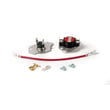
- Use that model number when ordering common wear parts like the belt 341241 or a dryer repair kit 4392065.
- If the label is worn, take a clear photo and zoom in to confirm each character.
Last updated: February 2026
How much does it cost to replace drum bearings on a dryer?
On a Kenmore 110C60222510 electric dryer, “drum bearing” service usually means replacing the drum support wear surfaces (commonly the front bearing ring) and any related drum-support parts that are worn. Typical total repair pricing runs $250 to $600 including labor; parts are usually a smaller share than labor.
What “drum bearings” means on this Kenmore model
Many Kenmore 110-series dryers use a front drum bearing ring and other support components rather than a sealed ball-bearing assembly. A technician typically inspects the full drum-support system once the drum is out.
- Front drum bearing ring or glide surface wears and squeals
- Support rollers can flat-spot and thump
- Idler pulley can chirp or grind
- Belt can crack or glaze
- Lint buildup inside the cabinet can accelerate wear
Cost breakdown you can expect
Pricing varies by region and shop rates, but the pattern is consistent: most of the cost is disassembly and reassembly.
| Cost item | Typical range | Notes |
|---|---|---|
| Labor | $180 to $450 | Commonly 1.5 to 3.0 hours on a drum-out repair |
| Parts | $20 to $150 | Depends on how many wear items are replaced |
| Service call/diagnosis | $0 to $120 | Often waived if you proceed with the repair |
Parts commonly replaced together (to avoid repeat labor)
If the dryer is already opened up, replacing other wear items at the same time often prevents a second teardown.
- Bearing ring 279441 (front drum bearing surface)
- Belt 341241 (drum drive belt)
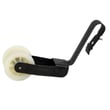
- Dryer idler pulley WP691366 (maintains belt tension)
- Dryer repair kit 4392065 (kit that often covers multiple drum-support wear items)
Why it matters
A worn bearing surface or support component lets the drum sag and rub; that increases noise, reduces airflow efficiency, and can shorten the life of the belt and drive motor.
How to confirm it is a drum-support wear issue
Use these quick checks before scheduling service; follow safety steps in the 110C60222510 owner’s manual.
- Squealing or scraping that changes with drum rotation
- Thumping that speeds up as the drum speeds up
- Drum feels rough or has side-to-side play when turned by hand (power off)
- Black dust or wear marks near the front drum area
Last updated: February 2026
What are common problems with Kenmore dryers?
Common problems on Kenmore dryers like model 110C60222510 include no heat, won’t start, long dry times, drum not turning, and unusual noises. Most issues trace back to airflow restrictions (lint and venting), power supply problems, or normal wear on drive and temperature-safety parts; see the 110C60222510 owner's manual for model-specific troubleshooting steps.
Most common symptoms and what usually causes them
- Dryer won’t run: door not fully closed, start button not held long enough, tripped breaker or blown fuse (electric dryers typically use two fuses/breakers), or incorrect power supply.
- No heat (drum turns but clothes stay wet): one fuse/breaker tripped, incorrect 240V supply, or a failed heat-control/safety component.
- Long drying times: clogged lint screen, crushed or blocked vent, restricted airflow.
- Drum not turning: worn belt, idler pulley problem, or motor issue.
- Thumping/squealing/rattling: items caught at drum edges, dryer not level, or worn drum support components.
Quick checks we recommend before replacing parts
- Confirm power: electric dryers need a proper 240-volt supply; a partial power loss can let the motor run with no heat.
- Check airflow: clean the lint screen; inspect the vent path for lint buildup or kinks.
- Listen and look: coins or small items can lodge between the drum and cabinet; check drum edges.
- Verify installation: make sure the dryer is level and has the recommended clearances; use the 110C60222510 installation guide for spacing and setup details.
Parts that commonly fix these problems (when diagnostics point there)
| Symptom | Common wear item | Example part for this model |
|---|---|---|
| Drum won’t turn | Drum belt | Belt 341241 |
| Squealing or poor drum support | Roller/idler service items | Dryer repair kit 4392065 |
| No heat after airflow is confirmed | Heat safety circuit | Dryer thermal cut-off fuse kit 279816 |
Why it matters
Airflow and power issues can mimic “bad parts.” Fixing venting and confirming the correct electrical supply often restores heat and prevents repeat failures of thermostats, thermal cut-offs, and heating components.
Last updated: February 2026
What size is a Kenmore Model 110C60222510 dryer?
The Kenmore electric dryer model 110C60222510 is a full-size 27-inch class dryer. The installation guide lists the cabinet at about 27 inches wide, 27 3/4 inches deep, and 43 3/8 inches tall (door style can slightly change the front clearance). See the 110C60222510 installation guide for the exact diagram.
Dimensions and space you should plan for
Here are the key measurements we use for fit and installation planning:
- Width: about 27 inches (listed as 27" / 705 mm)
- Depth (cabinet): about 27 3/4 inches (listed as 27 3/4" / 705 mm)
- Height: about 43 3/8 inches (listed as 43 3/8" / 1102 mm)
- Rear clearance for venting: most installs need about 5 1/2 inches behind the dryer for the exhaust vent and elbow
- Floor requirement: level floor with up to 1 inch slope under the dryer
Quick reference table
| Measurement | Approx. size | Notes |
|---|---|---|
| Width | 27 in | Standard full-size footprint |
| Depth | 27 3/4 in | Add space for vent connection behind |
| Height | 43 3/8 in | Measure to the top of the cabinet |
| Rear clearance | 5 1/2 in | Typical minimum for vent and elbow |
Why it matters
Correct sizing prevents crushed or kinked venting (which increases dry times) and helps you avoid installation issues in closets, recessed areas, and tight laundry rooms.
Tips before you measure your space
- Measure the opening width at the narrowest point (trim can reduce clearance).
- Add room for the power cord and exhaust vent routing.
- Confirm the door swing and that the door can open fully.
- If installing in a closet, plan for ventilation openings and required airspace.
Last updated: February 2026