

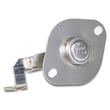
How to tell if a dryer thermal fuse is blown?
On a Roper RES7648EQ2 electric dryer, a blown thermal fuse typically causes the dryer to stop running (or run with no heat, depending on the circuit). We confirm it by unplugging the dryer and checking the fuse for continuity with a multimeter; no continuity means it is blown.
- Unplug the dryer (or switch off the breaker) before opening any panels.
- Access the blower housing area; the thermal fuse is commonly mounted near the exhaust path.
- Label and remove the wires from the fuse terminals.
- Set a multimeter to continuity (or lowest ohms).
- Touch a probe to each terminal:
- Good fuse: continuity (beep) or near 0 ohms
- Blown fuse: no beep or OL/infinite resistance
- If the fuse is blown, correct the overheating cause before running the dryer again.
Restricted airflow is the most common reason. Before replacing parts, we address airflow end-to-end.
| Checkpoint | What to look for | What to do |
|---|---|---|
| Lint screen | Film from fabric softener | Wash with warm water and a soft brush, dry fully |
| Lint chute and blower area | Packed lint | Clean the chute and blower housing |
| Vent hose | Kinks, crushed flex, lint buildup | Shorten/replace with rigid or semi-rigid metal |
| Outside vent hood | Weak flap opening, lint nest | Clear blockage and confirm strong airflow |
If the dryer still will not heat after airflow is corrected, these model-compatible parts are common suspects:
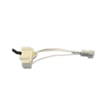
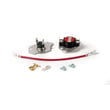
- Cut-off kit 279816 (thermal cut-off components used when overheating occurs)
- Dryer operating thermostat WP3387134 (regulates normal cycling temperature)
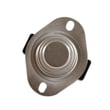
- Dryer thermostat WP3977767 (high-limit protection)
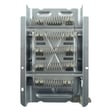
- Dryer element 279838 (heating element for electric heat)
The thermal fuse is a one-time safety device. If we replace it without fixing a clogged vent or overheating condition, the new fuse can blow again quickly and the dryer can keep drying poorly.
Last updated: February 2026
Where can I find the model number on a Roper dryer?
On a Roper dryer like model RES7648EQ2, the model number is printed on the appliance’s rating label. We most often see it on the door opening (cabinet frame) when you open the dryer door, or on the back of the dryer near the top.
- Open the dryer door and look around the door opening on the cabinet frame
- Check the inside edge of the door itself
- Look on the back panel near the top (upper left or upper right area)
- Check the lower front area behind the toe panel (if your version has one)
The label typically includes several identifiers. For ordering parts, we recommend copying these exactly:
- Model number (example: RES7648EQ2)
- Serial number
- Type (electric or gas)
- Electrical ratings (volts/amps)
- Use a flashlight; the print can be small or faded.
- Wipe lint and dust off the label so the characters are readable.
- Take a photo of the label before you start a repair.
The model number ensures you get the correct Roper electric dryer parts and diagrams for RES7648EQ2. Even small model-number differences can change which door switch, heating element, or belt fits.
| Part type | Example part for RES7648EQ2 | What it affects |
|---|---|---|
| Door switch | Door switch WP3406107 | Dryer starts and runs only with door closed |
| Drum belt | Drum belt 341241 | Drum tumbling and proper drying |
Last updated: February 2026
Why is my Roper dryer not drying completely?
For a Roper RES7648EQ2 electric dryer, incomplete drying is almost always caused by restricted airflow (lint screen, lint chute, vent hose, or outside hood) or a heat control problem that reduces heater run time. Start with airflow checks, then test the heating circuit parts.
- Clean the lint screen before every load; wash it with warm water if you use dryer sheets.
- Inspect and clean the lint chute and blower housing; a clogged chute is common (see dryer lint chute assembly W11117429).
- Verify the vent hose is short, smooth, and not crushed behind the dryer.
- Check the outside vent hood for a stuck flap, lint mat, or bird screen blockage.
- Run a timed dry cycle and confirm strong airflow at the outside hood.
If airflow is good but clothes still stay damp, the heater may be cycling off too soon or not heating consistently.
- Heating element can be partially shorted or open (see dryer element 279838).
- High-limit thermostat can open early and reduce heat (see dryer thermostat WP3977767).
- Operating thermostat can misread temperature and shorten heat cycles (see dryer operating thermostat WP3387134).
- Thermal cut-off can open from overheating and stop heat (see cut-off kit 279816).
| Symptom | Most likely cause | What to check first |
|---|---|---|
| Long dry times, dryer feels hot | Poor venting | Vent hose and outside hood |
| Runs but no heat | Heater circuit issue | Element, cut-off kit |
| Heat comes and goes | Thermostat cycling issue | Operating and high-limit thermostats |
Restricted venting traps heat and moisture in the drum, so the RES7648EQ2 cannot move wet air out fast enough. It also overheats the heater housing, which can trip safety parts like the thermal cut-off.
Use our step-by-step tips in dryer takes a long time to dry and maintenance steps in how to clean and maintain your clothes dryer.
Last updated: February 2026