Installation guide
 Owner’s manual
 Error Codes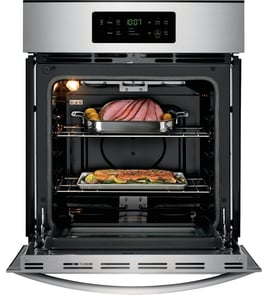



How to find wall oven model number?
For Kenmore wall oven model 79048839900, the model and serial number are printed on the serial plate located along the interior side trim and are visible when you open the oven door. Use that full model number when ordering parts or looking up instructions in the 79048839900 owner's manual.
Where to look on the oven
Check these spots in this order (most common first):
- Interior side trim: open the oven door and look along the inside side trim for the serial plate.
- Oven frame/rim: around the front frame where the door closes.
- Inside the oven cavity edge: near the door opening, sometimes on the side wall.
- Installation paperwork: the model number is often written on the purchase or install documents.
What to write down (and why)
Record the full information exactly as shown on the serial plate:
- Model number (example format: 790.XXXXXXX)
- Serial number
- Lot number or letter (if listed)
Why it matters
Kenmore wall ovens can look similar across multiple model series. The exact model number ensures we match the correct parts, wiring, and trim so repairs fit and function correctly.
Quick ID checklist
| Item | What it looks like | Used for |
|---|---|---|
| Model number | Starts with 790 | Finding correct parts diagrams and manuals |
| Serial number | Letters and numbers | Dating the unit, service history |
| Lot number/letter | Single letter/short code | Manufacturing run details for parts matching |
Last updated: January 2026
How to calibrate a Kenmore wall oven?
To calibrate the oven temperature on your Kenmore wall oven model 79048839900, we adjust the control’s temperature offset so the oven cooks slightly hotter or cooler than the displayed set temperature. This is done from the control panel and changes baking performance without changing Self-Clean temperatures.
How to calibrate (temperature offset adjustment)
Use these steps from the model’s control instructions in the 79048839900 owner's manual.
- Press and hold the Bake pad for 8 seconds.
- Look at the display; it shows the current offset (factory setting shows 0).
- Use the ▲ / ▼ pads to adjust the offset up or down (up to 35°F or 19°C, in 1-degree steps).
- If you lower the temperature, a minus sign (-) appears to show the oven will run cooler.
- Wait about 5 seconds; the control returns to the time-of-day display and saves the setting.
How much should I adjust?
Start small, then re-test with a reliable oven thermometer.
| Symptom | Good starting adjustment | What to do next |
|---|---|---|
| Food browns too fast, cakes too dark | -10°F to -15°F | Re-test after 2 to 3 bakes |
| Food takes too long, underbakes | +10°F to +15°F | Re-test after 2 to 3 bakes |
| Off by a lot consistently | Up to ±35°F max | Check sensor and airflow issues |
Why it matters
Calibration helps match the displayed temperature to real-world baking results. If your 79048839900 was factory-calibrated differently than a previous oven, recipes can come out overdone or underdone until you dial in the offset.
If calibration does not fix uneven or incorrect baking
These checks often solve the real cause of temperature complaints:
- Confirm you fully preheat before loading food.
- Use the recommended rack position and avoid overcrowding.
- Leave 2 to 4 inches of clearance around pans for airflow.
- Make sure the oven is level (leveling guidance is in the 79048839900 installation guide).
- If temperatures swing wildly, test the oven temperature sensor; the model uses a sensor like the frigidaire range oven temperature sensor 316217002.
Last updated: January 2026
How much does a 27 inch wall oven weigh?
A 27-inch electric wall oven like Kenmore model 79048839900 typically weighs about 120 to 180 pounds. For installation planning, we focus on cabinet support requirements; the installation instructions call for a base that can support 300 pounds for 27-inch models.
What to use for planning (weight vs. support rating)
When you are measuring for delivery, lifting, or cabinet reinforcement, use the oven’s approximate weight range. When you are building or verifying the cabinet base, use the support rating from the installation instructions.
- Moving/lifting estimate: plan for 120 to 180 lb for most 27-inch single electric wall ovens
- Cabinet base requirement (27-inch models): 300 lb capacity
- Door removal helps: removing the oven door reduces handling weight during install
- Secure the oven: mounting brackets are required to prevent tipping
- Keep spacers installed (if equipped): they help center the oven and reduce heat buildup risk
Quick reference table
| Planning need | What to use | Typical value |
|---|---|---|
| Carrying, lifting, dolly selection | Approximate oven weight | 120 to 180 lb |
| Cabinet base strength | Installation support requirement | 300 lb (27-inch models) |
Why it matters
Even if the oven itself weighs far less than 300 pounds, the cabinet base rating accounts for real-world loads and safety margin during installation and service. Using the support rating helps prevent cabinet sagging, door alignment problems, and heat-related cabinet damage.
Where to confirm your exact setup
For model-specific installation requirements (cutout dimensions, support capacity, door removal, and securing the oven), use the 79048839900 installation guide.
Last updated: January 2026
Are all 30 inch wall ovens the same size?
No. “30-inch” wall ovens are grouped by a nominal width, but the exact cabinet cutout and oven dimensions vary by brand and model. For Kenmore model 79048839900, the installation guide lists a 30-inch product width and specific cutout ranges you must match for a safe, flush fit; see the 79048839900 installation guide.
What “30-inch” usually means (and what it does not)
A “30-inch wall oven” label typically refers to the oven’s approximate front width, not a universal cutout size. Small differences in trim, chassis width, and required clearances can change whether an oven fits your cabinet opening.
Common differences between 30-inch models include:
- Required cutout width (minimum and maximum)
- Required cutout height (single vs. double oven)
- Required cutout depth (critical for trim to sit flush)
- Electrical junction box location and clearance needs
- Door swing clearance in front of the oven
Kenmore 79048839900 size guidance from the installation specs
For Kenmore 79048839900, the installation instructions provide these key targets.
| Measurement type | 30-inch single wall oven (typical spec for this model) | Why it matters |
|---|---|---|
| Product width | 30 in | Confirms the “30-inch” class |
| Cutout width | 28 1/2 to 29 in | Cabinet opening must fall in this range |
| Cutout depth | 23 1/2 in minimum | Helps the trim sit against the cabinet |
Additional fit and safety notes called out in the instructions:
- Allow at least 21 inches of clearance in front for the door when open.
- Do not remove any factory spacers (if equipped); they help center the oven and reduce heat buildup.
- The cabinet base must support the oven’s weight (30-inch models are heavier than 27-inch models).
How to measure your cabinet opening before you buy
Measure in three places (top, middle, bottom) because cabinets can be out of square.
- Width: inside edge to inside edge of the cutout
- Height: bottom support surface to the top of the cutout
- Depth: front cabinet face to the back wall (account for wiring)
- Front clearance: space for the door to open fully
Why it matters
A wall oven that is even slightly too wide, too tall, or too shallow for the cutout can sit proud of the cabinet, bind the door, overheat surrounding wood, or require cabinet modification. Matching the cutout range is the fastest way to avoid a bad fit.
Last updated: January 2026