 Owner’s manual
 Error Codes


How to raise a refrigerator off the floor?
To raise a Kenmore Elite refrigerator model 59676593601 off the floor, we adjust the built-in front rollers or leveling screws behind the base grille. This lifts the cabinet for better door closing and helps prevent the refrigerator from rocking.
How to raise it (model 59676593601)
Follow the leveling procedure in the 59676593601 owner's manual. In general, the steps are:
- Remove the base grille (grasp firmly and pull toward you).
- Have someone push gently against the top of the refrigerator to reduce weight on the adjusters.
- Use the correct hex driver for your style:
- Style 1 (rollers): use a 3/8-inch hex driver on the roller adjustment screws.
- Style 2 (leveling screws): use a 1/4-inch hex driver on the leveling screws.
- Raise the refrigerator:
- Roller style: turn the adjustment screw to the right.
- Leveling screw style: turn the screw clockwise.
- Recheck door closing; if needed, tilt slightly more to the rear by raising both sides the same amount.
Quick direction guide
| Base type | Tool | To raise | To lower |
|---|---|---|---|
| Adjustable rollers | 3/8-inch hex driver | Turn right | Turn left |
| Leveling screws | 1/4-inch hex driver | Turn clockwise | Turn counterclockwise |
Important tips (to avoid problems)
- Raise both sides evenly to keep the cabinet square and doors aligned.
- If your unit has a brake foot, turn it clockwise until firmly against the floor so the refrigerator does not roll forward when the freezer drawer opens.
- Do not “shim” with loose materials; the refrigerator needs stable support and airflow.
Why it matters
Proper leveling reduces door seal leaks, improves temperature stability, and prevents the refrigerator from creeping forward when you pull out the freezer drawer.
Last updated: February 2026
Is Kenmore Elite high end?
Yes. Kenmore Elite is Kenmore’s higher-end line, and the Kenmore Elite bottom-mount refrigerator model 59676593601 is built to offer more features and refinement than basic Kenmore models (for example, dedicated storage features and ice and water functions described in the 59676593601 owner's manual).
What “high end” means for Kenmore Elite
Kenmore Elite typically sits in the mid-to-high range for mainstream appliances. You usually get more convenience features and upgraded fit and finish compared to entry-level refrigerators.
Common “Elite” advantages include:
- More specialized storage (crisper humidity control, deli or pantry-style drawers)
- Ice and water features (depending on configuration)
- More electronic controls and sensors for temperature management
- More premium interior lighting and trim details
- More service and accessory support (filters, care items)
How to judge if it is “high end” for your needs
“High end” depends on what you value most: capacity and layout, ice maker performance, filtration, or long-term repairability.
| What you care about | What to check on 59676593601 | Why it matters |
|---|---|---|
| Food preservation | Temperature consistency and airflow features | Helps reduce freezing in fresh food or warm spots |
| Convenience | Drawer and bin layout (crisper, pantry/deli areas) | Makes the refrigerator easier to organize |
| Ice and water | Filter type, flushing steps, ice maker behavior | Impacts taste, flow, and ice quality |
| Ownership cost | Availability of common service parts | Helps keep repairs practical over time |
Parts that support “premium” performance
If performance issues show up, these are examples of parts that often affect day-to-day results on bottom-mount refrigerators:
- Refrigerator damper control WPW10196393 (airflow between freezer and fresh food section)
- Refrigerator temperature sensor 12002355 (temperature feedback to controls)
- Evaporator motor WPW10128551 (circulates cold air across the evaporator)
Why it matters
A refrigerator can look high end but still disappoint if airflow, temperature sensing, or ice and water maintenance are neglected. Following the care and filter guidance in the 59676593601 owner's manual helps protect performance and food quality.
Last updated: February 2026
What are the common problems with Kenmore Elite refrigerators?
Common problems on the Kenmore Elite 59676593601 bottom-mount refrigerator include weak or uneven cooling, ice maker and water dispenser troubles, water leaks, and unusual running or noise. Many issues trace back to airflow restrictions, dirty condenser coils, door seal gaps, or a defrost or fan problem; the 59676593601 owner's manual troubleshooting section helps narrow it down.
Most common symptoms and what usually causes them
- Not cooling well (fresh food or freezer): blocked air vents, dirty condenser coil, evaporator fan issue, or a defrost system problem
- Ice maker not making ice: water supply issue, inlet valve problem, or ice maker failure (often shows up as slow or no ice production)
- Water leaking: clogged defrost drain, loose water line connection, or a valve/line seep
- Runs a lot: warm room, frequent door openings, large food load, or doors not sealing
- Noisy operation: normal valve, fan, and compressor sounds can be more noticeable on high-efficiency designs
Quick checks we recommend first (no parts needed)
- Confirm the controls are ON and set to normal temperatures (not “coldest”).
- Allow 24 hours after installation or major loading for temperatures to stabilize.
- Make sure air vents inside the compartments are not blocked by food packages.
- Clean the condenser area (dust buildup can cause poor cooling and long run times).
- Check door gaskets for gaps, tears, or areas not sealing flat.
Parts that commonly solve these problems on this model
If the quick checks point to a component issue, these are frequent repair paths for model 59676593601:
| Symptom | Common suspect part | Example part for this model |
|---|---|---|
| Warm refrigerator section | Airflow control issue | Refrigerator damper control WPW10196393 |
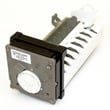
| No ice or slow ice | Ice maker failure | Whirlpool refrigerator ice maker (D7824706Q) D7824706Q |
| Frost buildup, warm temps | Defrost system issue | Refrigerator defrost heater WP67002493 |
| Poor airflow, warm temps | Evaporator fan issue | Evaporator motor WPW10128551 |
Why it matters
Cooling, ice, and leak complaints often share the same root causes: restricted airflow, poor heat removal at the condenser, or water system problems. Fixing the underlying cause prevents food spoilage, repeat icing, and water damage.
Last updated: February 2026
What is the average lifespan of a Kenmore Elite refrigerator?
A Kenmore Elite refrigerator like model 59676593601 typically lasts 10 to 15 years. Regular cleaning, correct temperature settings, and quick repairs when cooling or ice maker problems start are the biggest factors that keep a bottom-mount refrigerator running longer (often into the mid-teens).
Typical lifespan and what to expect
Most modern refrigerators fall into a similar life range; the difference is usually maintenance and how hard the unit works (hot garages, dusty condenser area, frequent door openings).
- Average lifespan: 10 to 15 years
- Common “life-extenders”: clean condenser area, good door seal, stable temperatures
- Common “life-shorteners”: restricted airflow, worn gaskets, ignored frost buildup, low water flow to ice maker
Maintenance that helps you reach the high end of the range
Use the care and cleaning guidance in the 59676593601 owner's manual as your baseline, then focus on these high-impact items.
- Keep the condenser area free of dust and pet hair
- Confirm doors close fully and seal tightly
- Set and maintain steady temps (avoid frequent warm-ups)
- Replace water filters on schedule and flush after changes
- Address unusual noises, warm spots, or heavy frost early
Parts that commonly affect longevity
These parts do not “set” the lifespan by themselves, but failures here are common reasons a refrigerator stops cooling well or starts running constantly.
| Symptom | Often involved system | Example part for this model |
|---|---|---|
| Fridge warm, freezer OK (or vice versa) | Airflow/damper | Refrigerator damper control WPW10196393 |
| Warm temps, compressor tries to start | Start device/overload | Refrigerator overload release W10613606 |
| Poor cooling, heavy frost, fan noise | Evaporator fan | Evaporator motor WPW10128551 |
Why it matters
A refrigerator that is struggling to cool usually runs longer cycles, which increases wear on the sealed system and electrical components. Simple upkeep (cleaning, sealing, airflow) reduces run time and helps the unit reach its normal service life.
Last updated: February 2026
What is the cubic foot of my Kenmore refrigerator model 59676593601?
Your Kenmore Elite bottom-mount refrigerator model 59676593601 has a total capacity of about 21.9 cubic feet. This is the overall (fresh food plus freezer) storage volume used for comparing refrigerator size and fit.
How to confirm the capacity for your exact configuration
We recommend checking the model list and specifications section in the 59676593601 owner's manual. This manual covers the 596.7657 series and closely related variants, which is helpful if your unit has a slightly different feature set (ice and water options, bin layout, etc.).
What “21.9 cu. ft.” means in real use
Capacity is measured as total internal volume, not usable shelf space. Usable space changes based on shelves, bins, the ice maker, and airflow clearances.
- Shelves and drawers reduce usable cubic space but improve organization
- An installed ice maker can reduce freezer storage
- Keeping vents clear helps maintain even temperatures
- Overpacking can restrict airflow and cause warm spots
- Door bins are convenient but not ideal for long-term temperature stability
Quick reference
| Spec | What it tells you | Why you care |
|---|---|---|
| Total capacity (cu. ft.) | Overall size class | Fit and storage planning |
| Fresh food vs. freezer split | How space is divided | Grocery vs. frozen storage balance |
| Feature impact | Ice maker, bins, drawers | Real usable space |
Why it matters
Knowing the cubic feet helps when replacing the refrigerator, planning kitchen layout, or comparing storage to other Kenmore models. It also sets expectations for how much food you can store without blocking airflow.
Last updated: February 2026
What model is my Kenmore Elite refrigerator?
Your Kenmore Elite refrigerator’s model number is printed on the model and serial tag, usually inside the fresh food compartment on a side wall, inside the freezer compartment, or behind the base grille (kickplate). For this series, model numbers look like 596.76593601.
Where to look for the model and serial tag
Check these common locations on Kenmore Elite bottom-mount refrigerators:
- Inside the refrigerator compartment on the left or right interior wall
- Inside the freezer compartment on an interior side wall
- Behind the base grille (grasp the grille and pull it toward you)
- On the cabinet frame just inside the door opening (near the hinge side)
For diagrams and location notes specific to this platform, use the 59676593601 owner's manual.
How to read the model number (what “596” means)
Kenmore model numbers typically include a 3-digit prefix that helps identify the manufacturing source.
| Example | What you’ll see | What it’s used for |
|---|---|---|
| 596.76593601 | Prefix + full model | Ordering the correct parts and matching the correct manual |
| 59676593601 | Same model without the dot | Often how parts sites and service systems list the model |
Tips to make sure you have the exact match
Using the exact model number matters because small differences can change parts like the ice maker, door gasket, or temperature sensor.
- Copy the model number exactly as printed (including any dots or extra digits)
- Also write down the serial number (it helps with production variations)
- Match the model number on the tag to the model number used when ordering parts
- If the tag is hard to read, take a clear photo and zoom in
Why it matters
We use your exact model number to match the correct Kenmore Elite parts list, wiring information, and service procedures. That prevents ordering a part that fits a similar 596-series refrigerator but not your exact configuration.
Last updated: February 2026
Where is my Kenmore refrigerator air filter located?
On Kenmore Elite model 59676593601, the user-accessible filter location called out in the documentation is the interior water filter, which mounts on the side wall inside the fresh food (refrigerator) compartment. For the exact placement and cover style, follow the steps in the 59676593601 owner's manual.
What to check inside the refrigerator compartment
In this model, look for a small filter head and cover on a side wall inside the refrigerator section.
- Check the left side wall first (often referenced during initial setup and flushing).
- Also check the right side wall (often referenced in the water filter replacement steps).
- Look for a hinged or snap-close filter cover that closes after the filter is rotated into place.
- If you see a blue bypass cap, that indicates the unit can be configured to run without the filter installed.
- If you are looking for an air filter, inspect the upper rear area of the fresh food compartment for a small vented housing (some configurations use an odor filter there).
Quick location guide (what you are likely looking for)
| Filter type | Typical location on this model | What it affects |
|---|---|---|
| Water filter | Inside refrigerator compartment, side wall mounting bracket | Water dispenser and ice maker |
| Air (odor) filter (if equipped) | Inside refrigerator compartment, usually upper area near airflow vents | Odors in fresh food section |
Why it matters
Finding the correct filter location prevents installing the wrong part in the wrong place and helps restore normal water flow and ice production. A missing or incorrectly seated filter can also cause leaks or poor dispensing.
Related parts that can be involved
If you are troubleshooting ice or water issues while locating the filter area, these model-matched parts are commonly involved:
- Refrigerator water filter plate WP67001668 (filter cover and housing area)
- Refrigerator water inlet valve assembly WP67006531 (controls water flow to dispenser and ice maker)
- Whirlpool refrigerator ice maker (D7824706Q) D7824706Q (ice production)
Last updated: February 2026
Why is my Kenmore Elite ice maker not making ice?
If your Kenmore Elite 59676593601 ice maker is not making ice, the most common causes are the ice maker being switched off (wire shutoff arm up), the freezer temperature being too warm, or a water supply problem (shutoff valve closed, kinked line, or restricted filter). Check the basics first, then test water flow.
Quick checks (most fixes)
- Make sure the wire shutoff arm is down (ON); do not force it.
- Confirm the refrigerator is connected to water and the shutoff valve is fully open.
- Inspect the water line for a kink or pinch behind the refrigerator.
- If this is a new install, allow 24 hours for the first ice; allow up to 72 hours for full production.
- If ice just started, discard the first three batches.
Water flow and filter checks
A restricted water supply is a top reason for no ice or slow ice production.
- If you have a filter installed, remove it and run the ice maker briefly; if ice production improves, reinstall the filter correctly or replace it.
- If you use reverse osmosis, low pressure can reduce ice production.
- If you are running the dispenser without a filter, install the bypass cap as shown in the 59676593601 owner's manual.
What to look for
| Symptom | Most likely cause | What to do next |
|---|---|---|
| No ice at all | Ice maker OFF, no water supply | Lower shutoff arm; open shutoff valve |
| Small cubes or slow output | Kinked line, clogged filter, low pressure | Straighten line; check filter; verify pressure |
| Ice tastes bad or looks gray | New plumbing, old ice, odor transfer | Dump ice, wash bin, store food airtight |
Temperature and production expectations
The ice maker typically makes a batch about every 3 hours when conditions are correct. For more ice, set the freezer colder and wait 24 hours between adjustments (temperature changes take time to stabilize).
Why it matters
Ice makers depend on two things: cold enough freezer temperatures and steady water flow. Fixing a simple shutoff arm, valve, or filter restriction often restores normal ice production without replacing parts.
Last updated: February 2026
Why is my Kenmore Elite refrigerator not cooling or freezing?
If our Kenmore Elite 59676593601 bottom-mount refrigerator is not cooling or freezing, the most common causes are a power or control issue, blocked airflow, or a failed cooling-system component (fan, sensor, or sealed-system). Start with the quick checks in the 59676593601 owner's manual and confirm the unit has had a full 24 hours to cool after any restart.
Quick checks we recommend first
- Verify the refrigerator is plugged into a working grounded 3-prong outlet; reset the breaker if needed.
- Confirm the temperature controls are turned on and set to normal (not Off).
- Allow 24 hours for temperatures to stabilize after installation, power loss, or control changes.
- Check that air vents in the fresh food and freezer compartments are not blocked by food packages.
- Make sure doors close and seal fully; warm air leaks can prevent proper cooling.
- If you recently loaded a lot of groceries or the room is warm, expect longer run times.
Temperature settings and control features
The display shows the actual compartment temperature when power is on. When adjusting set points, change only 1 degree at a time and wait 24 hours between adjustments.
| Symptom | What to change | What to expect |
|---|---|---|
| Refrigerator too warm | Lower refrigerator set point by 1° | Cooling improves after stabilizing |
| Freezer too warm or low ice | Lower freezer set point by 1° | Ice production and freezing improve |
| Refrigerator too cold | Raise refrigerator set point by 1° | Less freezing in fresh food |
| Freezer too cold | Raise freezer set point by 1° | Fewer over-frozen items |
Parts that commonly cause no-cool or weak-cool
If power, settings, and airflow look good, these model-compatible parts are common suspects:
- Evaporator fan not running: cold air will not circulate; consider the evaporator motor WPW10128551.
- Bad temperature feedback: the control may not “see” the true temperature; consider the refrigerator temperature sensor 12002355.
- Airflow control stuck: warm refrigerator section with a colder freezer can point to the refrigerator damper control WPW10196393.
- Frost buildup from defrost failure: heavy frost can block airflow; common parts include the refrigerator defrost heater WP67002493 and the refrigerator defrost bi-metal thermostat WP67003426.
Why it matters
A refrigerator that cannot hold safe temperatures can spoil food quickly. Doing the outlet, control, and vent checks first prevents unnecessary part replacement and helps us pinpoint whether the issue is airflow, defrost, or a cooling-system failure.
Last updated: February 2026
Why is my Kenmore refrigerator leaking water from the bottom?
For Kenmore model 59676593601, water leaking from the bottom is usually caused by water supply or dispenser tubing connections near the base grille, or by normal defrost water overflowing the drain pan area. We use the troubleshooting steps in the 59676593601 owner's manual to pinpoint whether the leak is from the water system or defrost drainage.
Quick checks (most common causes)
- Water dispenser line connections at the bottom of the door: a loose fitting can drip and run down to the floor.
- Ice maker fill and water valve area: a small seep can track along tubing and show up at the front.
- Defrost drain or drain pan overflow: during defrost, water should flow to the drain pan; if it does not, it can spill.
- Water filter recently changed: air in the system can cause brief dripping at the dispenser.
- Door left open: excess frost can melt and overwhelm normal drainage.
Step-by-step: isolate the leak source
- Dry the floor and base area, then watch for fresh water.
- Check the base grille area for water right after using the dispenser.
- Dispense water, then hold the glass under the spout 2 to 3 seconds after releasing the lever (this reduces after-drip).
- If the leak appears only when the ice maker runs, inspect the supply line and valve area; a damaged union can leak.
- If the leak appears without using water or ice, suspect defrost drainage or a drain pan issue.
Parts that commonly relate to bottom leaks
| Symptom you see | Likely area | Example part for this model |
|---|---|---|
| Water near base grille after dispensing | Dispenser tube connections | Refrigerator water supply tube union, 5/16 x 5/16-in WP2300868 |
| Drips when ice maker fills | Water inlet valve/tubing | Refrigerator water inlet valve assembly WP67006531 |
Why it matters
A small leak at the bottom can damage flooring and also lead to ice buildup in the freezer if defrost water is not draining correctly. Catching the source early prevents bigger cooling and moisture problems.
Last updated: February 2026






