Owner’s manual
 Error Codes


What is the most common problem with LG refrigerators ice?
On the LG LFXS26973S, one of the most common ice-maker issues we see is no ice production or very low ice output. The quickest fixes are usually restoring proper freezer temperature and confirming the refrigerator has steady water flow (see the LFXS26973S manual).
Quick checks first (fastest fixes)
- Make sure the icemaker power switch is set to ON (I).
- Confirm the freezer is cold enough; the default freezer setting is 0°F (-18°C).
- Verify the water shutoff valve is fully open and the supply line is not kinked.
- Empty and reseat the ice bin; uneven ice can make the icemaker stop early.
- If the unit was just installed, allow time for ice to start (details below).
Startup timing for this model
Your LFXS26973S can have more than one icemaker. The expected startup time depends on which one you’re using.
| Icemaker location | Typical time to start making ice after install | Notes |
|---|---|---|
| In-door icemaker (refrigerator) | 12 to 24 hours | Output varies with temps and door openings |
| Freezer icemaker | About 48 hours | First batches should be discarded |
Common symptoms and what they usually mean
| Symptom | Likely cause | What to do next |
|---|---|---|
| No ice at all | Icemaker off, freezer too warm, no water supply | Check switch, temps, water valve/line |
| Slow ice or small cubes | Restricted water flow, filter overdue | Replace filter, confirm water pressure |
| Ice clumps or jams | Ice stored too long, bin not seated, chute frost | Dump old ice, reseat bin, clear frost |
| Bad taste or odor | Old ice, food odors, filter overdue | Discard ice, clean bin, replace filter |
Parts that commonly affect ice production
If the checks above don’t help, these model-compatible parts are often involved:
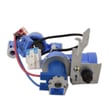
- LG refrigerator water inlet valve 5221JB2010G (controls water fill to the icemaker)
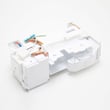
- Refrigerator ice maker assembly AEQ73110210 (cycles and harvests ice)
Why it matters
Ice production depends on two basics: freezer temperature and water supply. Verifying those first helps you avoid unnecessary part replacement and gets cubed and crushed ice working reliably.
Last updated: January 2026
What part number is the LG LFXS26973S water filter?
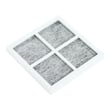
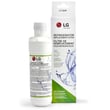
For the LG LFXS26973S bottom-mount refrigerator, the compatible refrigerator water filter is ADQ74793501. LG also identifies this filter family as LT1000P (replacement cartridge ADQ747935). For the exact replacement steps, use the LFXS26973S owner's manual.
How we confirm the correct filter for this model
The model’s manual and parts listing point to the LT1000P family and the ADQ747935 cartridge series.
- Your model number should read LFXS26973S on the rating label
- The manual calls out replacement cartridge ADQ747935 (LT1000P family)
- The model-specific replacement filter part listed is ADQ74793501
- Replace the filter about every 6 months (or sooner if flow drops)
After you install the new filter
The manual’s flush and reset steps help prevent sputtering and cloudy water.
- Dispense 2.5 gallons of water (about 5 minutes total)
- Flush in cycles: 30 seconds ON, 60 seconds OFF
- Press and hold the Water Filter button for 3 seconds to reset the indicator
Related part if the filter won’t seat or leaks
If the filter won’t lock in place or you see leaking at the housing, inspect the filter head and tubing. The compatible assembly listed for this model is the refrigerator water filter head ADQ36011715.
Quick reference
| Item | What to use on LG LFXS26973S | Typical interval |
|---|---|---|
| Water filter part number | ADQ74793501 | Every 6 months |
| Filter family name | LT1000P | Every 6 months |
| Manual-listed cartridge series | ADQ747935 | Every 6 months |
| Flush amount after replacement | 2.5 gallons | After each change |
Why it matters
Using the correct LG water filter helps maintain water flow, improves taste and odor reduction, and prevents leaks caused by poor fit. Replacing it on schedule also helps keep ice quality consistent.
Last updated: January 2026
Why is my LG refrigerator leaking from the bottom?
If your LG LFXS26973S refrigerator is leaking from the bottom, the most common causes are a clogged defrost drain that overflows into the base, a water supply leak related to the ice maker, or a problem in the sealed system that prevents normal cooling and creates excess meltwater. Use the LFXS26973S owner's manual to locate compartments and follow safe access steps.
Quick checks you can do first
- Unplug the refrigerator before inspecting behind panels or near wiring.
- Confirm the leak is water (not oily residue) and note whether it happens after defrosting or after using the dispenser.
- Check if the freezer drawer is closing fully; warm air can increase frost and defrost water.
- Look for ice buildup on the freezer floor or a sheet of ice under the bottom drawer.
- Inspect the water line connection at the back for drips.
Most likely causes (and what to look for)
1) Clogged defrost drain
During defrost, water should flow through the drain to the drain pan. If the drain is blocked by ice or debris, water can spill and run out the bottom.
2) Ice maker or water supply leak
A small leak at the ice maker fill tube, water inlet valve, or tubing can run down and appear as a bottom leak. If the leak happens more when ice is being made, focus here.
3) Cooling problem creating abnormal frost and meltwater
If the refrigerator is not cooling correctly, you can get heavy frost that later melts and overwhelms drainage. This is less common than a drain clog but important if you also notice warm temps.
Parts that may be involved
| Symptom clue | Likely area | Example compatible part |
|---|---|---|
| Water after defrost, ice under drawers | Defrost drain path | (Drain components vary by configuration) |
| Leak when ice maker runs | Ice maker assembly | Refrigerator ice maker assembly AEQ73110210 |
| Drips at rear water connection or during fill | Water inlet valve | LG refrigerator water inlet valve 5221JB2010G |
Why it matters
Bottom leaks can damage flooring and can also point to airflow, door sealing, or ice maker water supply issues that affect cooling performance and ice production.
Last updated: January 2026