Owner’s manual
 Error Codes





What is the advantage of a bottom mount fridge?
A bottom-mount refrigerator like the KitchenAid KRFC300ESS01 keeps the fresh-food compartment at eye level, so you reach everyday items with less bending. The freezer stays in a lower drawer, which can make frozen storage easier to organize and access in one pull-out space (depending on how you load it). For operating and care tips specific to your unit, use the KRFC300ESS01 user manual.
Key advantages in day-to-day use
- Less bending for fresh food: produce, drinks, and leftovers are higher up.
- Better visibility: you can scan shelves quickly without crouching.
- Freezer drawer organization: baskets and dividers help separate meats, veggies, and ice.
- Convenient for meal prep: most-used ingredients are closer to counter height.
- Good for families: kids can often reach fridge shelves more easily than a top freezer.
Bottom-mount vs top-freezer: quick comparison
| Feature | Bottom-mount refrigerator | Top-freezer refrigerator |
|---|---|---|
| Fresh-food access | Higher, easier reach | Lower, more bending |
| Freezer access | Lower drawer | Upper door |
| Frozen-food organization | Often better with baskets | Often simpler, fewer sections |
| Typical daily convenience | Higher (fresh food) | Higher (frozen food) |
Tips to get the most from a bottom-mount layout
- Keep everyday items (milk, condiments, lunch foods) on the middle shelves.
- Use clear bins to group snacks, deli items, and breakfast foods.
- In the freezer, group by category and label baskets.
- Avoid overpacking the freezer drawer; airflow and easy closing matter.
Why it matters
Most households open the refrigerator section far more than the freezer. With a bottom-mount design, the foods you use most often are positioned where you naturally look and reach, which can make the kitchen feel more efficient.
Last updated: January 2026
What is the most common problem with a KitchenAid refrigerator?
For the KitchenAid KRFC300ESS01 bottom-mount refrigerator, the most common service issues we see are cooling complaints (warm fresh-food section, temperature swings) and water or ice maker problems (slow ice production, leaks). These symptoms are often tied to airflow restrictions, defrost drain issues, or water-supply components; see the KRFC300ESS01 user manual for operating checks and control settings.
Most common symptoms and what they usually point to
- Freezer cold but refrigerator warm: restricted airflow, damper issue, or evaporator frost buildup
- Water pooling inside or on the floor: clogged/iced defrost drain or a leaking water line connection
- Ice maker not making enough ice: water supply restriction, filter restriction, or inlet valve issue
- Loud humming or rattling: condenser fan area, compressor start components, or items vibrating against panels
- Food freezing in the refrigerator section: temperature sensing or control problem
Quick checks we recommend first (no parts swapping)
- Confirm temperature settings and allow 24 hours after changes.
- Make sure vents inside the fresh-food section are not blocked by containers.
- Check door closing and sealing; a poor seal can cause frost and cooling swings.
- If you have a water dispenser/ice maker, verify the household shutoff valve is fully open.
- Replace the water filter on schedule; a restricted filter can reduce water flow.
Parts that commonly relate to these problems on KRFC300ESS01
| Symptom | Commonly involved component | Example compatible part for this model |
|---|---|---|
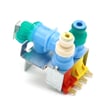
| Ice maker slow/no ice | Water supply and fill control | Refrigerator water inlet valve assembly WPW10420083 |
| Leaks or icing from drain area | Defrost drain path | Extension-dr W10619951 |
| Temperature swings/freezing | Temperature sensing | Refrigerator thermistor W10316760 |
| Frost buildup affecting airflow | Defrost system | Refrigerator defrost heater WP12729123 |
Why it matters
Catching the root cause early helps prevent food spoilage, reduces compressor run time, and can stop small issues (like a partially blocked drain or restricted filter) from turning into repeated icing, leaks, or inconsistent temperatures.
Last updated: January 2026
What is the life expectancy of a bottom freezer refrigerator?
A bottom-freezer refrigerator like the KitchenAid KRFC300ESS01 typically lasts 15 to 20 years with normal household use and routine maintenance. Lifespan is driven mostly by compressor workload, airflow health, and how well the doors seal to keep warm air out.
Typical lifespan range
Bottom-mount (bottom-freezer) refrigerators commonly reach the 15 to 20 year range because they use multiple fans, sensors, and controls to manage airflow and defrost.
- 15 to 20 years: typical for bottom-freezer refrigerators
- 10 to 15 years: more typical for simpler top-freezer designs
- Early repairs often involve airflow, defrost, or door sealing rather than the cabinet
What most affects lifespan on KRFC300ESS01
Model-specific access points and cleaning steps can vary, so we recommend following the KRFC300ESS01 manual. In general, these factors have the biggest impact:
- Dirty condenser area (forces longer compressor run time)
- Door gasket leaks (warm air intrusion, frost, longer run times)
- Blocked vents from overpacking (poor airflow, uneven temperatures)
- Frequent door openings and warm food loads
- Unit not level so doors do not self-close consistently
Quick maintenance schedule
| Task | How often | Why it helps |
|---|---|---|
| Clean condenser area | Every 6 to 12 months | Reduces compressor strain |
| Inspect and clean door gaskets | Every 3 to 6 months | Prevents air leaks and frost |
| Verify temperatures | Monthly | Avoids overworking the sealed system |
| Keep vents clear | Ongoing | Maintains proper airflow |
Parts that can affect longevity (when symptoms show up)
If you are seeing warm temperatures, long run times, or air leaks on KRFC300ESS01, these compatible parts are commonly involved:
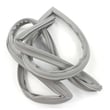
- Refrigerator door gasket W10830162 (helps prevent warm air leaks)
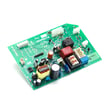
- Refrigerator electronic control board WPW10317076 (manages cooling and defrost cycles)
- Refrigerator run capacitor WPW10350564 (helps the compressor start and run properly)
Why it matters
When a refrigerator runs longer and harder than designed, expensive components like the compressor and control system wear faster. Basic upkeep helps stabilize temperatures, reduce energy use, and delay major repairs.
Last updated: January 2026