Installation guide
 Owner’s manual


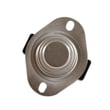
How to tell if a dryer thermal fuse is blown?
On Kenmore gas dryer model 11074942300, a blown thermal fuse typically shows up as a dryer that will not start or runs but has no heat. The reliable way to confirm it is a continuity test with a multimeter; a good fuse reads closed (near 0 ohms).
Quick symptoms to look for
A thermal fuse is a one-time safety device that opens if the dryer overheats. Common signs include:
- Dryer will not run at all (no motor operation)
- Drum turns but there is no heat (some designs)
- Dryer stops mid-cycle and will not restart until the issue is corrected
- You recently had poor airflow (long dry times, very hot cabinet, burning smell)
How we test a thermal fuse (continuity test)
- Unplug the dryer (or disconnect power at the breaker).
- Access the thermal fuse (location varies by design; check the owner's manual).
- Pull the wires off the fuse terminals.
- Set a multimeter to continuity or ohms.
- Touch a probe to each terminal.
- Good fuse: continuity tone or a reading near 0 Ω
- Blown fuse: no continuity (open circuit)
What usually causes the fuse to blow (fix this first)
Replacing the fuse without correcting overheating often leads to another failure. Check:
- Lint screen and lint screen housing for buildup
- Exhaust vent for crushing, kinks, or heavy lint
- Outside vent hood for blockage
- Blower area for lint accumulation (airflow restriction)
What to do next (common repair paths)
| What you find | What it points to | Typical next step |
|---|---|---|
| Fuse is open (no continuity) | Overheat event | Clear venting, then replace fuse |
| Fuse tests good | Not the fuse | Troubleshoot door switch, start switch, timer, motor |
| No heat on gas | Burner not lighting | Check gas shutoff valve is open; then ignition components |
If the dryer will not start, also follow the basic checks in the installation steps (power, door closed, cycle selected) in the installation guide.
Why it matters
A blown thermal fuse is a safety shutdown that protects your Kenmore dryer from dangerous overheating. Restoring proper airflow (lint and venting) is the key to preventing repeat failures.
Last updated: February 2026
What size is a Kenmore Model 11074942300 dryer?
For Kenmore gas dryer model 11074942300, the installation guide indicates it’s built in a standard full-size footprint and calls out clearance planning rather than a single “one-size” measurement. Most Kenmore 110-series dryers of this style are about 27 to 29 inches wide, 27 to 30 inches deep, and 36 to 43 inches high; use the 11074942300 installation guide for the exact dimension diagram and required spacing.
How to measure your dryer the right way
Use a tape measure and capture the cabinet size, then add what your setup needs (door swing, vent, and gas line).
- Width: left side panel to right side panel (do not include the open door)
- Height: floor to the top of the cabinet (include leveling legs if extended)
- Depth (cabinet): back panel to the front edge of the cabinet
- Depth (installed): add space for the exhaust vent and gas connector behind the dryer
- Door clearance: confirm the door can open fully in the planned location
Space and clearance guidelines (what the guide emphasizes)
The installation instructions focus on minimum spacing and ventilation needs for safe operation and service access.
| Installation situation | What to plan for | Typical guidance |
|---|---|---|
| Standard laundry area | Room for door swing and service access | Extra space makes installation and repairs easier |
| Closet or confined space | Minimum clearances plus door ventilation openings | Louvered doors or equivalent vent openings are commonly required |
| Tight fit next to walls | Noise transfer and vibration | About 1 inch on sides is commonly recommended |
Why it matters
Correct sizing prevents crushed venting, kinked gas lines, and blocked airflow; those issues can cause long dry times, overheating, and hard-to-service installs. The dimension and clearance diagram in the 11074942300 installation guide is the best reference when you’re fitting the dryer into a closet, alcove, or laundry room cutout.
Last updated: February 2026
How do I tell what model my Kenmore dryer is?
Your Kenmore dryer’s model number is printed on the model and serial number label located at the top inside the dryer door well. For this dryer, the model number format typically starts with 110 (a common Kenmore prefix used on Whirlpool-built models), followed by additional digits.
Where to look (fast checklist)
- Open the dryer door.
- Look along the top inside edge of the door opening (the dryer door well).
- Find the model and serial number label.
- Write down the full model number (for example, 11074942300) and the serial number.
- Keep the information with your purchase records; it helps match the correct parts and diagrams.
What the model number and serial number are used for
The model number identifies the exact design of your dryer so we can match the right parts (like a door switch, idler pulley, or gas ignition parts). The serial number is mainly used for service records and can help determine the unit’s production details.
| You’ll see on the label | What it tells you | Why it matters |
|---|---|---|
| Model number | Exact dryer design and configuration | Ensures correct replacement parts for Kenmore 11074942300 |
| Serial number | Unique ID for your specific unit | Helpful for service history and documentation |
Why it matters for parts and troubleshooting
Kenmore dryers can look similar across many model numbers, but internal components can differ. Using the full model number helps avoid ordering the wrong part and speeds up troubleshooting.
If you are diagnosing a symptom (won’t start, no heat, noisy drum), the model number lets you match common fixes to the correct components, such as the dryer door switch WP3406107 or the dryer push-to-start switch WP3977456.
Tip: confirm the model number in the documentation
We recommend matching the label information to the owner's manual for your Kenmore 11074942300 so you have the correct reference for operation, safety, and maintenance.
Last updated: February 2026