Installation guide
 Owner’s manual


What is the average lifespan of a whirlpool dryer?
A Whirlpool electric dryer like model WED72HEDW0 typically lasts about 10 years with normal household use. With consistent venting and lint maintenance, many Whirlpool dryers reach 12 to 15 years before major repairs (motor, drum support, or heat system) become more likely.
What affects lifespan the most
A dryer’s life is usually determined by heat stress, airflow restriction, and mechanical wear. For WED72HEDW0, we recommend following the maintenance intervals and airflow guidance in the WED72HEDW0 use & care manual.
- Venting and airflow: long runs, crushed ducting, or lint buildup increase heat and strain
- Lint screen habits: not cleaning every load raises drying time and operating temperature
- Load size: overloading accelerates belt, roller, and idler wear
- Cycle selection: frequent high-heat timed cycles can shorten component life
- Installation quality: an unlevel dryer can increase vibration and roller wear
Typical lifespan ranges (what to expect)
These ranges are practical expectations for Whirlpool electric dryers in general, including WED72HEDW0.
| Usage pattern | Typical lifespan | What usually fails first |
|---|---|---|
| Light (1 to 3 loads/week) | 12 to 15 years | Belt/rollers, door switch |
| Average (4 to 7 loads/week) | About 10 years | Heating circuit, rollers/idler |
| Heavy (8+ loads/week) | 7 to 9 years | Rollers/idler, motor, heat issues |
Maintenance that helps you reach the high end
These steps reduce overheating and mechanical strain, which are the two biggest lifespan killers.
- Clean the lint screen before every load
- Clean the full vent run and exterior hood at least every 2 years
- Use rigid 4-inch metal venting where possible (avoid plastic or foil)
- Do not pack the drum; keep loads tumbling freely
- If drying times increase, address airflow first before replacing parts
Why it matters
A dryer that runs with restricted airflow can take longer to dry, run hotter, and cycle the heater more often. That extra heat and run time can shorten the life of key components and increase the chance of no-heat or shutdown problems.
Last updated: January 2026
Is a 7.4 cu ft dryer big?
Yes. For the Whirlpool WED72HEDW0 electric dryer, 7.4 cu. ft. is considered a large-capacity size (a common rule of thumb is that anything over about 7.0 cu. ft. is “large”). For best results, follow the load-size guidance in the WED72HEDW0 use & care manual.
What “7.4 cu. ft.” means in real use
Capacity is the drum volume, not a guarantee you can pack the drum full. Even with a large-capacity dryer, items need room to tumble for airflow and even drying.
- Large loads dry best when the drum is about 3/4 full
- Overpacking can cause long dry times, wrinkles, and damp spots
- Bulky items (comforters, pillows) often need repositioning mid-cycle
- Good venting matters as much as capacity for performance
Quick capacity comparison
| Dryer capacity | Common label | Best for |
|---|---|---|
| Under ~7.0 cu. ft. | Standard | Smaller households, lighter loads |
| ~7.0 to ~8.0 cu. ft. | Large | Families, mixed loads, towels, bedding |
| Over ~8.0 cu. ft. | Extra-large | Very large households, frequent bulky loads |
Tips to get the most from a large-capacity Whirlpool dryer
These habits help a 7.4 cu. ft. dryer perform like it should:
- Clean the lint screen before every load; replace it if it is torn or warped (see dryer lint screen W11758174)
- Use Automatic cycles for most loads; they stop when the load reaches the selected dryness
- Avoid tightly packing; items should tumble freely
- Check airflow at the outside vent hood if dry times increase
- Use the Bulky cycle for comforters and pillows; rearrange items when prompted
Why it matters
A large-capacity drum like 7.4 cu. ft. can handle bigger loads, but airflow and tumbling space are what prevent long dry times and overheating. Proper venting and a clean lint screen protect performance and help reduce wear on parts like the heating system.
Last updated: January 2026
How to find part number for Whirlpool dryer?
For your Whirlpool electric dryer model WED72HEDW0, the most reliable way to find the correct part number is to first copy the full model number from the manufacturer nameplate in the inner door well, then use that exact model to match the part by diagram location and part description.
Step 1: Confirm the model number on the dryer
The use and care guide for this series notes the manufacturer nameplate is found in the inner door well. Use that tag to confirm you are working with WED72HEDW0.
- Open the dryer door
- Look around the door opening (inner door well)
- Write down the full model number and serial number exactly
- If the label is worn, take a photo and zoom in
For model-specific references, use the WED72HEDW0 use & care manual.
Step 2: Match the part by system and location
Once you have WED72HEDW0, match the part using the parts diagrams and the part list for that model.
- Identify what is failing (no heat, noise, won’t start, long dry times)
- Choose the system (heater, drum, blower, door, controls)
- Match the part name and its position in the diagram
- Verify the part ID before ordering
Example part lookups for WED72HEDW0
These are examples of parts listed for this model that customers commonly need.
| What you’re fixing | Part to look up | Example part listed for WED72HEDW0 |
|---|---|---|
| Dryer runs but has no heat | Heating circuit | Dryer heating element WP8544772 |
| Squealing or thumping noise | Drum support | Dryer drum support roller WPW10314173 |
| Drum not turning properly | Belt drive system | Dryer idler pulley W10837240 |
Why it matters
Whirlpool dryers can look similar across model numbers, but internal components (like heating and drum support parts) can differ. Using the exact WED72HEDW0 model number helps ensure the replacement part fits and functions correctly.
Last updated: January 2026
How to clear whirlpool dryer error code?
On the Whirlpool WED72HEDW0 electric dryer, you can usually clear a displayed message by canceling the cycle or power-resetting the control. If the code returns, the dryer is detecting an active problem, so clearing it repeatedly will not fix the root cause. See the WED72HEDW0 use & care manual for the exact display messages and what they mean.
Safe reset steps for WED72HEDW0
Try these in order:
- Touch POWER to stop/cancel the cycle and turn the dryer off.
- Wait 1 minute, then touch POWER to turn the dryer back on.
- If the display shows “Loc” or “Lc”, touch and hold CONTROL LOCK for 3 seconds to unlock.
- If the display shows “PF” (power failure), touch and hold START/PAUSE to restart.
- If the Check Vent indicator is lit, start a new cycle after cleaning the lint screen and checking the vent.
What common display messages mean
These are the messages called out for this Whirlpool electronic dryer.
| Display message/light | What it indicates | What to do next |
|---|---|---|
| PF | Cycle interrupted by a power failure | Restart with START/PAUSE; unlock Control Lock if needed |
| Loc / Lc | Control Lock enabled | Hold CONTROL LOCK 3 seconds |
| Check Vent light | Restricted airflow (lint screen or vent issue) | Clean lint screen; inspect vent run and outside hood |
| F# E# | Control detected a failure that needs service | Power reset; if it returns, troubleshoot the underlying issue |
| L2 | Low or no line voltage diagnostic (shown during initial installation) | Clear the display; verify 240V supply, cord, and breakers |
When “clearing” is not the fix
If the message comes back during the next cycle, focus on the cause:
- Airflow restriction: Clean the lint screen; confirm the vent is not crushed, kinked, or clogged.
- Power supply: Electric dryers need full 240V; one tripped breaker can let the motor run but prevent heat.
- Overheating or no-heat symptoms: Safety devices can open if airflow is poor.
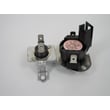
If you are troubleshooting overheating or a dryer that will not run or heat, a protective fuse kit may be involved; the Whirlpool dryer thermal cut-off fuse kit (352-degree f) 280148 is one option listed for this model.
Why it matters
Error messages and indicator lights are designed to prevent poor drying performance, repeat shutdowns, and overheating. Resetting gets you started again, but correcting airflow and power issues first is what keeps the code from returning.
Last updated: January 2026