Installation guide
 Owner’s manual


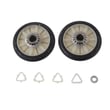
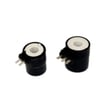
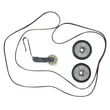
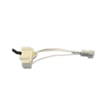
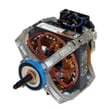
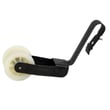
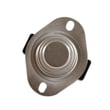
How do I tell what model my Kenmore dryer is?
Your Kenmore dryer’s model number is printed on the model and serial label in the dryer door well. On Kenmore model 11077642600, that label is located at the top inside the door opening, and it lists both the full model number and serial number.
Where to look on the dryer
Check these common label locations (start with the door opening):
- Top inside the dryer door well (most common on Kenmore 110-series dryers)
- Inside the door opening on the cabinet frame
- Rear panel (less common, but possible)
- Near the lint screen housing (some designs place the label nearby)
What to write down (and why)
Record the full model number and serial number exactly as shown; this is what we use to match the correct parts diagrams, installation requirements, and troubleshooting info.
- Model number (example: 11077642600)
- Serial number (helps identify production run details)
- Purchase date (useful for service history and maintenance tracking)
For the official “Product Record” section and label location notes, use the 11077642600 owner’s manual.
Quick ID guide: what the numbers mean
Many Kenmore dryers start with a 3-digit prefix that helps identify the manufacturer family.
| What you see on the label | What it tells you | What to do next |
|---|---|---|
| 110.xxxxxxxx | Kenmore 110-series platform | Use the full number to match parts |
| 796.xxxxxxxx | Different Kenmore platform | Use the full number to match parts |
| Letters after numbers | Feature/series variation | Include them when ordering |
Why it matters
Using the exact model number prevents ordering the wrong dryer drum belt, door switch, thermostat, or control board. Even small model variations can change fit, wiring connectors, and mounting points.
Last updated: February 2026
How do I know if my Kenmore dryer thermal fuse is blown?
On Kenmore dryer model 11077642600, a blown thermal fuse usually shows up as a dryer that won’t start or runs but won’t heat. The sure way to confirm is a continuity test with a multimeter after disconnecting power; an open (no continuity) fuse is blown.
Quick symptoms to look for
- Dryer will not run even with the door closed and a cycle selected
- Drum tumbles but there is no heat (common when one power leg is lost on electric dryers)
- Dryer stops mid-cycle and will not restart until it cools (often tied to overheating issues)
- You recently noticed poor airflow, long dry times, or a very hot cabinet
Confirm it with a continuity test (best check)
- Unplug the dryer (or shut off the breaker). For gas models, also close the gas shutoff valve.
- Access the thermal fuse area (location and panel removal steps vary by configuration); follow the 11077642600 owner’s manual.
- Remove at least one wire from the fuse terminal.
- Test across the fuse with a multimeter set to continuity or ohms.
How to read the meter
| Meter result | What it means | What to do next |
|---|---|---|
| Beep or near 0 ohms | Fuse is good | Keep troubleshooting heat or start circuit |
| No beep or OL/infinite | Fuse is blown | Replace the fuse and fix the overheating cause |
Why the fuse blows (and what to fix so it doesn’t happen again)
A thermal fuse is a safety device that opens when the dryer overheats. Replacing the fuse without correcting airflow problems often leads to repeat failures.
- Clean the lint screen and housing
- Check the vent hose for kinks or crushing
- Clear the wall vent and exterior hood flap
- Verify strong airflow at the outside vent while running
- If heat is still inconsistent on a gas dryer, follow the heat check steps in the 11077642600 installation guide
Related parts that can affect heat and overheating
If you’re diagnosing a no-heat or overheating complaint, these model-compatible parts are commonly involved:
Last updated: February 2026
How to hard reset a Kenmore dryer?
To hard reset your Kenmore dryer model 11077642600, we unplug the dryer (or switch off the breaker) for about 1 minute, then restore power and start a Timed Dry cycle. This clears many control glitches and gets the dryer ready to run again; see the 11077642600 owner’s manual.
Hard reset steps (safe and effective)
- Turn the Cycle Selector to Off.
- Unplug the dryer (or turn off the circuit breaker).
- Wait 60 seconds.
- Plug back in (or turn the breaker on).
- Close the door, select Timed Dry (heated), then press Push to Start.
- If it still will not start, follow the start-up checks in the 11077642600 installation guide.
If the dryer still will not start after a reset
These checks solve most “dead” or “won’t start” complaints:
- Confirm the outlet has power; avoid extension cords and adapters.
- Make sure the door fully closes; a failed door switch can prevent starting.
- Turn the cycle knob off and reselect a cycle; then press Push to Start.
- Clean the lint screen and make sure airflow is not blocked.
- If the drum will not turn, inspect the belt and idler system.
Common parts related to “won’t start” or “won’t run”
| Symptom | Most common area | Example part for this model |
|---|---|---|
| Dryer does nothing | Door circuit | Dryer door switch WP3406107 |
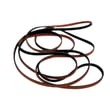
| Motor hums, drum won’t turn | Belt/idler | Dryer drum belt 341241, dryer idler pulley WP691366 |
| Runs but shuts down from heat | Overheat protection | Dryer high-limit thermostat W11050897 |
Why it matters
A hard reset fixes temporary control or cycle-selection issues, but it will not correct a mechanical failure (belt, idler pulley, motor) or a safety shutdown caused by overheating. Doing the quick checks above helps us pinpoint whether you need a cleaning, a settings correction, or a replacement part.
Last updated: February 2026
How much does it cost to replace a heating element in a Kenmore dryer?
For a Kenmore dryer like model 11077642600, replacing the heating element typically runs $20 to $100+ for the part (more if it’s sold as a full heater housing/assembly) and about $100 to $350 total when you include professional labor.
What you’ll usually pay (part vs. service)
Heating-element pricing varies by whether you’re buying just the element coil or a complete heater assembly, plus whether you DIY or hire service.
- DIY part-only: commonly $20 to $100+
- Service call + labor: often $80 to $250 (varies by area)
- Typical total installed: $100 to $350
- Extra parts sometimes needed: thermal cut-off/high-limit thermostat, wiring terminals, venting supplies
- Cost driver: restricted airflow (clogged vent) can overheat and shorten heater life
| Scenario | What you pay for | Typical total |
|---|---|---|
| DIY replacement | Heating element only | $20 to $100+ |
| Pro replacement | Part + labor | $100 to $350 |
| Heater issue caused by overheating | Part + possible thermostat(s) + vent cleaning | $130 to $450 |
How to confirm you’re buying the right heater
We match parts by model, so start with the model-specific diagrams and instructions.
- Use the model 11077642600 parts list to identify the exact heater style used in your dryer
- Check the heater’s mounting style and wire terminal layout before ordering
- Follow the disassembly and access steps in the 11077642600 owner’s manual
- If your dryer is gas, the “no heat” cause is often not a heating element; it’s commonly ignition or gas valve components
Why it matters
A dryer that heats poorly or not at all is often suffering from airflow restriction. Fixing the venting and lint buildup at the same time helps the new heater (and thermostats) last longer and keeps drying times normal.
Related parts that commonly fail with heat problems
If you’re diagnosing a heat complaint, these model-matched parts are commonly involved:
- Dryer operating thermostat WP3387134 (regulates operating temperature)
- Dryer high-limit thermostat W11050897 (safety limit; can open if overheating occurs)
Last updated: February 2026