Installation guide
 Owner’s manual
 Error Codes


What size is a Kenmore Model 11062102310 dryer?
The Kenmore electric dryer model 11062102310 is a 29-inch class dryer; the installation instructions show an overall height of about 43 3/8 inches and a cabinet width around 29 inches. Depth varies by door style and venting clearance; confirm your exact setup in the installation guide.
Dimensions and clearances to plan for
Use these installation-guide dimensions as your baseline for fitting the dryer into a laundry space:
- Width: about 29 in. (29-inch models)
- Height: about 43 3/8 in.
- Depth (cabinet): about 27 3/4 in.
- Depth (door open/overall projection): plan for 22 3/4 in. to 27 3/4 in. depending on door style
- Rear clearance for venting: most installs need at least 5 1/2 in. behind the dryer for the exhaust vent and elbow
Quick reference table
| Measurement | What it affects | What to allow for |
|---|---|---|
| Width | Side-to-side fit | ~29 in. plus side clearance |
| Height | Under-shelf fit | ~43 3/8 in. plus leveling leg adjustment |
| Depth | Front-to-back fit | ~27 3/4 in. plus vent clearance |
| Rear clearance | Vent hookup | 5 1/2 in. minimum in many installs |
Why it matters
Correct sizing prevents installation problems like a door that cannot open fully, a crushed vent that causes long dry times, or a dryer that cannot be leveled properly. Planning for vent clearance is especially important on electric dryers because restricted airflow can also lead to overheating and nuisance thermal cutoffs.
Last updated: February 2026
How many volts is a dryer motor?
On the Kenmore 11062102310 electric dryer, the dryer’s power supply is 240 volts, but the drive motor itself typically runs on 120 volts through the dryer’s internal wiring. For the correct electrical requirements and connection type (3-wire vs. 4-wire), use the installation guide.
What voltage matters for troubleshooting
When people ask about “dryer motor voltage,” there are two different voltages involved:
- Supply voltage (to the dryer): 240V for a full-size electric dryer
- Control/motor circuit voltage (inside the dryer): typically 120V
- Outlet and cord rating: commonly 120/240V minimum for the cord set
- Circuit size: typically a dedicated 30-amp circuit
If the dryer tumbles but has no heat, you can still have a 240V supply problem (one leg of power missing) even though the motor runs.
Quick checks we recommend (safe, no disassembly)
- Confirm the dryer is on a dedicated 30-amp circuit.
- Reset both breakers (electric dryers often use a 2-pole breaker).
- If the drum turns but there’s no heat, check for a partial power loss (one breaker leg tripped).
- Make sure the cord and receptacle match your setup (3-wire vs. 4-wire).
- If you smell burning or see arcing at the outlet, stop using the dryer and have the circuit inspected.
Common symptoms and what they usually indicate
| Symptom | What it often means | What to check first |
|---|---|---|
| Dryer won’t run at all | No power to controls or open safety circuit | Breaker, door switch, start procedure |
| Drum turns, no heat | Missing one 120V leg of the 240V supply or heating circuit fault | Breaker/fuses, power cord, terminal block |
| Hums, won’t start | Motor or drum/belt issue | Belt, drum movement, motor |
Why it matters
Knowing the difference between 240V supply and 120V motor/control voltage helps you diagnose correctly. A dryer can appear “powered” (lights on, motor runs) while still lacking the full 240V needed for heating.
Last updated: February 2026
How do I reset my Kenmore dryer?
To reset your Kenmore electric dryer model 11062102310, we recommend a simple power reset: unplug the dryer (or switch off the breaker) for 1 minute, then restore power and start a cycle. This clears many control glitches and “won’t start” conditions.
Quick reset steps (safe and effective)
- Turn the dryer OFF.
- Unplug the power cord (or turn both dryer breakers OFF).
- Wait 1 minute.
- Restore power.
- Close the door fully.
- Press and hold the PUSH to START button until you hear the dryer start and the drum begins moving.
For model-specific operating details and control behavior, follow the steps in the owner's manual.
If it still will not start after a reset
The installation and use-and-care guidance for this model points to a few common “no start” causes. Check these in order:
- Controls are set to an “On” or running position.
- Start was pushed firmly and held long enough.
- Dryer is plugged in and the electrical supply is on.
- Door is fully closed (a failed door switch can prevent starting).
- Household fuses or breakers are OK (many electric dryers use two fuses or breakers).
If the door feels like it closes but the dryer still will not run, a failed dryer door switch WP3406107 is a common fix.
Reset vs. no heat: what’s different?
A reset can clear a control issue, but it will not fix a heating or airflow failure.
| Symptom | Most likely category | What to check first |
|---|---|---|
| Won’t start at all | Power, door, controls | Door closed, hold Start, breakers/fuses |
| Runs but no heat | Power (240V), heating circuit | Check both breakers/fuses, then heating parts |
| Runs then stops | Overheat protection | Lint screen, venting, thermal cut-off |
If the dryer runs but you do not feel heat after about 5 minutes on a full-heat cycle, check that both breakers/fuses are good. If airflow is restricted, the dryer can overheat and open a safety device such as the dryer thermal cut-off fuse kit 279816.
Why it matters
Resetting is a fast first step, but repeated resets usually mean an underlying issue (door switch, power supply, overheating from a clogged vent, or a heating circuit problem). Fixing the root cause helps prevent no-starts, no-heat drying, and nuisance shutdowns.
Last updated: February 2026
What does CE mean on my dryer?
On a Kenmore electric dryer model 11062102310, a CE display is treated as an electronic control/communication-related fault. Start by resetting power and checking basic start conditions; if the code returns, focus troubleshooting on the door switch and control circuit using the owner's manual.
Quick checks we recommend first
- Unplug the dryer (or switch off the breaker) for 2 minutes, then restore power.
- Confirm the door is fully closed and the latch is engaging.
- Make sure the controls are set to a running cycle and Start is pressed firmly.
- Verify the dryer has power; many electric dryers use two household fuses/breakers, so check both.
- If the dryer starts but stops and shows CE again, stop using it until you identify the cause.
Parts that commonly relate to electronic or “won’t start” symptoms
If CE appears along with no-start or intermittent operation, these model-compatible parts are common suspects:
- Dryer door switch WP3406107 (door not sensed as closed)
- Dryer timer WP3979618 (cycle control issues on timer-driven models)
Symptom-to-part guide
| What you notice | What it often points to | What to check next |
|---|---|---|
| CE and dryer will not start | Door not detected closed, control not enabling start | Door switch operation, door alignment |
| CE appears mid-cycle | Intermittent control signal or power issue | Power supply, wiring connections, heat-related shutdown |
| CE plus no heat | Heating circuit problem triggering abnormal operation | Heating element, thermal cut-off, airflow restriction |
Why it matters
A CE code usually means the dryer is not reliably reading a sensor or control input. Continuing to run the dryer with an active electronics fault can lead to repeated shutdowns, poor drying, or additional component stress.
If CE shows up with “no heat”
Airflow and overheat protection can contribute to odd behavior. If you also have no heat, check the heating circuit parts commonly used on this model:
- Dryer heating element 279838
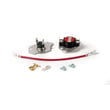
- Dryer thermal cut-off fuse kit 279816
- Dryer high-limit thermostat WP3977767
Last updated: February 2026