 Installation guide
 Owner’s manual
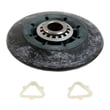


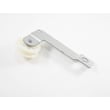
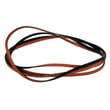
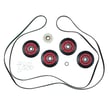
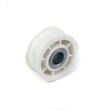
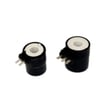
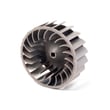
What model Kenmore dryer do I have?
If you have a Kenmore dryer, the fastest way to identify the exact model is to read the model/serial rating plate on the dryer. For Kenmore model 11076002010, the rating plate is typically in the door opening (door well), and that full number is what we use to match the correct parts and instructions.
Check these common locations on Kenmore dryers:
- In the door opening (door well) on the cabinet frame (most common)
- On the back panel of the dryer cabinet
- On the inside of the door
- Near the lint screen housing (varies by design)
If you see 11076002010 on the label, that confirms your exact Kenmore dryer model.
Record both numbers exactly as shown:
- Model number (example: 11076002010)
- Serial number (unique to your unit)
- Gas type info listed on the rating plate (important for gas dryers)
The model number locks in the correct fit for parts like the dryer door switch, idler pulley, and drum support roller, and it also ensures you follow the right safety and installation requirements.
Use this to confirm you have the right information before ordering parts:
| What you found | What it tells us | What to do next |
|---|---|---|
| Model number starts with 110 | Common Kenmore platform identifier | Use the full model number for parts lookup |
| Rating plate in the door well | Normal location for this style | Copy model and serial exactly |
| Gas type listed (Natural/LP) | Fuel compatibility | Follow the installation guide for gas requirements |
- Use the model number to pull diagrams and part lists
- Match symptoms to common wear items (rollers, belt, idler)
- If the dryer will not start, check the door switch circuit first
For reference, a common start-related part on this model is the dryer door switch WP3406107.
Last updated: February 2026
How do I know if my Kenmore dryer thermal fuse is blown?
A blown thermal fuse in your Kenmore dryer model 11076002010 typically shows up as a dryer that will not start (most common) or runs but won’t heat on some designs. The sure way to confirm is a continuity test with a multimeter after unplugging the dryer.
- Dryer won’t start even though the door is closed
- Motor won’t run and the drum won’t tumble
- Timer or controls may light up, but nothing happens when you press Start
- Dryer runs but has no heat (less common, depends on how the fuse is wired)
- Problem started after a long cycle, restricted venting, or a very hot load
- Unplug the dryer (or switch off the breaker).
- Access the thermal fuse (commonly on the blower housing or exhaust duct area).
- Pull the wire connectors off the fuse terminals (grab the connector, not the wire).
- Set your multimeter to continuity or the lowest ohms setting.
- Touch a probe to each terminal.
Results:
| Meter result | What it means | What to do next |
|---|---|---|
| Beep or near 0 Ω | Fuse is good | Keep troubleshooting (door switch, motor circuit, control) |
| No beep or OL/infinite | Fuse is blown | Replace the fuse and correct the overheating cause |
A thermal fuse is a one-time safety device that opens when the dryer overheats. If you replace the fuse without fixing the airflow problem, the new fuse often blows again.
Common overheating causes:
- Crushed, kinked, or excessively long vent run
- Lint buildup in the vent duct or blower housing
- Blocked exterior vent hood
- Restricted airflow from a damaged blower wheel
The installation checklist for this Kenmore dryer emphasizes verifying power, a closed door, and proper vent routing (not crushed or kinked). Use the steps and safety notes in the installation guide before disassembly.
If the dryer won’t start, also confirm:
- Plug is fully seated in a grounded outlet
- House fuse is intact or breaker is not tripped
- Door closes firmly; a failed door switch can mimic a blown fuse (see dryer door switch WP3406107)
Last updated: February 2026
How much does it cost to replace a heating element in a Kenmore dryer?
Replacing a heating element in a Kenmore dryer typically costs $30 to $120 for the part and $150 to $350 total when you include professional labor. For Kenmore model 11076002010, confirm the exact heating system and access steps in the 11076002010 installation guide before ordering parts.
Costs vary by whether you replace only the element coil or a complete heater assembly, plus service call and labor time.
- Heating element part: $30 to $120 (most common range)
- Service call / diagnostic: $75 to $125
- Labor: $75 to $200 (often 1 to 2 hours)
- Total installed cost: $150 to $350
| Scenario | What you pay for | Typical total |
|---|---|---|
| DIY replacement | Part only (plus basic supplies) | $30 to $120 |
| Pro replacement | Part + labor + service call | $150 to $350 |
| “No-heat” but not the element | Diagnosis + different part | $100 to $350 |
- Dryer type: Electric dryers use a heating element; gas dryers heat with an igniter and gas valve system.
- Assembly vs. element-only: Some models use a complete heater housing that costs more.
- Vent restriction: Poor airflow can overheat and shorten heater life, increasing repeat repairs.
- Access time: Some dryers require more disassembly to reach the heater.
If the dryer runs but does not heat, we recommend these basics first:
- Verify the cycle and temperature settings are correct.
- Check the household breaker/fuse (electric dryers can run on 120V but not heat without full 240V).
- Confirm strong airflow at the outside vent and clean lint buildup.
- For gas models, confirm the gas shutoff valve is open and the dryer heats during a short test run.
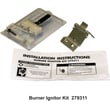
Many “no heat” gas-dryer repairs are not a heating element at all. Common fixes include the dryer valve coil kit 279834 or the igniter 279311, depending on symptoms.
Replacing the wrong heating component wastes time and money. A fast airflow and power/fuel check helps you target the correct part the first time and prevents repeat overheating failures.
Last updated: February 2026
What size is a Kenmore Model 11076002010 dryer?
The Kenmore dryer model 11076002010 is a 27-inch wide dryer. For planning space, most 27-inch Kenmore dryers are roughly about 38 inches tall and about 28 to 30 inches deep, plus extra room for venting and the door swing; confirm the exact measurements in the 11076002010 installation guide.
- Width: 27 inches (cabinet width)
- Depth: typically about 28 to 30 inches (varies by door style and vent hookup)
- Height: typically about 38 inches to the top of the cabinet
- Rear clearance for venting: plan for at least 5 1/2 inches behind the dryer in many installs
- Door clearance: allow enough room for the door to open fully
| What you are measuring | What to expect for Kenmore 11076002010 | What to include in your plan |
|---|---|---|
| Cabinet width | 27 in. | Nothing extra unless in a tight alcove |
| Overall depth | About 28 to 30 in. | Add vent elbow space and wall clearance |
| Overall height | About 38 in. | Add leveling feet adjustment if needed |
| Install clearance | Rear clearance often 5 1/2 in. minimum | Helps prevent crushed venting and poor airflow |
Correct sizing prevents a crushed exhaust vent (long dry times, overheating risk), avoids door-interference issues, and helps the automatic cycles work properly when the dryer is level and has proper airflow.
Use the dimension diagram and spacing notes in the 11076002010 installation guide. If you are measuring for a replacement, also compare your cutout width and the vent location (rear, side, or bottom) before ordering.
Last updated: February 2026








