Owner’s manual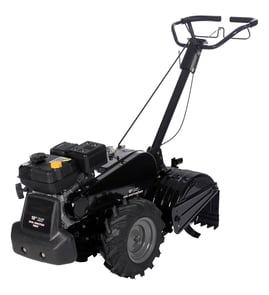





How many horsepower do you need for a 5 foot tiller?
For a 5-foot (60-inch) tiller, we recommend planning on about 25 to 40 horsepower at the tractor PTO, with around 5 HP per foot as a solid baseline. More horsepower helps you maintain tine speed in hard soil, sod, or deeper passes; see the Craftsman 486252445 owner’s manual for operating depth and speed guidance.
Quick rule of thumb (and when to go bigger)
- Baseline: ~5 HP per foot of tiller width (5 ft = ~25 HP)
- Light, previously worked soil: 20 to 25 HP can work
- Average garden soil: 25 to 35 HP is a good target
- Hard clay, virgin ground, or deeper tilling: 35 to 50+ HP performs better
Why horsepower needs change in real use
Horsepower demand goes up when the tiller is working harder. These factors matter most:
- Soil type: clay and rocky soil load the tines more than sandy loam
- Tilling depth: deeper passes require more power
- Ground speed: faster travel speed increases load
- Tine condition: worn or bent tines reduce efficiency and can increase strain
- Moisture level: overly wet soil clumps and drags; overly dry soil can be very hard
What your Craftsman 486252445 tells us (useful comparison)
Your Craftsman 486252445 is a 36-inch tow-behind tiller, so it is smaller than a 5-foot tiller. The manual lists a tilling width of 36 in. and a tilling ground speed of about 2 MPH, which helps explain why wider tillers typically need more tractor power to keep performance consistent.
| Tiller width | Typical tractor power target | Best for |
|---|---|---|
| 36 in. (3 ft) | ~15 to 25 HP | gardens, lighter duty work |
| 60 in. (5 ft) | ~25 to 40 HP | larger plots, faster coverage |
Why it matters
Matching horsepower to tiller width helps prevent stalling, protects driveline components, and gives you cleaner soil breakup in fewer passes. It also makes it easier to maintain steady tine action when conditions get tough.
Last updated: February 2026
Where to find model number on Craftsman Rear Tine Tiller?
On the Craftsman 486252445 36-inch tow-behind tiller, the model number is printed on the product identification label; it’s typically placed on the tiller frame near the tine shield/tine guard area so it stays with the attachment, not the tractor.
Where to look first (fast checks)
- Check the main frame rail on the tiller, near the hitch or transmission area.
- Look on or near the tine shield (tine guard) where debris is deflected.
- Inspect the rear area by the depth stake support bracket.
- Wipe dirt and oil off the frame; labels can be hard to see under soil buildup.
- If the label is missing, use the parts list diagrams in the 486252445 owner's manual to match assemblies (tine assemblies, belt guard, drive housing) to your unit.
How to read the label correctly
Most Craftsman tow-behind tillers list a model number and sometimes a form number or other identifiers. For this unit, the manual identifies it as Model No. 486.252445 (often shown without the dot as 486252445).
Common label fields
| Label field | What it means | Example for this tiller |
|---|---|---|
| Model number | The number you use to find parts and manuals | 486.252445 (or 486252445) |
| Serial number | Unique to your specific unit | Varies |
| Brand | Manufacturer/brand family | Craftsman |
Why it matters
Using the exact model number prevents ordering the wrong tine assemblies, belt guard, transmission parts, or hardware. Even small differences in a tow-behind tiller can change the correct tine shaft, chain, or mounting hardware.
Last updated: February 2026
Can you attach a tiller to a lawn mower?
Yes, you can attach a tiller to a riding lawn tractor or lawn mower that has a rear drawbar and enough traction; the Craftsman 486252445 is a 36-inch tow-behind tiller designed to hitch behind a tractor-style mower, not a walk-behind push mower. Follow the hitching and safety steps in the 486252445 owner’s manual before operating.
What “lawn mower” works with a tow-behind tiller
A tow-behind tiller like the Craftsman 486252445 connects to the tractor’s drawbar using a hitch bracket extension, hitch pin, and hair cotter pin. It works best with a riding mower or garden tractor that can safely pull ground-engaging attachments.
Good candidates
- Riding lawn tractor with a rear drawbar
- Garden tractor with adequate weight and tire grip
- Mower set up for towing attachments (level hitch point)
Not a good fit
- Walk-behind push mowers (no drawbar, not built for towing)
- Zero-turn mowers unless the manufacturer specifically approves towing a ground-engaging tiller
- Lightweight riders that lose traction or get pushed by the tiller
Basic attachment steps (what we follow in the field)
Use these as a quick overview, then match the hardware and orientation to the manual.
- Park on level ground; set parking brake; shut off engine
- Position the tiller on level ground and back the tractor to the hitch
- Pin the hitch bracket extension to the floating hitch (hitch pin plus hair cotter pin)
- Bolt the hitch bracket extension to the tractor drawbar
- Add rear wheel weights or tire chains if traction is limited
Hardware and traction checklist
| What to check | Why it matters | What to do |
|---|---|---|
| Rear drawbar present | Provides the correct hitch point | Install/verify drawbar before towing |
| Hitch pins secured | Prevents disconnect while tilling | Use the correct pin and cotter style |
| Fasteners tight | Reduces vibration loosening | Recheck before each use |
| Traction adequate | Prevents slipping and poor till depth | Add weights or chains as needed |
Why it matters
A tow-behind tiller puts load on the tractor and can throw debris from the augers/tines. Correct hitching, safe distance from rotating parts, and checking for loose fasteners before each use helps prevent damage and injury.
Last updated: February 2026