Owner’s manual
 Error Codes


How to tell if a dryer heating element is bad?
If your Kenmore 11062922100 dryer runs but won’t heat (or takes much longer to dry), the heating element may be open or shorted. The most reliable check is unplugging the dryer and testing the element for continuity with a multimeter; no continuity typically means the element is bad.
Quick symptoms to look for
- Dryer tumbles normally but there’s no heat on heated cycles
- Clothes stay damp and drying times increase
- You smell a burning/metallic odor (sometimes from a broken coil touching metal)
- The dryer heats briefly, then stops heating (can also point to a safety device)
- The dryer seems to run, but you get no heat because one house fuse/breaker leg is out
How we test the heating element (basic steps)
Use the wiring and access guidance in the 11062922100 owner’s manual before opening panels.
- Disconnect power (unplug the cord).
- Access the heater housing and remove at least one wire from the element terminal.
- Set your multimeter to ohms (Ω).
- Measure across the element terminals.
- Also check for a short to ground by measuring from an element terminal to the metal heater housing.
What readings usually mean
| Multimeter result | What it suggests | Next step |
|---|---|---|
| Continuity present (some resistance) | Element is likely not open | Check airflow, thermostats, fuses |
| No continuity (open circuit) | Element is bad | Replace the element |
| Continuity from terminal to metal housing | Element is shorted | Replace the element |
Parts that commonly fail with (or instead of) the element
On the Kenmore 11062922100, a “no heat” complaint is often tied to the heater circuit safety parts as well:
- Dryer thermal fuse WP3390719 (opens if the dryer overheats)
- Cut-off kit 279769 (thermal cut-off protection)
- Operating thermostat (temperature regulation)
Why it matters
A failed heating element stops heat production, but overheating and airflow problems can also shut heat down by blowing a thermal fuse or cut-off. Fixing the root cause (often lint buildup or a crushed vent) helps prevent repeat failures.
Last updated: January 2026
Can I replace a dryer heating element myself?
Yes, on the Kenmore 11062922100 electric dryer, many homeowners can replace the heating element themselves if they can safely shut off 240V power and follow careful disassembly and wiring steps. Use the 11062922100 owner’s manual for safety guidance and access details.
Before you start (safety and prep)
- Disconnect power: unplug the cord or switch off the breaker (verify power is off).
- Let the dryer cool completely.
- Take clear photos of every wire connection before removing anything.
- Label wires and keep screws grouped by panel.
- If you see melted terminals or brittle wiring, repair that before running the dryer.
Parts you may need to inspect or replace
A “no heat” issue is sometimes more than just the heater. While you have the heater area open, we recommend checking these common heat-circuit safety parts:
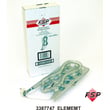
- Dryer heating element WP3387747 (the electric heater coil assembly)
- Dryer thermal fuse WP3390719 (opens if the dryer overheats)
- Dryer high-limit thermostat WP3390291 (helps prevent overheating)
Typical DIY steps (high level)
- Disconnect power.
- Remove the panel(s) needed to reach the heater housing.
- Label and disconnect wires from the heating element and safety devices.
- Remove the heating element assembly; transfer any mounted components if required.
- Reinstall, reconnect wires exactly as documented, and reassemble.
- Test on a timed heat cycle and confirm strong airflow at the exhaust.
Quick decision guide
| Situation | DIY-friendly? | What we recommend |
|---|---|---|
| Comfortable with tools, labeling wires, and reassembly | Yes | Replace the element and inspect safety devices |
| Melted connectors or damaged wiring found | Maybe | Repair wiring first; then replace failed parts |
| Not comfortable working around 240V circuits | No | Use a qualified technician |
Why it matters
Restricted airflow (lint buildup, crushed vent, clogged hood) can overheat the heater circuit and cause repeat failures. Fixing airflow issues helps protect the new heating element and safety fuses.
For step-by-step visuals, use our how to replace a heating element in an electric dryer guide.
Last updated: January 2026
Is it worth replacing a heating element in a dryer?
Yes, it’s usually worth replacing the heating element in your Kenmore 11062922100 electric dryer when the dryer otherwise runs normally, because a heater repair is typically far less expensive than replacing the whole dryer. Just make sure you also correct any airflow restriction that could have caused overheating.
When it’s worth it (and when it isn’t)
Replacing the heater is typically a good value when:
- The drum tumbles normally but there’s no heat or weak heat
- The dryer is in good overall condition (no major noise, no timer issues)
- You can clean and verify the venting system for proper airflow
It’s usually not worth it when:
- The dryer has multiple major failures (motor, timer, drum support problems)
- Heat-related parts keep failing because the venting problem was never fixed
- The cabinet or drum is badly worn or damaged
Parts commonly involved in “no heat” on this model
On the Kenmore 11062922100, a “no heat” symptom can be caused by more than the heating element. These parts are commonly checked during diagnosis:
- Dryer thermal fuse WP3390719
- Cut-off kit 279769
- Dryer operating thermostat WP3387134
- Dryer high-limit thermostat WP3390291
Quick decision guide
| What you observe | Most likely direction | What to check next |
|---|---|---|
| Runs but never heats | Heat circuit issue | Thermal fuse, thermal cut-off, thermostats, heating element |
| Heats once then stops heating | Overheat or airflow restriction | Venting, cut-off kit, high-limit thermostat |
| Long dry times but some heat | Airflow restriction | Lint screen, vent duct, blower wheel |
Why it matters
Restricted venting can overheat the heater housing and repeatedly trip safety devices (thermal fuse or thermal cut-off). Fixing airflow helps the replacement heater last longer and restores normal drying performance.
Where to confirm procedures and safety steps
We recommend following the disassembly, venting, and safety guidance in the 11062922100 owner’s manual.
Last updated: January 2026